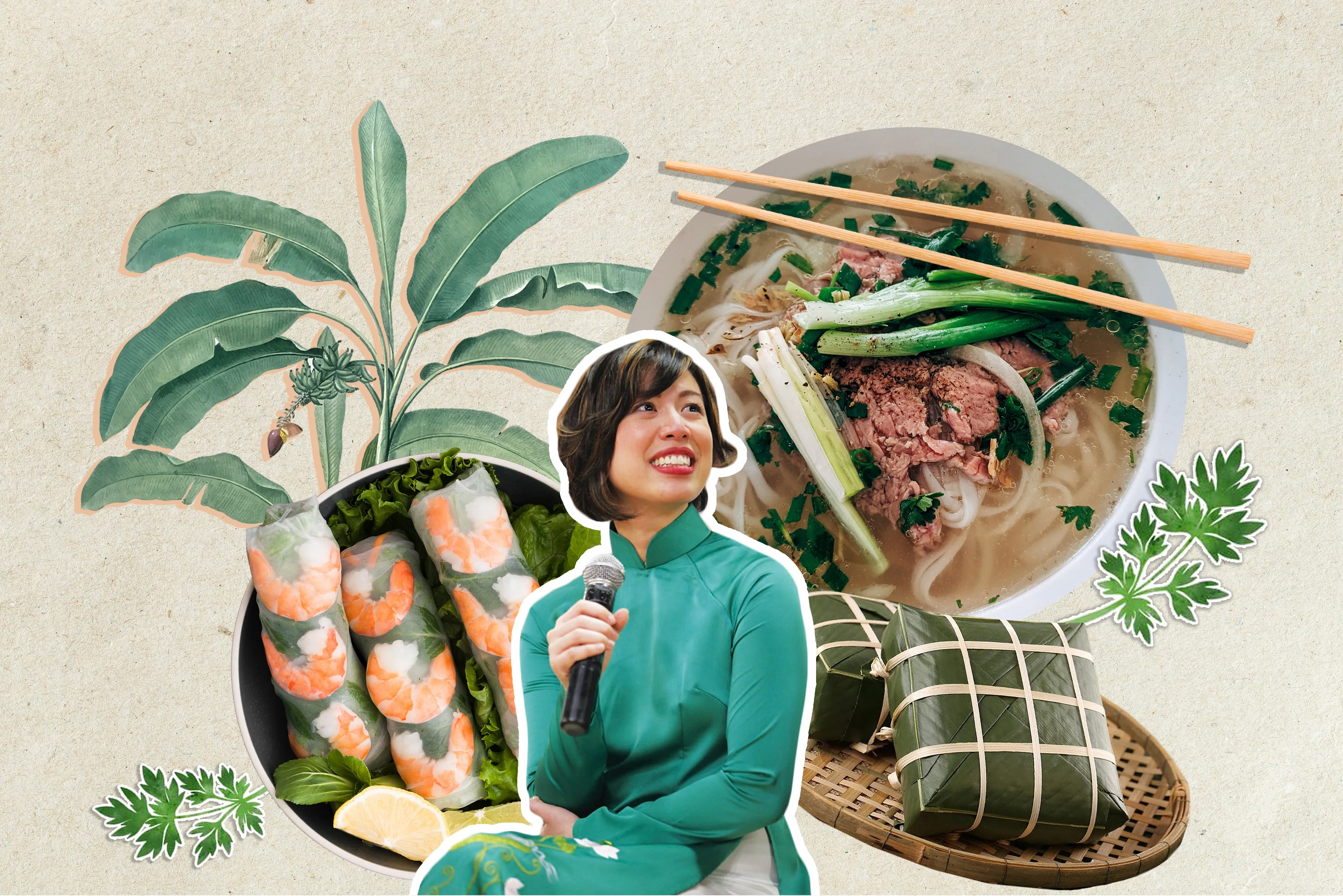
Christine Ha Writes New Food Stories From Her Parents' Culinary Heritage
Culture
2026年6月30日
5
Saigoneer
Relations
🇻🇳Vietnam🇺🇸United States

Christine Ha Writes New Food Stories From Her Parents' Culinary Heritage

AI サマリー

Vietnamese-American chef Christine Ha is weaving new culinary narratives, honoring her roots in Vietnamese cuisine. From MasterChef winner to judge, she showcases the richness of Vietnamese food culture by blending tradition and innovation.

Christine Ha, the Vietnamese-American chef who captured hearts by winning the U.S. MasterChef, is now weaving new culinary narratives, honoring her roots in Vietnamese cuisine. Her journey from contestant to judge showcases the richness of Vietnamese food culture through a blend of tradition and innovation. Ha's family originally hailed from Northern Vietnam, immigrating south after the 1954 Geneva Agreements. This heritage influences her palate, particularly her appreciation for Northern-style pho, characterized by its wider noodles and minimal herbs. Her grandmother was also renowned for crafting large bánh chưng during Tết. Amidst the turmoil of the Vietnam War, Ha's parents made the critical decision to leave the country on April 29, 1975. After stops in the Philippines and Guam, they eventually settled in Houston, Texas, when Ha was just two years old. Eighteen years later, as Ha began to explore her passion for cooking, she was diagnosed with neuromyelitis optica (NMO), a rare autoimmune disorder that led to vision loss. While pursuing a Master's in Creative Writing, her blog, "The Blind Cook," established with her then-boyfriend (now husband) John Suh, caught the attention of MasterChef U.S. In 2012, Ha was invited to audition for MasterChef Season 3. Initially viewing it as a source of inspiration for her writing, she was also encouraged by friends and family to apply to raise awareness for the capabilities of visually impaired individuals. Her audition dish, "thịt kho" (braised pork), a staple of her childhood, reflected her ongoing quest to recreate her late mother's recipes. Khôi Phạm, Deputy Editor of Saigoneer, highlights Ha's commitment to her heritage. His reflection on Saigoneer Podcast notes, "I think she’s one of my favorite contestants because she sticks to her roots. Her audition dish is actually a very, very traditional dish. If you watch western cooking shows, the fish is usually filleted horizontally but for Christine’s dish, she cut it vertically. If you go to fish markets in Vietnam, all the butchers will cut it that way. She doesn’t even try to deconstruct it or add any frills, bells and whistles." A perfect balance of savory and sweet, her caramelized and braised catfish dish impressed the judges, and thus Christine’s life was changed from that point forward. From contestant to the other side Ha later took on a judging role for MasterChef Vietnam (Vua Đầu Bếp) Season 3 in 2015, becoming the first former contestant to serve as a regular judge in the international franchise. She described the transition from contestant to mentor as a "great feeling." MasterChef Vietnam Season 1 Runner-Up, Trí Phan, reflects, "From her story, I realized the most important thing when it comes to cooking is taste. And since then, I started to put more emphasis on flavor combinations that make sense, [instead of] throwing many things on a plate, just to make it look impressive." The Five Fungi Congee served at Christine’s new restaurant Xin Chao. It’s a grown-up take on a dish all Vietnamese children remember eating. Photo by Tam Le. To reference the ubiquitous Thai phrase known to anyone who has traveled to the Land of Smiles, filming MasterChef Vietnam was "same same, but different" from filming MasterChef U.S. "A lot of the challenges emulated the American ones, but there were still many differences. For example, the contestants cooked for the military, just like I did, but the military bases were so different. The ingredients in the pantry included a lot of fish and shellfish I’ve never heard of because they’re regional to Vietnam." Additionally, the unionization of film crew labor in the United States meant that production could only take place six days a week, stretching filming over a period of three months; whereas Vietnam’s ability to work seven days a week meant a rigorous one-month film schedule. Same same, but different. As a Việt Kiều, Christine faces the additional challenge of having only spoken conversational Vietnamese at home. "When I came to MasterChef Vietnam, it was terrible. Not only was there new slang, but there’s a different lexicon to speak formally on TV." If Christine’s upbringing was anything like mine — which, as a Việt Kiều who also grew up in Houston and attended the same university undergrad program as Christine, I think is a fairly safe bet — she may have only heard this formal way of speaking on Paris by Night which has been playing non-stop at all Vietnamese family gatherings since the late 1980s. "As I grew older, I didn't really have family around to keep it up. So I feel like my Vietnamese [was] rusty when I first arrive in Vietnam. It’s an ordeal when I travel with my husband John, who is Korean American, but has sight. Whereas I know Vietnamese, but I can’t see. So he has to spell out all the signs, and I need to remind him to include the accents or I won’t be able to read it. But it’s like riding a bike — it comes back." When I asked Christine about the dishes in Vietnam that surprised her the most, she had the same answer I did when I first moved to Saigon: the new street snacks. "In America, the Vietnamese food we got was what our parents brought over [in the late 1970s], which has stayed stagnant. Now a newer generation has come up with new dishes like bánh tráng trộn and bánh tráng nướng. That’s the kind of stuff that really intrigued me." Through her culinary explorations, Christine Ha continues to share the vibrant flavors and evolving spirit of Vietnamese cuisine with the world.

多角的分析

経済的影響

クリスティン・ハ氏の成功は、ベトナム料理が国際市場で高い評価を得ていることを示唆している。これは、ベトナムの食文化産業、特に高級レストランや輸出可能な加工食品分野への投資機会を増大させる可能性がある。彼女のような著名人がベトナムの食材や料理法を積極的に紹介することは、ベトナム産農産物や食品加工品のブランドイメージ向上に繋がり、輸出拡大に貢献しうる。また、彼女のレストラン事業は、雇用創ちや地域経済への波及効果も期待できる。

投資家心理

クリスティン・ハ氏の活動は、ベトナムの食文化への関心を高めることで、関連分野への投資を促進する可能性がある。特に、ベトナム料理レストラン、食品加工、農業分野における投資家は、彼女の成功を参考に、市場の成長ポテンシャルを評価するだろう。彼女の国際的な知名度は、ベトナムの食関連スタートアップや中小企業への投資リスクを軽減し、魅力的な投資先として位置づける助けとなるかもしれない。

社会的影響

クリスティン・ハ氏の物語は、ベトナム系ディアスポラ(Việt Kiều)が自身のルーツとどのように繋がり、それを現代社会で表現していくかという点において、多くの人々に共感を呼んでいる。彼女が視覚障がいを乗り越え、料理の世界で成功を収めたことは、障害を持つ人々への希望となり、また、文化的多様性やアイデンティティの探求という普遍的なテーマを提示している。彼女がベトナムの伝統料理を現代的に再解釈し、新しい世代にアピールする手法は、世代間の文化継承のあり方としても示唆に富む。

市民の声

クリスティン・ハ氏のベトナム料理への情熱は、多くのベトナム市民にとって、自国の食文化への誇りを再認識させるきっかけとなるだろう。特に、彼女がベトナムで出会った新しいストリートフードに魅力を感じている点は、国内の食文化の活気と創造性を示しており、市民の食への関心を高める。また、彼女が母語の習得に挑戦する姿勢は、海外で暮らすベトナム人コミュニティにとって、自身のルーツとの繋がりを大切にすることの重要性を示唆している。

背景・歴史的文脈

クリスティン・ハ氏のルーツは、1954年のジュネーブ協定以降のベトナム戦争による南北分断と、それに伴う大規模な難民移動にある。北部から南部への移住、そして1975年のサイゴン陥落後の国外脱出は、多くのベトナム人家族が故郷を離れ、世界各地にディアスポラを形成するきっかけとなった。ハ氏の家族もその一人であり、アメリカでの生活の中で、彼女は自身のアイデンティティとベトナムの食文化との繋がりを模索することになる。MasterChefへの参加は、単なる料理コンテストではなく、自身のルーツと向き合い、それを世界に発信するプラットフォームとなった。これは、ディアスポラが故国の文化を再発見し、現代社会で再解釈していく現象の一例と言える。

原文ソース

Saigoneer

原文を読む