Thailand: New Regulations on Deportations Risk Enabling Forcible Returns of Refugees
Society
2026年8月6日
5
Fortify Rights
Relations
🇹🇭Thailand🇲🇲Myanmar🇰🇭Cambodia🇱🇦Laos

General articles are free for 24 hours after publish.

Thailand: New Regulations on Deportations Risk Enabling Forcible Returns of Refugees

Share
AI Summary

New draft regulations on deportations from Thailand lack adequate safeguards and could enable authorities to forcibly return refugees and others to countries where they face persecution, Fortify Rights said, urging the government to suspend their adoption and comprehensively review them.

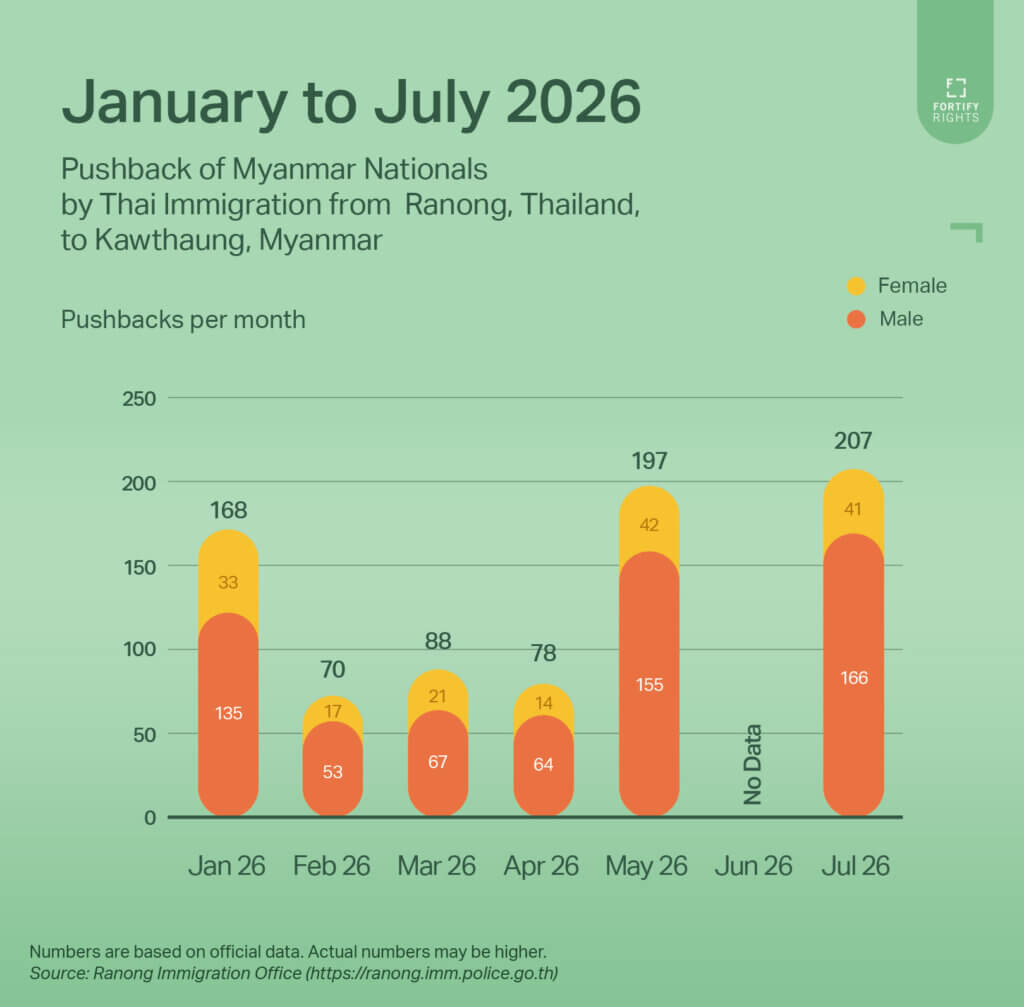
The Thai government should suspend the adoption of a draft regulation on deportations that lacks adequate safeguards and could enable authorities to forcibly return refugees and others to countries where they face persecution, torture, enforced disappearance, or death, Fortify Rights said today, recommending that the government immediately suspend their adoption and comprehensively review them. Last month, Thailand’s Cabinet approved the Prime Minister’s Office Regulation on Deportation, which would establish expedited procedures for deporting non-Thai nationals, including refugees and others at risk of serious human rights violations. By emphasizing rapid deportation without requiring the authorities to properly assess refugees’ protection needs, the draft law increases the risk of returning people to countries where they could face persecution, torture, or other serious harm. It would also allow the authorities to return individuals to the last country where they lived if their nationality cannot be confirmed, putting groups such as the Rohingya from Myanmar at particular risk. According to documents on file with Fortify Rights, relevant government agencies provided comments on the draft regulation before Cabinet approval. The Ministry of Foreign Affairs concluded on July 12, 2026: Since early 2024, Thai authorities have worked in concert with the Myanmar military to forcibly return Myanmar nationals from Thailand to Myanmar, where they face forced conscription, torture, and other forms of persecution. Fortify Rights exposed how Thai immigration authorities worked directly with representatives of the Myanmar military junta to forcibly return more than 3,500 Myanmar nationals through the Ranong-Kawthaung border crossing between February 2024 and November 2025. The practice has continued. Based on Fortify Rights’s ongoing open-source monitoring, Thai authorities forced at least 808 additional Myanmar nationals to Myanmar from January 2026 to July 7, 2026, which counts for an estimated total forced returns of 4,571 since December 2023. Many of those returned face a substantial risk of arbitrary detention, torture, and forced military conscription under the Myanmar junta’s practice of forced conscription. In interviews with Fortify Rights, officials from the Ranong Immigration Office said they had followed their standard operating procedures when carrying out pushbacks. They explained that coordination with the Myanmar military junta was necessary because the Kawthaung border crossing with Myanmar, unlike other sections of the Thailand-Myanmar border, remains under the junta’s control. As a result, the officials said this “government-to-government” arrangement provides operational clarity, as Thailand has not recognized any alternative authority of Myanmar’s ethnic or resistance groups. They stated that Immigration’s responsibility ends once the deportation is completed and declined to elaborate on operational details. Fortify Rights also interviewed Myanmar refugees who faced Thailand’s pushbacks and testified how Thailand’s existing procedures failed to provide effective protection for them and other people at risk of persecution. “Kyaw Tin Soe” is a 42-year-old former Myanmar police officer from Mandalay and a member of the country’s Civil Disobedience Movement (CDM)–a nationwide movement of civil servants who refused to serve under the military junta after the 2021 coup. He told Fortify Rights about the dangers he would face if returned to Myanmar military junta’s custody: (Quote from Kyaw Tin Soe, not provided in the prompt, so omitted here) The risks extend beyond Myanmar. In February 2025, Thai authorities forcibly returned approximately 40 Uyghur refugees to China after they spent years in immigration detention, despite repeated warnings from U.N. experts and governments that they could face imprisonment and other serious human rights violations upon return. The draft Prime Minister’s Office Regulation on Deportation does not fully comply with Thailand’s international obligations, including the principle of non-refoulement, which is a non-derogable obligation under customary international law, making it binding on all states regardless of whether they are parties to the 1951 Refugee Convention. States may not return any person to a country where they face a real risk of torture, persecution, or other serious human rights violations, and this obligation cannot be set aside on grounds of national security, public order, or other policy considerations. Thailand has further codified this obligation in Section 13 of the Prevention and Suppression of Torture and Enforced Disappearance Act B.E. 2565 (2022), reinforcing its duty to prevent refoulement. Thailand’s Deportation Act B.E. 2499 (1956), as amended by the Deportation Act (No. 3), B.E. 2521 (1978), Section 6 paragraph 3 acknowledged: “In the case where the execution of the deportation order has not been set ready (sic) for the deportee to be deported from Thailand yet, the Minister [of Interior] may, during the detention of the deportee and upon the deportee’s request, issue an order allowing the deportee to be sent for work at any place instead of being detained as deemed appropriate.” However, in practice, refugees without legal status are typically prosecuted and forcibly deported under the Immigration Act. On July 15, 2026, civil society working to support refugees in Thailand released a joint statement urging the Thai government to halt the adoption of the draft regulations and conduct a comprehensive review through meaningful consultations with the National Human Rights Commission of Thailand, the Ministry of Foreign Affairs, international law experts, international organizations, and refugees themselves.

0

Original source

Fortify Rights

原文を読む