General articles are free for 24 hours after publish.
Philippine Congress Resumes Session, Prioritizes Economic Recovery and 2027 Budget
The Philippine Congress resumed session with a legislative agenda focused on economic recovery, lower food prices, healthcare reforms, government transparency, and the timely passage of the proposed 2027 national budget. Measures to ease household burdens amid slowing economic growth were emphasized.
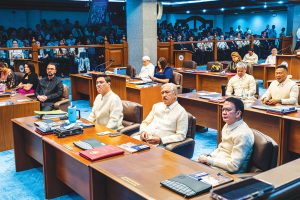
By Kaela Patricia B. Gabriel and Pexcel John Bacon THE Senate and House of Representatives on Monday resumed session with a legislative agenda centered on economic recovery, lower food prices, healthcare reforms, government transparency and the timely passage of the proposed 2027 national budget. Senate President Sherwin T. Gatchalian said lawmakers would focus on measures that ease the burden on households as the economy slows. “Genuine economic recovery cannot be measured by growth figures alone,” he said in his opening speech. “It must be felt in the things that really matter — affordable goods and services, secure jobs and food on the table.” Citing Development Budget Coordination Committee projections, Mr. Gatchalian noted that economic growth is expected at 3.5% to 4.5%, the weakest since 2009. “These numbers are not abstract. They translate into lower incomes, fewer job opportunities and heavier burdens for families struggling to get by,” he added. He said the Senate would prioritize amendments to the Rice Tariffication Law to boost the National Food Authority’s role in ensuring rice supply while protecting farmers’ incomes. The chamber will also push a measure exempting workers earning up to P400,000 annually from income tax to increase take-home pay, strengthen the Energy Regulatory Commission to help address high electricity costs, amend the Downstream Oil Deregulation Act to cushion consumers from fuel price shocks during global crises, and update the Magna Carta for Micro, Small and Medium Enterprises. “The burden of high energy costs extends beyond electricity,” Mr. Gatchalian said. “We also feel its effects in the transport sector, where our continued dependence on imported petroleum leaves workers, commuters and motorists vulnerable to events beyond our shores.” The House of Representatives, meanwhile, identified lower rice prices, healthcare, transparency and cybersecurity among its legislative priorities. Speaker Faustino “Bojie” G. Dy III said lawmakers would seek the passage of the proposed Rice Industry and Consumer Empowerment Act, amendments to the Universal Health Care Act, the Cadena Act to strengthen transparency in government spending, and the Cybersecurity Act. “It is our priority to pass the Rice Industry and Consumer Empowerment Act to lower rice prices and strengthen support for our farmers; amendments to the Universal Health Care Act to ensure quality and accessible healthcare services; the CADENA Act to foster greater openness and transparency in the use of public funds; and the Cybersecurity Act, which aims to protect every Filipino from the threats of the digital space,” he said. Mr. Dy also urged lawmakers to prioritize House Bill No. 9965, or the Children’s Social Media Safety Act, which seeks to prohibit children below 13 years old from using social media, and called on Congress to ensure recently enacted laws are effectively implemented. “We must make sure that these laws are translated into programs that are effectively implemented so they truly improve the lives of our countrymen,” he said. The Speaker said the House approved 163 bills during the first regular session, including 26 measures endorsed by the Legislative-Executive Development Advisory Council, covering social welfare, nutrition and education reforms. Separately, House Majority Leader Ferdinand Alexander A. Marcos III said preparations for the proposed 2027 national budget would proceed despite the Senate impeachment trial of Vice-President Sara Duterte-Carpio. “The impeachment is not in the lower House,” he told reporters in Filipino. “We will continue doing our job.” Mr. Marcos said the House expects the National Expenditure Program to be transmitted in August, after which budget briefings and agency hearings will begin under what he described as a more transparent and participatory budget process. Twenty-one senators attended the opening of the session, although several minority lawmakers skipped President Ferdinand R. Marcos, Jr.’s State of the Nation Address. Senate Minority Leader Alan Peter S. Cayetano said he preferred to watch the address on television as a form of protest. “I’d probably prefer to just watch it on TV,” he said. “That way, the administration may be more comfortable too, and it’s my simple way of protesting, including by wearing black.” Senator Maria Imelda “Imee” R. Marcos also skipped the address, citing concern over criminal cases filed against fellow minority Senators Jose “Jinggoy” P. Ejercito Estrada, Jr., Ronald “Bato” M. dela Rosa and Rodante D. Marcoleta.
Original source
BusinessWorld Nation