General articles are free for 24 hours after publish.
Six Javan Slow Lorises Reintroduced to Ujung Kulon National Park
Six critically endangered Javan slow lorises have been released into Ujung Kulon National Park, Indonesia, after rehabilitation. Their return to the wild requires strict physical and behavioral assessments, with recovery from severe injuries, particularly from electric shocks, posing a significant challenge.
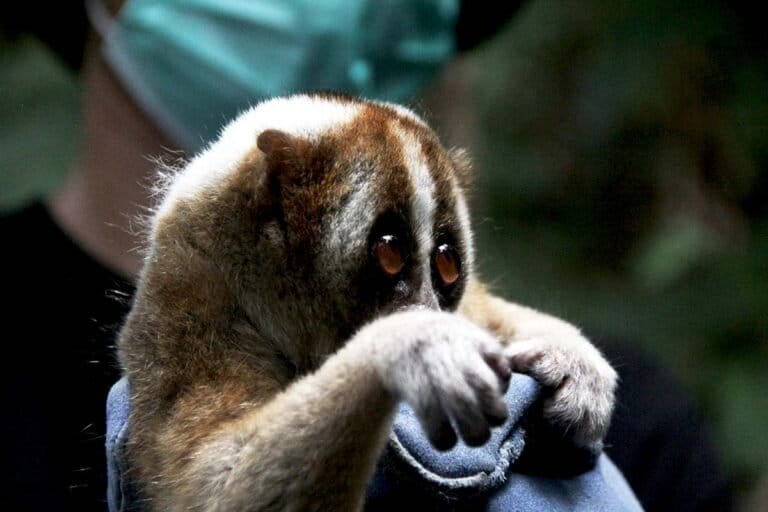
Six critically endangered Javan slow lorises (Nycticebus javanicus) have been returned to the wild at Ujung Kulon National Park in Banten, Indonesia. One male and five females made the approximately six-hour journey from the rehabilitation center of the Yayasan Inisiasi Alam Rehabilitasi Indonesia (YIARI) in Bogor to the park. Most of these slow lorises were handed over by the community to the Natural Resources Conservation Center (BKSDA) and subsequently entrusted to YIARI for care. However, returning them to the forest is not a simple matter. According to Indri Saptorini, a veterinarian at YIARI, slow lorises can only be released if they are physically and behaviorally healthy. Each individual undergoes a physical examination, blood tests, X-rays, and parasite screening and treatment. After being declared healthy, the slow lorises undergo a quarantine period of about six weeks before being moved to socialization cages. Here, their natural behaviors such as feeding, grooming, social interactions, and locomotion are observed. This behavioral assessment requires approximately 200 hours of observation. The rehabilitation process is not always smooth. If a slow loris develops diarrhea, hair loss, refuses to eat, or shows other changes in condition, it must be re-examined at the clinic. "The biggest challenge is when the slow lorises arrive in severe condition, especially due to electric shocks," said Indri. Severe injuries can take months to heal. In some cases, healing from amputations caused by electric shocks can take up to 10 months, not including behavioral recovery. The release project also involves community participation. Rosid, the head of the local neighborhood (RT) in Rancapinang Village, Pandeglang Regency, participated in transporting the animals to the release site. He usually only occasionally sees Javan slow lorises in the wild but this time he was directly involved in bringing the primate to Ujung Kulon. "This is the first time I've experienced this directly," he said. Slow lorises, due to their unique morphology and nocturnal habits, are also in demand as pets, and are critically endangered due to poaching and habitat destruction. Such reintroduction programs are crucial for species conservation. Source: Mongabay Indonesia
Original source
Mongabay Indonesia