General articles are free for 24 hours after publish.
Thai Politics at 94: Stuck in Authoritarianism? Experts Criticize Political Interference in Independent Bodies
Prominent Thai figures are criticizing independent bodies for losing credibility due to political and commercial interference. Reflecting on 94 years of Thai politics, they call for reforms of these institutions and increased public oversight to break free from a cycle of authoritarianism and patronage.
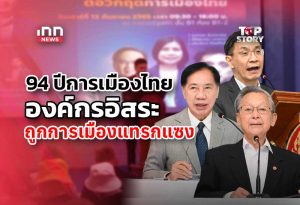
A significant seminar held at the Thai Parliament has brought to the forefront concerns regarding the integrity and functionality of independent organizations within Thailand's political framework. Two former Speakers of the Parliament, Mr. Chuan Leekpai and Mr. Phokin Pluekpan, alongside Dr. Samkirt Tangkitvanich, President of the Thailand Development Research Institute (TDRI), participated in a panel discussion that was critical of the nation's political trajectory. The central theme revolved around Thailand's 94-year political history, which the speakers contended has been perpetually caught in a cycle of authoritarianism and patronage. A particular focus of their critique was directed at the country's independent bodies. These organizations, entrusted with significant oversight responsibilities and managing an annual budget reportedly exceeding 20 billion baht, were accused of being deeply compromised by political and business interests. This interference, they argued, has severely undermined their credibility and effectiveness. Mr. Chuan Leekpai, a former Prime Minister and Speaker, elaborated on this point. He recalled that the independent bodies were initially conceived under the 1997 constitution as a mechanism to check and balance state power. However, he lamented that they have increasingly fallen under the sway of the executive branch and powerful business conglomerates. These entities, he suggested, have infiltrated these organizations, using their substantial budgets without accountability to the public, instead deferring to political powers, thereby becoming a burden on taxpayers. Mr. Phokin Pluekpan, another former Speaker, offered a broader perspective on Thailand's democratic journey. He characterized the past 94 years as a period where the nation has consistently failed to break free from the entrenched systems of authoritarian rule, bureaucratic dominance, and patronage networks. He drew a stark analogy, suggesting that even religious institutions have faced undue influence, leading to a need for political maneuvering for status. In such an environment, he questioned how independent organizations could possibly remain impartial. To address these systemic issues, Mr. Phokin proposed a four-pronged approach. These included reviving mechanisms from the 1997 constitution that allow citizens to initiate impeachment proceedings, establishing a citizen-led version of the National Anti-Corruption Commission (PACC), dismantling legal obstacles that perpetuate patronage, and significantly reducing the size and scope of the state bureaucracy. Dr. Samkirt Tangkitvanich of TDRI reinforced the critique by pinpointing a critical vulnerability in the system: the selection process for senators (S.W.). He argued that if the origin of senators is flawed or lacks legitimacy, this inherent weakness inevitably transfers to the independent bodies they help to form or oversee. He specifically raised concerns about the Election Commission (EC) regarding alleged collusion in the Senate elections. Dr. Samkirt urged the EC to expedite the referral of this case to the Supreme Court to ensure transparency. He cautioned that if the EC were to unilaterally drop the investigation, it could be construed as a dereliction of duty, potentially aimed at protecting the legitimacy of the senators involved. The overarching conclusion from the seminar is a stark warning: unless these independent organizations can successfully extricate themselves from political interference and re-establish public trust, the prospect of Thailand's democracy truly escaping its 94-year-old authoritarian loop remains dim. Source: INN News
Original source
INN News