General articles are free for 24 hours after publish.
An Giang Province Nears Completion of Summer-Autumn Rice Harvest, Boosting Profits Through Quality and Low Emissions
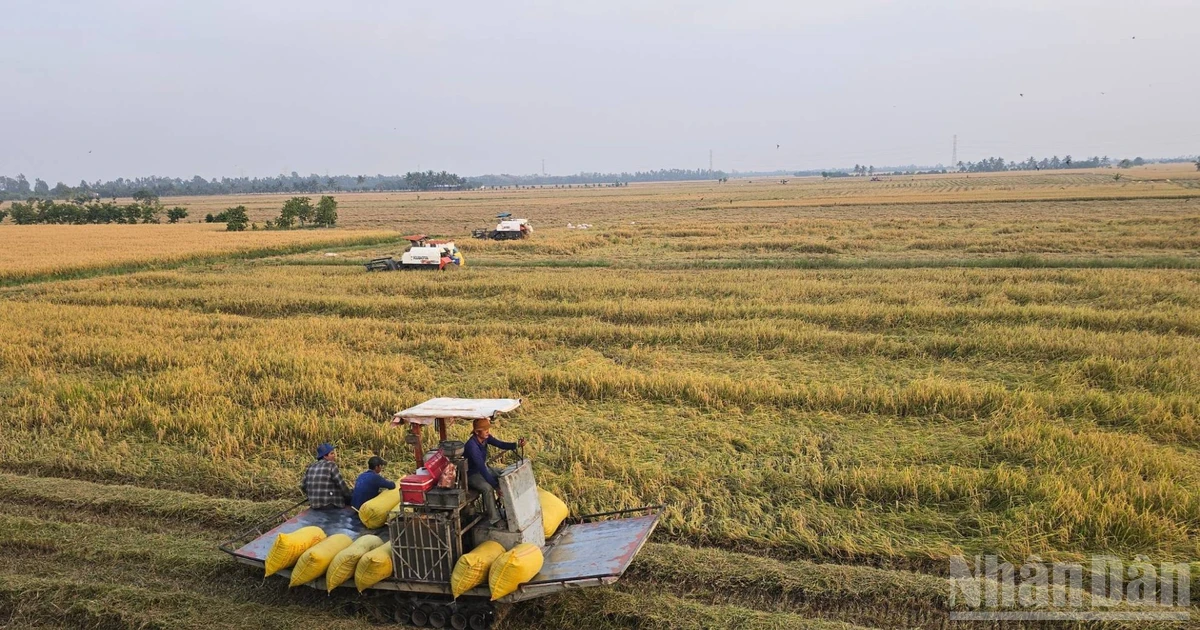
An Giang Province in Vietnam is nearing the completion of its summer-autumn rice harvest, focusing on expanding high-quality, low-emission rice production to increase farmer profits. Notably, a low-emission rice production promotion project is contributing to cost reduction and profit growth.
An Giang Province in Vietnam is nearing the completion of its summer-autumn rice harvest. The province planted over 500,000 hectares for the 2026 summer-autumn season, with more than 280,000 hectares already harvested. The average yield is estimated at 6.14 tons per hectare, and the remaining approximately 217,000 hectares are expected to be harvested by the end of September. From June to August, the region experienced heavy rains and flooding from the upper Mekong River, raising concerns among farmers about reduced yields. However, the agricultural sector's proactive management, including strict adherence to planting schedules to avoid floods, ensured the safety of rice production against natural disasters. Areas outside the dykes, at higher risk of flooding, were harvested completely and early, thus avoiding damage from the flood season. For areas where rice had not yet ripened, the agricultural sector intensified operations of irrigation and drainage systems, reinforced dykes, and managed water discharge effectively. Increased field monitoring allowed for timely responses to mitigate potential losses or adverse effects on yield and grain quality. Rice and paddy prices saw a good start to the season but later experienced a slight decrease of 100 to 400 VND per kilogram due to slower trading and reduced purchases by traders. Nevertheless, An Giang has actively expanded the cultivation of high-quality, aromatic, and specialty rice varieties to meet export market demands, with high-quality rice accounting for over 75% of the province's total rice production. Significantly, the initial success of the province's project to develop one million hectares of sustainable, low-emission, high-quality rice production in the Mekong Delta has helped farmers reduce production costs, with an average cost reduction of 420 VND per kilogram. This initiative, implemented amidst rising input costs and volatile paddy prices, focuses on optimizing production costs rather than solely increasing yields. Total costs are estimated at over 3 million VND per hectare (achieved through reduced seeding rates, lower fertilizer application, and fewer pesticide sprays), leading to an estimated average profit of over 30 million VND per hectare, an increase of 4.372 million VND per hectare compared to control fields. Furthermore, the agricultural sector has proactively facilitated business linkages for the production and consumption of high-quality rice. The province has partnered with 11 major enterprises to implement production and product consumption linkage models with cooperatives and farmers, covering over 17,000 hectares. These enterprises purchase rice at prices 800-1,000 VND per kilogram higher than the market price for farmers without such contracts. This demonstrates that, in addition to higher selling prices, the application of low-emission, high-quality rice cultivation techniques enables farmers to save on input costs (seeds, fertilizers, pesticides), thereby significantly increasing net profits per unit area. Source: Nhan Dan
Original source
Nhan Dan