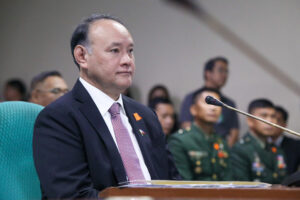
Teodoro Urges Increased Defense Spending for Maritime Security
Philippine Defense Secretary Gilberto C. Teodoro Jr. has called for increased defense spending, advocating for 2% to 4% of GDP to bolster maritime security and military capabilities. He also expressed support for a firm response to China's claims over the Batanes Islands.
Defense Secretary Gilberto C. Teodoro Jr. said on Friday that the Philippines should increase defense spending to between 2% to 4% of gross domestic product (GDP) to strengthen its military capabilities and maritime security, as the government prepares to expand maritime patrols and receive additional defense assets. Mr. Teodoro said that the government would need to realign its budget to support higher defense spending, noting that resources are finite. “We definitely need to realign,” he told reporters on the sideline of the Stratbase Institute conference, “More for one means less for another.” Asked if where the funding can get, he said, “It is up to somebody, all I’m saying is we need to increase.” Mr. Teodoro also confirmed that the planned transfer of five Japanese warships has been accepted “in principle” and is being worked out, although he declined to provide a timeline. He said that the vessels would be transferred at no costs, but the Philippines would shoulder expenses for transport, crew training and system integration, as well as invest in new naval facilities to support future acquisitions. Mr. Teodoro also backed calls for a stronger response to China’s latest claims involving Batanes, saying that the country’s pushback should be firm as such assertions violate international law and Philippine sovereignty. “Naturally, our pushback should be strong because, number one, this is not only a violation of international law… it is also a violation of the normal thinking of the people,” Mr. Teodoro said. Former Senior Associate Justice Antonio T. Carpio, meanwhile, challenged China to bring its reported claim over the Batanes Islands before an international court, saying Beijing should prove its assertions through legal channels instead of public statements. “My challenge to China is why don’t they bring that issue to the International Court of Justice that they own the Batanes Island,” Mr. Carpio told reporters. “Go ahead, bring a case in the International Court of Justice. We will meet there. We will abide by the ruling,” he added. Meanwhile, Batanes Rep. Ciriaco B. Gato Jr. rejected the claims, calling the assertions an affront to Philippine sovereignty and the identity of the Ivatan people. “Batanes is a province of the Republic of the Philippines. The Ivatans are Filipinos,” Mr. Gato said in a statement on Friday, “We treat any insinuation that seeks to question or undermine the absolute sovereignty of the Republic of the Philippines over our islands with utmost gravity.” Adding, “Any challenge to our statues is not merely a geopolitical provocation; it is an affront to our identity that we will not tolerate.” The Chinese Embassy to the Philippines did not immediately reply to a Viber message seeking comments. Meanwhile, Mr. Teodoro said that the Philippines should leverage its growing defense partnerships to deepen economic and political ties with like-minded countries, arguing that security cooperation alone would not be enough to sustain the country’s long-term strategic objectives. “These defense alliances will not be sustainable if these are strictly defense alliances, but should be the foundations for more extensive economic and, at the end of the day, political relations,” he said at the Stratbase Institute conference marking the 10th anniversary of the 2016 arbitral ruling. Mr. Teodoro said that the government is shifting its defense strategy from one centered on internal security and land-based operations to a multi-domain approach that includes the country’s exclusive economic zone, the Philippine Rise and other maritime areas under Philippine jurisdiction. He said that the review of the country’s defense posture identified significant gaps in infrastructure, logistics, defense industries, and military capabilities, underscoring the need for sustained investments. The defense secretary also called for stronger cooperation among government, businesses, and civil society in building a credible deterrence, saying that the country’s security depends not only on military spending but also on resilient supply chains, telecommunications networks, critical infrastructure, and strategic industries. “Without that commitment, then we cannot build a credible deterrence posture, which at the end of the day is necessary for us to assert our rights,” Mr. Teodoro said. He also described the 2016 arbitral award as a catalyst for the Philippines’ shift toward external defense, saying the ruling has strengthened international support for a rules-based order in the Indo-Pacific. “It is not an award for the Philippines, it is an award for the world because it institutes the primacy of UNCLOS and guards it against revisionist attempts,” he said. AFP Chief of Staff Romeo S. Brawner Jr. said that the military’s experience over the past decade has shown that the Philippines must continuously exercise the rights affirmed by the 2016 arbitral ruling. “Rights endure only when they are exercised,” Mr. Brawner said, adding that the ruling provides a strong legal foundation that must remain meaningful “not only in legal discourse but also in our actions.” He said that the AFP’s objective is to prevent conflict through credible deterrence posture. “Credible deterrence is much more than military hardware,” Mr. Brawner said, “It is built through capable forces, operational readiness, trusted partnerships, resilient institutions, and above all, the national resolve to stand firm in defense of what is rightfully ours.” He also stressed the importance of maintaining a sustained presence in the West Philippine Sea, saying every patrol, resupply mission, and joint exercise reinforce the country’s sovereign rights. — Pexcel John Bacon
多角的分析
国防費のGDP比2~4%への引き上げは、フィリピン経済にとって大きな財政的負担となる可能性がある。限られた国家予算の中で、国防費の増額は教育、医療、インフラ整備といった他の優先分野からの資金流出を意味する。これは、経済成長の持続可能性や国民生活の質に影響を与える可能性がある。特に、防衛資産の購入や維持には継続的な投資が必要であり、長期的な財政計画が不可欠となる。日本からの護衛艦無償譲渡は初期費用を抑えるものの、輸送費、訓練費、システム統合費、施設投資など、相当額の追加支出を伴う。これらの費用がどのように捻出されるかが、経済的な持続可能性の鍵となる。
国防費増額の動きは、インフラ、ロジスティクス、防衛産業、軍事能力といった分野への投資機会を示唆する。特に、日本からの防衛資産移譲は、関連するサプライチェーンやサービス産業にビジネスチャンスをもたらす可能性がある。しかし、投資家にとっては、国防費増額が国家財政に与える影響、特に他の公共サービスへの投資削減が経済成長に与える潜在的な悪影響を慎重に見極める必要がある。また、南シナ海情勢の緊迫化は、地域全体の投資リスクを高める要因となりうる。長期的な戦略目標達成のためには、防衛協力が経済・政治関係の基盤となるべきというテオドロ長官の発言は、経済連携を重視する投資家にとって注目すべき点である。
国防費増額の議論は、国民生活に直接的な影響を与える公共サービスへの予算配分との間で、社会的な緊張を生む可能性がある。テオドロ長官が指摘した「一つが増えれば、他は減る」という状況は、教育、医療、社会福祉といった分野への投資が削減される可能性を示唆しており、市民の不安を招く恐れがある。また、中国によるバタン諸島への主張は、フィリピン国民のアイデンティティと領土保全に対する深刻な懸念を引き起こしている。イバタンの人々が「侮辱」と感じるほどの強い反発は、国民の団結を促す一方で、地域間の関係や、国家安全保障と市民生活のバランスという公共の課題を浮き彫りにする。軍事能力強化が、国民の安全と繁栄にどう貢献するのか、その説明責任が問われる。
国防費増額の提言は、国民、特に税金を納める市民にとって、その影響を直接的に感じることになる。テオドロ国防長官が示唆したように、国防費の増加は、教育、医療、インフラ整備といった、市民生活に不可欠な分野への予算配分を圧迫する可能性がある。例えば、学校の建設や修繕、医療施設の拡充、公共交通機関の改善などが遅れることになれば、市民の不満は高まるだろう。また、中国によるバタン諸島への領有権主張は、フィリピン国民全体の安全保障への懸念を増大させている。特に、バタン諸島に住むイバタンの人々にとっては、自分たちの土地とアイデンティティが脅かされるという直接的な不安につながる。市民は、国家安全保障の強化が、自分たちの生活の質や安全を犠牲にするものではないことを、政府に強く求めている。軍事的な抑止力強化が、紛争を防ぎ、平和と安定をもたらすという説明を、市民は求めている。
背景・歴史的文脈
フィリピンの国防費増額の動きは、長年にわたる南シナ海における中国の海洋進出と、それに伴う地域安全保障環境の悪化を背景としている。特に2016年の仲裁判断以降、フィリピンは国際法に基づいた権利主張を強める一方で、軍事力の近代化と防衛協力の強化を模索してきた。日本は、フィリピンとの戦略的パートナーシップを重視し、防衛装備品供与や共同訓練などを通じて、同国の安全保障能力向上を支援してきた。今回のテオドロ国防長官の提言は、こうした国際情勢と、フィリピンが直面する領土・主権問題への対応策を具体化したものである。国防費のGDP比目標設定は、軍事能力向上のための継続的な投資を確保する狙いがある。
原文ソース
BusinessWorld Nation