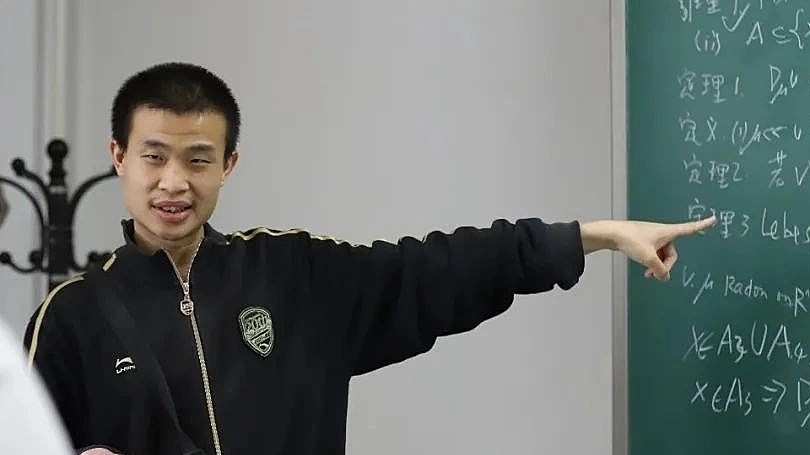
Chinese 'Math Prodigy' Wins Prestigious Science Award
Wei Dongyi, once an internet sensation for his unpretentious demeanor, has won a second-tier National Science and Technology Progress Award for Natural Sciences in China alongside Zhang Zhifei for their research on fluid transition mechanisms. The award highlights his exceptional academic achievements.
Chinese mathematician Wei Dongyi, along with his collaborator Zhang Zhifei, has been awarded a second-tier prize in the Natural Sciences category at China's prestigious National Science and Technology Progress Awards. This recognition highlights the exceptional academic achievements of Wei, who previously became an internet sensation for his unpretentious demeanor. According to Peking University, Wei and Zhang's joint work focuses on the "transition mechanism of fluid flow," providing new theoretical tools to understand the process of transition from laminar to turbulent flow. They have previously co-authored a series of papers on Navier-Stokes equations, Euler equations, and nonlinear differential equation theory in leading global mathematics journals. Born in 1991, Wei gained internet fame in China in 2021 following a candid street interview video. He appeared in a simple, even disheveled, manner, holding a large bottle of mineral water and a bag of steamed buns, speaking somewhat shyly. However, his personal background stunned the public. Wei achieved perfect scores twice at the International Mathematical Olympiad (IMO) in 2008 and 2009. During high school, he reportedly "shocked" his teacher by solving 23.5 out of 24 problems across eight gifted student selection competitions, notably using his own methods instead of conventional approaches. Following his IMO triumphs, Wei declined a full scholarship offer from Harvard University to attend Peking University, where he completed his doctoral studies. He is affectionately known by academics and the public alike as "God Wei" for his extraordinary talent. Established in 1999, the National Science and Technology Progress Award is one of China's most significant state-level honors, recognizing groundbreaking discoveries in fundamental research across fields such as mathematics, physics, chemistry, biology, and engineering. The award has two tiers, first and second prize, and three categories: Natural Sciences, Technological Invention, and Scientific and Technological Progress. Over 250 projects were recognized this year. Source: VnExpress
多角的分析
This news primarily concerns scientific achievement rather than direct economic impact. However, the awarding of prestigious national science prizes in China signifies the government's ongoing commitment to fostering innovation and research, which is a long-term economic strategy. Investment in fundamental research, even in theoretical fields like fluid dynamics, can eventually lead to technological advancements and economic benefits in areas such as aerospace, energy, and manufacturing. The Chinese government's emphasis on science and technology is a key component of its broader economic transformation goals, aiming to move from a manufacturing-based economy to one driven by innovation and high-value industries.
For investors, this news is indirectly relevant. While not a direct market-moving event, it underscores China's strategic focus on developing its scientific and technological capabilities. Investors looking at the long-term growth potential of Chinese companies, particularly in sectors that benefit from advanced research (e.g., high-tech manufacturing, AI, advanced materials), may see this as a positive signal. It reinforces the narrative of China's ambition to become a global leader in innovation, which could translate into future investment opportunities. However, the direct financial returns from theoretical mathematics research are typically long-term and indirect.
The story of Wei Dongyi resonates deeply with the Chinese public due to the stark contrast between his humble appearance and his extraordinary intellect. This narrative challenges societal stereotypes and highlights that brilliance can emerge from unexpected places. His decision to study at Peking University instead of Harvard also appeals to national pride. For younger generations, especially students, Wei serves as an inspirational figure, demonstrating the value of dedication to academic pursuits and the potential for recognition through merit. The public's fascination with his story reflects a societal admiration for intellectual prowess and a desire to see China excel on the global stage in science and technology.
For the average citizen, the story of Wei Dongyi offers a moment of national pride and inspiration. It showcases that China is producing world-class talent, even in highly specialized fields like theoretical mathematics. The narrative of a humble individual achieving such high recognition can be seen as a testament to the opportunities available through the education system, despite the often-cited pressures and competition. It might also spark conversations about the value placed on intellectual pursuits versus material success, particularly given his simple lifestyle. For parents, it reinforces the importance of education and nurturing their children's talents.
背景・歴史的文脈
中国における科学技術振興は、改革開放以降、国家の発展戦略の中心に据えられてきた。特に、近年は「科学技術強国」を目指す方針を掲げ、基礎研究への投資を大幅に増やしている。国家科学技術進歩賞は、こうした国家的な科学技術振興策の一環として、画期的な研究成果を奨励し、科学者のモチベーションを高める目的で創設された。魏東益氏のような若手研究者が国際的な舞台で活躍し、国内で高い評価を得ることは、中国が科学技術分野で先進国に追いつき、追い越すという国家目標を象徴する出来事として捉えられている。彼の逸話は、学術的な才能と謙虚さの融合として国民の関心を集め、科学への関心を高める役割も果たしている。
原文ソース
VnExpress