General articles are free for 24 hours after publish.
Journey to South Kalimantan's Highest Village for Solar Power Installation
A report on the arduous journey to Juhu Village, the highest settlement in South Kalimantan, aiming to install renewable energy. The team navigated treacherous mountain paths and broken bridges, highlighting efforts to improve energy access for the local community.
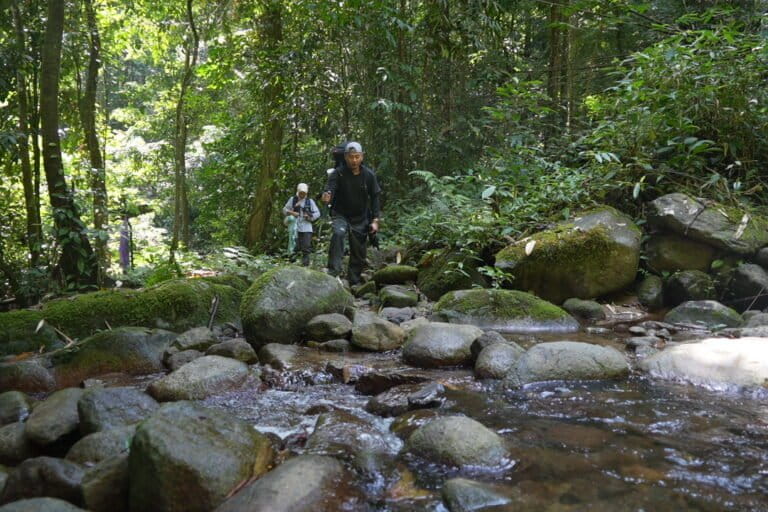
A team from the Girls and Women in Renewable Energy Academy (GAWIREA), led by Andi Rosita Dewi, along with Ayyub Muhajid and his student Yuansen Tio from the Development Economics program at ULM University's Faculty of Economics and Business, and Mongabay, embarked on a challenging journey to Juhu Village, the highest settlement in South Kalimantan (Kalsel), in late July. Their mission was to install solar energy systems there. The team faced a difficult trek, starting from Desa Hinas Kiri, the last point accessible by motorized vehicles. From there, they navigated through numerous broken and fragile suspension bridges, steep hills, slippery rocky terrains, rivers of varying widths with strong currents, dense forests, and deep valleys to bring clean energy access to the Meratus Indigenous Community. According to watch records, the journey covered approximately 18.59 kilometers, with a total elevation gain of 1,343 meters and a descent of 1,711 meters. The starting point was at coordinates -2.703160, 115.673370, and the journey concluded at -2.622290, 115.581510. While the team took two days to complete this route, local villagers accustomed to the path can traverse it in just 18 hours one way. From the Puncak Tiranggan junction, a route leading to Mount Halau-Halau, the team was guided by Pinan, a Meratus Dayak elder who descended from the mountain to meet them. The previous day, the four individuals had met him in Barabai, the capital of Hulu Sungai Tengah Regency. Also present was the Chairman of Rubi, the Regional Management of the Alliance of Indigenous Peoples of the Archipelago (PW AMAN) for South Kalimantan. Throughout the journey, Pinan consistently took the lead as the guide, ensuring the group's formation was maintained. No one was allowed to overtake or fall behind. "No one should go ahead, it's taboo (pamali)," he stated. At the time, in late July 2026, the dry season was in full swing. Beneath the dense forest canopy, the team pressed on. Source: Mongabay Indonesia
Original source
Mongabay Indonesia