General articles are free for 24 hours after publish.
Vietnam's Southernmost Province Battles Climate Change-Induced Erosion
Vietnam's southernmost Ca Mau province is facing severe impacts from climate change, including rising sea levels, salinity intrusion, and coastal erosion, prompting urgent calls for central government investment to protect its land and 'ecological shield.' The province loses over 400 hectares annually, with damages totaling hundreds of billions of dong.
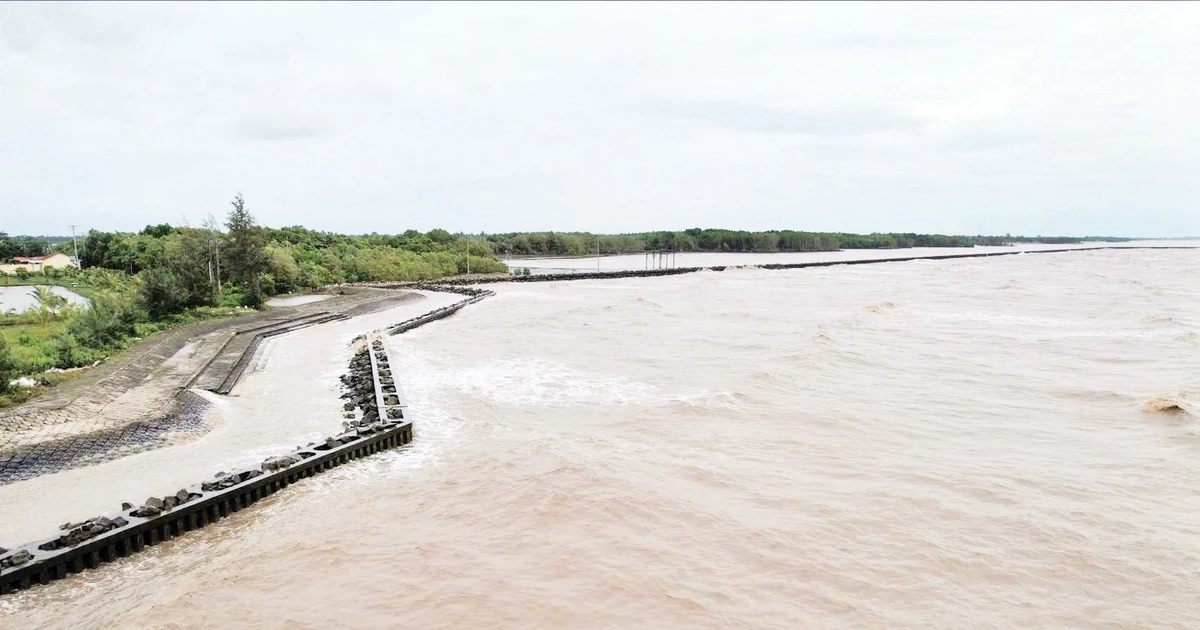
Ca Mau province, located at the southernmost tip of Vietnam, holds a strategically vital position for marine economic development, security, and national sovereignty, owing to its approximately 310 km of coastline and its position surrounded by the sea on three sides. However, this region is increasingly facing severe impacts from climate change, including rising sea levels, salinity intrusion, and coastal and riverbank erosion. According to reports from the Ca Mau Provincial People's Committee, natural disaster developments are becoming more unpredictable. Since the beginning of 2026 alone, the province has experienced 76 erosion incidents spanning over 2 km, with initial damages estimated at nearly 9 billion VND. During severe drought and salinity intrusion periods in 2015-2016, 2019-2020, and 2023-2024, the total damage across the province is estimated to exceed 2,300 billion VND. What is concerning is that the erosion process is no longer localized but is directly shrinking the natural development space of the locality. On average, Ca Mau loses over 400 hectares of land each year. Comparing administrative boundary maps over different periods shows that since 1904, the coastline at the country's southern tip has been encroached upon by approximately 5.8 km inland. Since 2011 alone, erosion has caused the loss of about 6,250 hectares of land and coastal protective forests; approximately 1,093 km out of 14,000 km of rivers and canals are experiencing erosion to varying degrees. In recent times, with support from the central government, Ca Mau has completed nearly 135 km of coastal anti-erosion dikes, contributing to the restoration of over 1,000 hectares of coastal protective forests. Over 45 km of riverbank protection dikes have been invested in, and approximately 13 km of coastal anti-erosion dikes are under construction. The entire province has invested in 408 centralized water supply works with a total investment of about 1,320 billion VND, enhancing water source regulation, supporting production, and improving living conditions for residents. For the period 2026-2030, the Ministry of Agriculture and Rural Development is implementing and will implement projects in the province with a total investment of nearly 11,748 billion VND, including upgrading sea dikes, constructing structures for flood control, regulating salinity-freshwater, and supporting production infrastructure. However, the current scale of investment still lags behind the speed and expanding scope of erosion. Chairman of the Ca Mau Provincial People's Committee, Lu Quang Ngoi, emphasized that Ca Mau is not only a vital area for national defense and security but also plays the role of an 'ecological shield' and an important coastal defense line for the entire Mekong Delta against climate change and rising sea levels. Meanwhile, the investment demand is immense, exceeding the balancing capacity of the local budget. The province has petitioned the central government to prioritize the allocation of medium-term public investment capital for the 2026-2030 period, while also supporting the mobilization of other resources to complete the irrigation system, dikes, natural disaster prevention, water supply, and population resettlement. Protecting Ca Mau is not just about preserving land, forests, and ensuring the lives of people at the country's southern tip. It is also a mission to safeguard the development space, ecological security, and natural defense line for the entire Mekong Delta region against the increasingly severe challenges of climate change. For the 2026-2030 period, the Ca Mau Provincial People's Committee has identified the investment needs for irrigation, dike, and natural disaster prevention projects at approximately 16,898 billion VND; rural clean water supply projects require 850 billion VND; and projects for population resettlement, flood control, urban embellishment, and relocation of houses along rivers and canals need about 36,165 billion VND.
Original source
Nhan Dan