General articles are free for 24 hours after publish.
US and Cambodia to Resume Joint Military Exercises After Decade-Long Break
Cambodia has announced the resumption of joint military exercises with the United States, "Angkor Sentinel," in February next year. This marks the first such exercise in a decade, signaling improving ties. The drills aim to enhance interoperability and disaster response capabilities.
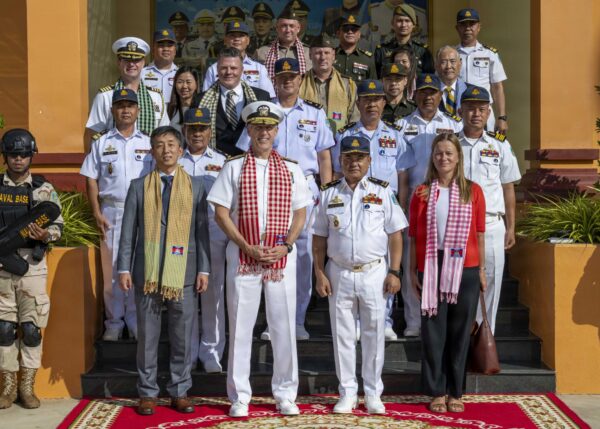
Cambodia's army has confirmed that it will resume joint military exercises with the United States early next year after a decade-long suspension, the latest sign of improving ties between the two nations. The Royal Cambodian Army announced on Facebook on Friday that officials from the two nations had concluded an Initial Planning Conference for Exercise Angkor Sentinel 2027, which it said would be held in February of next year. The exercise has the aim of “strengthening interoperability and disaster-response capabilities, reflecting renewed momentum in Cambodia–U.S. military cooperation and a shared commitment to strengthening defense cooperation.” The announcement follows several high-level meetings between U.S. and Cambodian officials. These include a meeting last month between Prime Minister Hun Manet and Elbridge A. Colby, undersecretary for policy at the U.S. Department of War, during which the two discussed expanded defense cooperation. Hun Manet said at the time that he was satisfied with the “positive momentum in Cambodia-U.S. relations” and the ongoing talks about the resumption of Angkor Sentinel, the Associated Press reported. “The joint exercises and training not only build military capability but also serve as a vital bridge to foster close friendship between the armed forces of both countries,” he added. This was not long after Adm. Steve Koehler, commander of the U.S. Pacific Fleet, traveled to Phnom Penh for meetings with officials including Gen. Vong Pisen, the commander-in-chief of the Royal Cambodian Armed Forces, and Vice Adm. Tea Sokha, the commander of the Royal Cambodian Navy. The visit “reaffirmed the United States’ long-term commitment to strengthening bilateral relationships and partnerships that advance a shared vision for a free and open Indo-Pacific,” the U.S. Pacific Fleet said in a statement at the time. Angkor Sentinel was held for the first time in 2010 but was unilaterally canceled by the Cambodian government in early 2017, shortly after Cambodian troops took part for the first time in Golden Dragon, a joint military exercise with the Chinese military. The move reflected the mutually reinforcing deterioration of Phnom Penh’s relations with Washington and its growing proximity to China. The resumption of the exercise has been anticipated by both sides for some time. It was first publicly discussed in early 2025, just prior to President Trump’s return to the White House, and has been referenced in most high-level diplomatic meetings since then. It reflects the sea change that has taken place in U.S.-Cambodia relations since the midpoint of the Biden administration, as Phnom Penh has sought to diversify its foreign relations and the U.S. has worked to pull the country out of China’s orbit. However, the rapprochement has gained inexorable momentum since the inauguration of the second Trump administration, whose transactional mode of diplomacy has been much more to Phnom Penh’s liking. In particular, President Donald Trump’s decision to shutter USAID and cut off U.S. funding for democracy promotion efforts and media outlets like Radio Free Asia removed a key impediment to improved relations on the Cambodian side. As I noted in 2025, Cambodia’s government finally has what it has always wanted: “a relationship with the U.S. that strengthens, rather than undermines, the CPP’s hold on power.” Last June, the U.S. government officially removed Cambodia from its arms sale blacklist, a month after an American ship docked for the first time at Cambodia’s Ream Naval Base. The latter was particularly significant, given the extensive Chinese refurbishment of the base, which U.S. and Western officials feared was intended to host a permanent Chinese military presence. Adm. Samuel Paparo, commander of the United States Indo-Pacific Command, described the port visit as a sign of the “strong upward trajectory” of relations between Phnom Penh and Washington. These improvements have come even as branches of the U.S. government have come to officially recognize the extent of the Cambodian elite’s involvement in the country’s gigantic online scamming industry. According to U.S. government agencies, online scamming cost U.S. citizens at least $10 billion in 2024.
Original source
The Diplomat Indonesia