Cambodia Intensifies Vector-Borne Disease Control Amid Rainy Season and El Niño
Health
2026年7月8日
7
CPP Cambodia
Relations
🇰🇭Cambodia🇹🇭Thailand

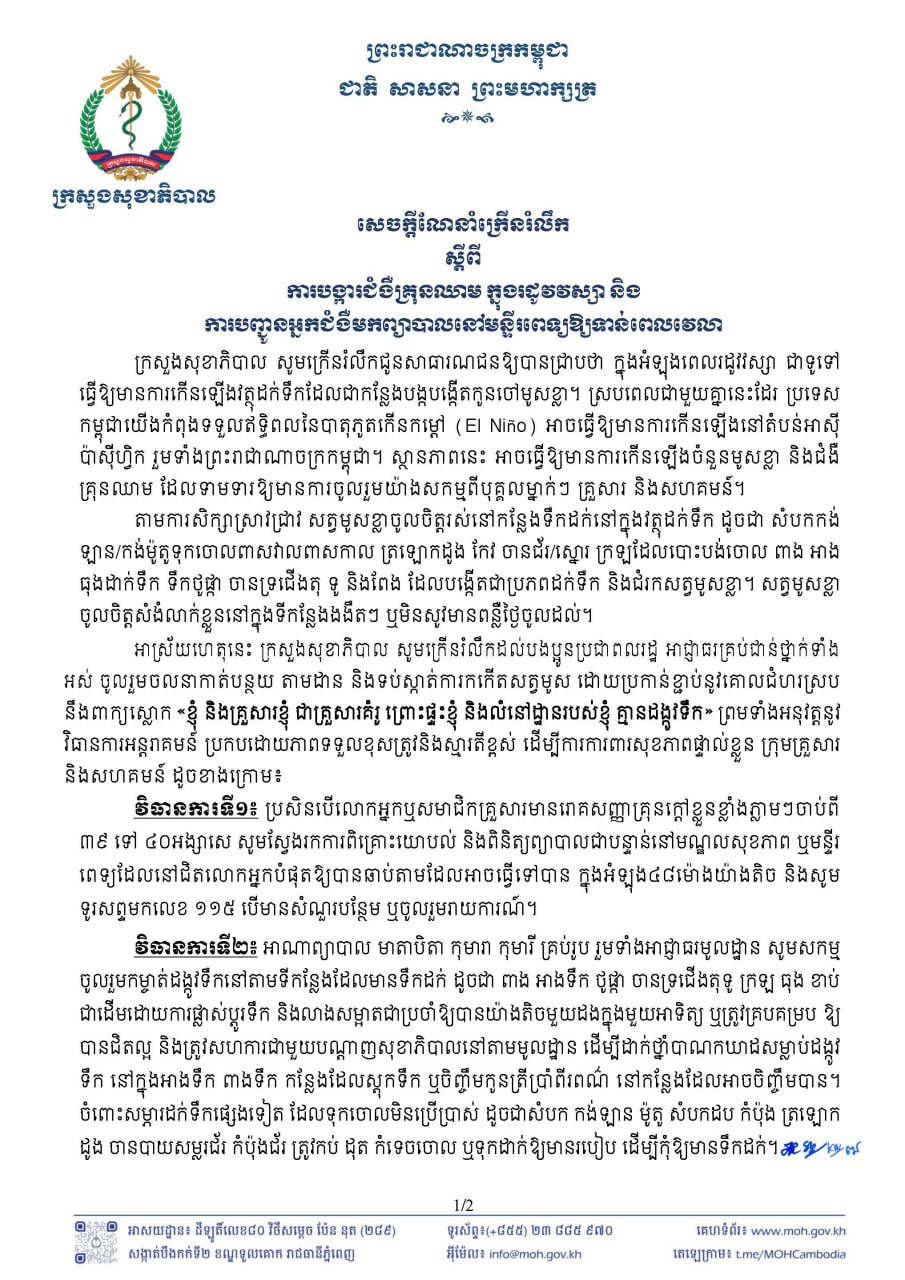
Cambodia Intensifies Vector-Borne Disease Control Amid Rainy Season and El Niño

AI サマリー

Cambodia's Ministry of Health has issued a directive urging the public to eliminate mosquito breeding grounds and seek prompt medical attention, citing the rainy season and El Niño's potential to increase mosquito populations and dengue fever cases. Specific warnings target children, construction sites, and tire vendors.

The Ministry of Health of Cambodia has issued a directive on July 8th, urging the public to prevent dengue fever during the rainy season and to ensure timely treatment for patients at hospitals. The Ministry highlighted that the rainy season typically leads to an increase in water accumulation, which serves as a breeding ground for mosquitoes. Concurrently, Cambodia is experiencing the influence of the El Niño phenomenon, which is expected to cause rising temperatures across the Asia-Pacific region, including Cambodia. This situation could lead to an increase in mosquito populations and dengue fever cases, necessitating active participation from individuals, families, and communities. Research indicates that mosquitoes prefer to inhabit stagnant water in various containers such as discarded car and motorcycle tires, coconut shells, plastic cups, abandoned drums, jars, basins, water tanks, flower vases, table stands, and cupboards, all of which create sources of stagnant water and mosquito habitats. Mosquitoes tend to hide in dark places or areas with little sunlight. Therefore, the Ministry of Health reminds citizens and all levels of authorities to actively participate in reducing, monitoring, and preventing mosquito breeding. Adhering to the slogan "I and my family are a model family because my house and my residence are free of mosquito larvae," and implementing intervention measures with responsibility and high spirit to protect personal, family, and community health, as follows: Measure 1: If you or a family member experiences a sudden high fever of 39 to 40 degrees Celsius, seek consultation and treatment immediately at the nearest health center or hospital. It is advised to do so within at least 48 hours. For further questions or to report, call 115. Measure 2: Parents, guardians, and all children, along with local authorities, should actively participate in eliminating mosquito larvae in places with stagnant water, such as jars, water tanks, flower vases, table stands, cupboards, drums, and cups, by changing the water and cleaning regularly at least once a week, or by covering them properly. Cooperation with local health networks is also encouraged to apply larvicides in water tanks, water jars, and areas where fish are raised. Other water-holding materials that are no longer in use, such as car and motorcycle tires, bottles, cans, coconut shells, plastic bowls, and plastic containers, should be buried, burned, crushed, or stored properly to prevent water accumulation. Measure 3: Owners of construction sites and their workers are urged to clean their construction sites, eliminate water-holding objects and puddles, and store construction materials that can accumulate water in a proper, covered location to avoid water accumulation and eliminate mosquito breeding sources and habitats. This will help prevent the transmission of dengue fever to residents living within 150 meters of the construction sites. Measure 4: Business owners and operators involved in the car and motorcycle tire business must manage discarded tires that can accumulate water by stacking them and covering them tightly with boards or mosquito nets, or by pouring old engine oil into them, filling them with soil, or storing them under a roof. Measure 5: Eliminate mosquito habitats by cutting and clearing grass and weeds around the house. Maintain cleanliness within the home, organize clothing properly, and ensure good ventilation and sunlight. Doors and windows should have screens. Take protective measures by wearing long pants, long-sleeved shirts, and socks to cover most of the body (preferably light-colored clothing, not black or dark). Use mosquito repellent sprays or lotions. Pregnant women can use these repellents safely. Sleep in mosquito nets during both day and night. Measure 6: Health departments of the 25 provinces and cities must collaborate with relevant authorities to inspect construction sites and promote effective implementation of mosquito reduction and prevention activities in their areas to help reduce the morbidity and mortality rates from dengue fever. The Ministry of Health will continue to provide information on public health issues through its official social media channels, website (www.moh.gov.kh), the official Facebook page of the Department of Communicable Disease Control, and the websites www.cdcmoh.gov.kh and www.cnm.gov.kh. For more information, contact the Ministry of Health's emergency hotline at 115, free of charge.

多角的分析

経済的影響

デング熱の流行は、医療費の増加や生産性の低下を通じて経済に直接的な影響を与えます。特に、医療インフラが限られている地域では、病気の蔓延が労働力不足を招き、農業や小規模ビジネスの生産性を損なう可能性があります。また、感染症対策のための公的支出の増加は、他の開発プロジェクトへの予算配分に影響を与えることも考えられます。

投資家心理

感染症の流行リスクは、カンボジアへの投資環境において無視できない要素です。特に、観光業やサービス業に依存する投資家にとって、公衆衛生の悪化は観光客の減少や事業運営の混乱を招く可能性があります。政府による効果的な感染症対策は、投資家の信頼を維持し、安定した事業環境を確保する上で重要となります。

社会的影響

デング熱の流行は、特に子供たちや高齢者など、脆弱な層に disproportionately な影響を与えます。水たまりの除去といった予防策は、地域住民の日常的な活動に負担を強いる可能性があります。また、公衆衛生への意識向上と、政府の対策への住民の協力が不可欠であり、地域社会の連帯感が試される場面と言えます。建設現場やタイヤ販売業者への注意喚起は、特定の産業従事者とその周辺住民の健康リスクに焦点を当てています。

市民の声

雨季とエルニーニョ現象によるデング熱のリスク増加は、カンボジア市民、特に子供を持つ家庭にとって直接的な懸念事項です。水たまりの除去や蚊よけ対策といった日々の努力は、家庭の負担となります。また、高熱が出た際の迅速な医療アクセスへのアクセスは、医療インフラの整備状況や地理的な要因によって、市民の健康状態に大きな差を生む可能性があります。115番への通報は、情報へのアクセスを容易にする一方で、その後の医療提供体制の迅速さが重要となります。

背景・歴史的文脈

カンボジアでは、雨季(5月~10月頃)になると気温と湿度の上昇により蚊が繁殖しやすくなり、デング熱の感染が拡大する傾向があります。特に、都市部では水たまりができやすい環境が多く、感染リスクが高まります。近年、エルニーニョ現象による異常気象が観測されており、これが蚊の活動期間の延長や繁殖の活発化を招き、デング熱の流行をより深刻化させる可能性が指摘されています。過去にも同様の流行が見られており、保健省は毎年雨季前に注意喚起と対策の実施を呼びかけています。

原文ソース

CPP Cambodia

原文を読む