General articles are free for 24 hours after publish.
Vietnam Emphasizes Ideological Work for New Development Era
Vietnam's Communist Party stresses the crucial role of ideological work, propaganda, and mobilization in realizing national development aspirations during a new era. This is framed as a strategy to navigate globalization and the Fourth Industrial Revolution, ensuring party leadership and social cohesion.
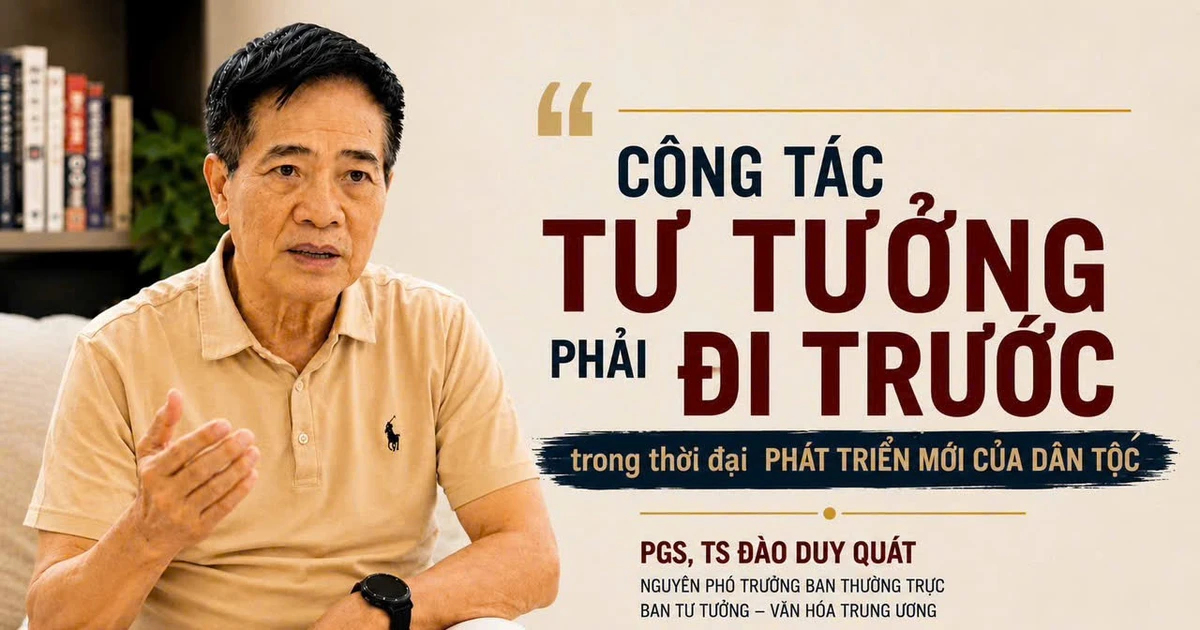
Vietnam's Communist Party is re-emphasizing the critical importance of ideological work, propaganda, and mobilization (công tác tư tưởng) as the nation enters a new era of development. This is seen as fundamental to successfully realizing the country's development aspirations. In an interview with Vietnam News Agency (VNA), Associate Professor, Dr. Đào Duy Quát, former permanent deputy head of the Central Propaganda and Training Department, stated that ideological work is paramount in the Party's leadership activities. He noted that throughout Vietnam's nearly 100-year revolutionary history, milestones in ideological work have always been intertwined with revolutionary milestones. He specifically highlighted the ideological groundwork laid by activities such as the founding of the 'Thanh Nien' (Youth) newspaper by Nguyễn Ái Quốc (later President Hồ Chí Minh) in 1925 and the efforts leading to the establishment of the Communist Party of Vietnam in 1930. In the current era, globalization and the Fourth Industrial Revolution are reshaping the world, with digital transformation, technological innovation, and green transition becoming key determinants of national competitiveness and sustainable development. Against this backdrop, ideological work must continue to play a leading role in strengthening the Party politically, ideologically, morally, and organizationally. It is tasked with researching, developing, and creatively applying Marxism-Leninism and Hồ Chí Minh's ideology, and preparing the scientific and practical foundation for the Party's platforms, policies, and strategies in this new era. Furthermore, ideological work is responsible for disseminating Marxism-Leninism, Hồ Chí Minh's ideology, the Party's platforms, and state laws. It aims to foster unity within the Party, consensus in society, build national great solidarity, and cultivate patriotism, self-reliance, and the aspiration to build a prosperous, civilized, and happy nation. Over 96 years of revolutionary leadership, ideological work has consistently been a step ahead, preparing the scientific and practical basis for formulating platforms and policies, while also inspiring unity, solidarity, and creativity among Party members and the people. This tradition, he stressed, must continue to be upheld in the nation's new development era. Dr. Đào Duy Quát pointed out that digital transformation and artificial intelligence are impacting not only communication methods but also societal thinking, lifestyles, and perceptions. In response, propaganda and training work must innovate by renewing and elevating theoretical thinking, accurately understanding the laws of production force development under new conditions, proactively building appropriate production relations, and correctly identifying the country's development stage. This is essential to keep pace with the times. Vietnam's important geopolitical and geo-economic position in the Asia-Pacific region means it is rapidly and multi-dimensionally affected by globalization and the Fourth Industrial Revolution. These impacts extend beyond economics, culture, society, defense, and foreign affairs, directly affecting the subjects and objects of ideological work, as well as its core components: theoretical research, political theory education, and the propaganda and mobilization of revolutionary movements. Therefore, innovating ideological work is an urgent requirement.
Original source
Nhan Dan