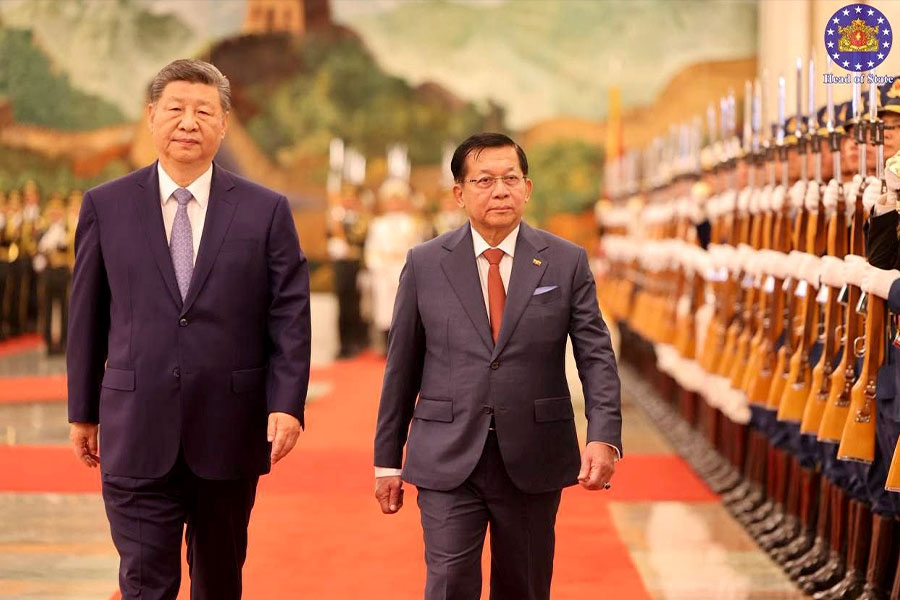
Myanmar military regime's "100-day peace initiative" questioned as major revolutionary forces excluded
Security
2026年7月23日
2
BNI (Burma News International)
Relations
🇲🇲Myanmar🇨🇳China

General articles are free for 24 hours after publish.

Myanmar military regime's "100-day peace initiative" questioned as major revolutionary forces excluded

Share
AI Summary

Political and military analysts are questioning the credibility of the Myanmar military regime’s "100-day peace initiative," pointing out that the junta has entirely excluded the major revolutionary forces currently figh

Political and military analysts are questioning the credibility of the Myanmar military regime’s "100-day peace initiative," pointing out that the junta has entirely excluded the major revolutionary forces currently fighting its troops on the ground. Since former junta chief Min Aung Hlaing assumed the self-appointed presidency, the regime has promoted the initiative—set from April 21 to July 31, 2026—as an effort to engage Ethnic Armed Organizations (EAOs). However, the refusal to include active combat forces has led observers to label the process a failure. The regime’s National Solidarity and Peacemaking Negotiation Committee (NSPNC), led by Lieutenant-General Yar Pyae, has so far limited its engagement to Chinese border-based EAOs in northern Shan State, alongside invitations to the 7 EAO Alliance, a coalition of non-combatant Nationwide Ceasefire Agreement (NCA) signatories. Crucially, no talks have been held with the key anti-regime forces spearheading the armed resistance, including the Arakan Army (AA), Kachin Independence Army (KIA), Karen National Union (KNU), Chin National Front/Army (CNF/CNA), Karenni Nationalities Defence Force (KNDF), or the People’s Defence Forces (PDF) under the civilian National Unity Government (NUG). Political observers emphasize that with intense fighting continuing unabated across the country, side-lining the primary combatants undermines any genuine prospect for peace. "We can say this initiative has already failed. The main democratic forces and armed organizations that ought to be involved are completely absent," said U Aung Marm Oo, Editor-in-Chief of Development Media Group (DMG) and a political analyst. "The regime is merely meeting a handful of groups in northern Shan State or hosting ceremonies in Nay Pyi Taw. In reality, the most critical battles involve the AA, KIA, and KNU—these are the principal forces with whom peace must be negotiated." Following the launch of the opposition’s Operation 1027 in October 2023, the military suffered unprecedented battlefield losses, losing control of over 100 towns nationwide. Under pressure to stabilize its borders, the regime turned to Beijing to mediate talks with members of the Three Brotherhood Alliance. Capt. Zin Yaw, a military defector and security analyst, noted that recent moves—such as NSPNC delegations traveling to northern Shan State to meet the United Wa State Army (UWSA) and the National Democratic Alliance Army (NDAA-Mongla)—reflect Beijing's heavy involvement as well as the junta's weakened position. "Following initial talks with the Ta'ang National Liberation Army (TNLA), more northern groups are expected to arrive in Nay Pyi Taw in stages under China’s arrangement," Capt. Zin Yaw said. "While the regime frames these as peace talks, they actually reflect its battlefield setbacks. The participating groups are leveraging their military gains to demand political concessions. The regime will have to compromise, even if it uses the meetings to project a false narrative of progress." During recent discussions, the TNLA officially requested the regime's recognition of a designated "Ta'ang State." While the junta did not immediately accept the proposal, analysts note that the regime’s willingness to negotiate stems entirely from its inability to retake lost territory by force. Despite Beijing's pressure leading to temporary ceasefires with groups like the MNDAA and TNLA, the broader conflict remains unaddressed. Without engaging the broad coalition of resistance forces—including the NUG, Bamar People’s Liberation Army (BPLA), All Burma Students’ Democratic Front (ABSDF), and regional PDFs—the regime’s 100-day initiative is widely seen as an exercise in diplomatic theater rather than a genuine peace process.

0

Original source

BNI (Burma News International)

原文を読む