Cambodia Begins Maritime Conciliation with Thailand, Drawing Lessons from Timor-Leste
Diplomacy
2026年7月4日
5
Phnom Penh Post
Relations
🇰🇭Cambodia🇹🇭Thailand🇦🇺Australia🌐United Nations / ASEAN

Cambodia Begins Maritime Conciliation with Thailand, Drawing Lessons from Timor-Leste

AI サマリー

Cambodia has initiated compulsory conciliation proceedings under UNCLOS with Thailand to resolve overlapping maritime claims, drawing lessons from Timor-Leste's successful dispute resolution with Australia.

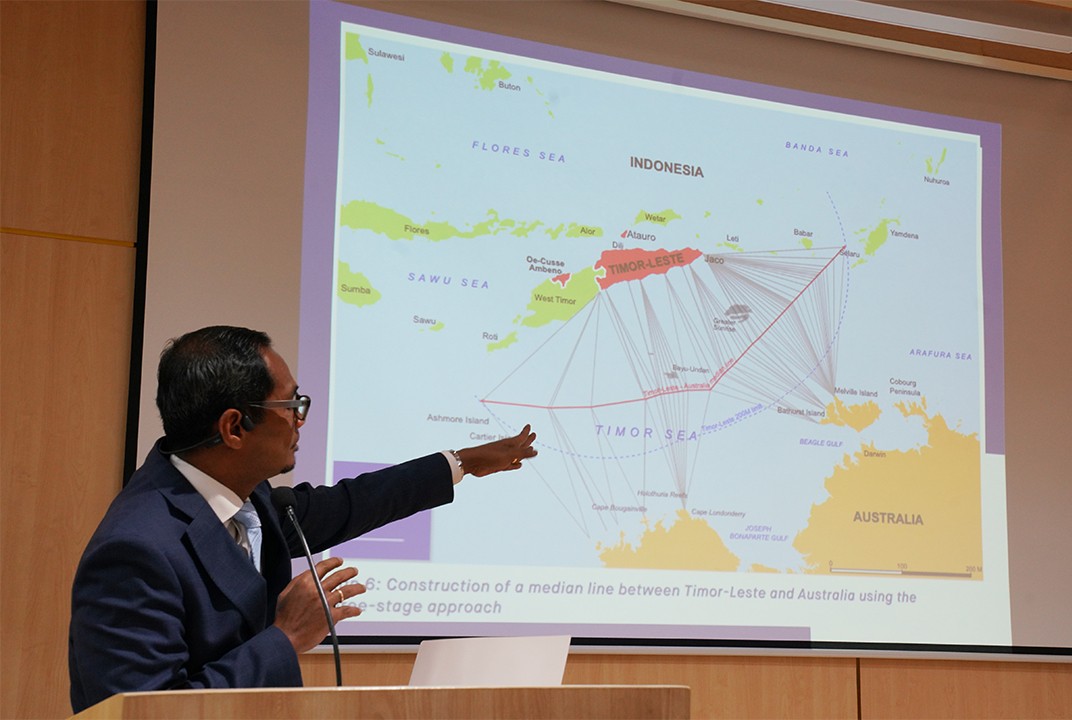
Timor-Leste’s landmark use of compulsory conciliation under the UN Convention on the Law of the Sea (UNCLOS) offers Cambodia valuable lessons as it embarks on the same legal process with Thailand, with speakers stressing that international law can reopen stalled negotiations, but success ultimately depends on confidence-building, political will and sustained dialogue. Speaking at a public lecture hosted by the Cambodian Center for Regional Studies (CCRS) at Cam-ASEAN International School today, July 3, Timor-Leste ambassador to Cambodia, Marcos dos Reis da Costa, shared his country’s experience as the first nation to invoke compulsory conciliation under UNCLOS to settle a maritime boundary dispute with Australia. The lecture came just weeks after Cambodia formally initiated compulsory conciliation proceedings with Thailand over their overlapping maritime claims in the Gulf of Thailand, making Cambodia only the second country to use the rarely invoked UNCLOS mechanism. Opening the event, CCRS distinguished senior advisor Pou Sothirak said Timor-Leste’s experience could serve as a practical reference as Cambodia seeks a peaceful resolution to its maritime dispute with Thailand while maintaining separate bilateral mechanisms for land border issues. “It was regarded as a breakthrough diplomatic mechanism which was used to resolve the intractable deadlock over maritime boundary,” he noted. Sothirak explained that Cambodia’s decision to pursue compulsory conciliation followed Thailand’s termination of the 2001 Memorandum of Understanding governing maritime negotiations, arguing that the UNCLOS mechanism had effectively reopened a diplomatic channel. “After the MoU closed, there’s no way, no channel,” he said, during his closing remarks. “Cambodia has done a great job, in my opinion, to engage this process. Cambodia has reopened the negotiation path,” he added. Marcos recounted how Timor-Leste initiated compulsory conciliation against Australia in April 2016 after years of unsuccessful bilateral negotiations over maritime boundaries. “It was a very bold move from a small nation like Timor-Leste against a giant nation like Australia,” he said. “It is not about winning or losing, but we had to try because we believe in international law,” he added. The process, which lasted from 2016 to 2018, culminated in the signing of a landmark maritime boundary treaty in New York, establishing a permanent maritime boundary and a new revenue-sharing arrangement for the Greater Sunrise gas field. Marcos said one of the biggest milestones came early in the proceedings when the conciliation commission ruled that it had jurisdiction despite Australia’s objections, compelling Canberra to negotiate. “For us it was already good enough to see that Australia could now sit with us to negotiate and discuss the maritime boundary,” he said. Throughout the lecture, Marcos repeatedly emphasised that compulsory conciliation should not be viewed as litigation but as a structured diplomatic process designed to facilitate dialogue. “This is a process that brings states to the table, to have dialogue,” he said. “We just would like to know under international law what are our rights, and that’s it,” he continued. Rather than focusing solely on legal arguments, Marcos highlighted confidence-building as the decisive factor behind Timor-Leste’s eventual success. He said both governments deliberately maintained confidentiality during negotiations, avoided inflammatory public rhetoric and ensured that broader bilateral cooperation continued despite the dispute. “We like megaphone diplomacy,” he said, with a smile. “But we also learned during this period that we had to restrain ourselves,” he noted. He explained that negotiations remained confidential until both parties agreed on what information could be released publicly. “What we agreed, we told each other. What we didn’t agree, that stayed between us,” Marcos said. He added that Timor-Leste continued engaging with Australia across other areas throughout the conciliation process. “We negotiated government-to-government. All cooperation with Australia continued. There was no problem at all,” he said. Reflecting on Timor-Leste’s broader diplomatic strategy, Marcos said his country drew heavily on lessons from its struggle for independence. “We fought against the regime in Indonesia. We did not fight against the Indonesian people,” he said. “It makes the difference,” he added. He said Timor-Leste also invested heavily in public diplomacy by engaging universities, civil society, overseas communities and international supporters while ensuring the government remained the primary source of official information. Asked how Timor-Leste prevented sovereignty issues from becoming politically divisive, Marcos said maritime boundaries had been treated as a national rather than partisan issue. “In Timor-Leste, the issue of sovereignty and borders is a national issue. It’s not a partisan issue,” he said. “All political parties, whether in government or opposition, have the same stance when it comes to our sovereignty,” he noted. He added that regular briefings to parliament, transparent public communication and public education helped reduce opportunities for political exploitation and misinformation. “We try to counter misinformation with facts and official statements,” he said. “When people see that the government is working hard and following the right legal procedures, they are less likely to be swayed by misinformation,” he added. During the discussion, participants also asked about the role of youth in safeguarding sovereignty. Marcos said Timor-Leste’s younger generation had become active participants in public discussions on maritime boundaries. “They understand that the future of our country depends on our resources and our sovereignty,” he explained, adding “They are not just passive observers; they are active participants in the national dialogue”. Summarising the day’s discussions, Sothirak identified six major lessons from Timor-Leste’s experience, describing compulsory conciliation as an important diplomatic process rather than a courtroom proceeding. “Compulsory conciliation is not a court but a process,” he said. He stressed that the mechanism allows disputing parties to resume negotiations, supported by impartial conciliators, even though the commission’s recommendations themselves are not legally binding. “International law is a great equaliser,” Sothirak said. “Small states have the same rights as big states,” he added. He also underlined the importance of confidence-building measures, saying they create the conditions necessary for preventive diplomacy and eventual conflict resolution. “Without confidence-building measures from the start, you will never have anything else,” he said. Looking ahead, Sothirak welcomed Thailand’s decision to participate in Cambodia’s compulsory conciliation proceedings and expressed h

多角的分析

経済的影響

カンボジアがタイとの海洋境界紛争解決にUNCLOSの強制調停を用いることは、潜在的な資源(特に石油・天然ガス)の共同開発や、それら資源からの収益分配に関する長期的な経済的安定に寄与する可能性がある。紛争が長期化・悪化すれば、投資家の信頼を損ない、開発プロジェクトの遅延や中止につながりかねない。東ティモールの事例のように、紛争解決が実現すれば、関係海域における経済活動の活性化や、新たな投資機会の創出が期待できる。

投資家心理

海洋境界の確定は、特に石油・天然ガスなどの資源開発に関心を持つ投資家にとって、不確実性を低減させる重要な要素である。カンボジアがUNCLOS調停プロセスを通じてタイとの紛争を平和的に解決できれば、関係海域における資源開発プロジェクトへの投資リスクが軽減され、より多くの国内外からの投資を呼び込むことが可能になる。逆に、調停が失敗し紛争が泥沼化すれば、投資家はリスク回避のためにカンボジア沖での開発から撤退する可能性もある。

社会的影響

海洋境界紛争の解決は、沿岸コミュニティの漁業権や生計に直接的な影響を与える。東ティモールの事例のように、調停プロセスが紛争当事者間の対話を促進し、信頼醸成につながれば、関係海域の持続可能な資源管理や、漁業資源の公平な分配に関する合意形成が進む可能性がある。しかし、調停プロセスが不透明であったり、結果が一部のコミュニティに不利益をもたらしたりする場合、社会的な不満や摩擦が生じるリスクも排除できない。

市民の声

カンボジア市民にとって、海洋境界の確定は国家主権の維持と、将来的な資源開発による経済的恩恵への期待と結びついている。東ティモールの事例で大使が強調したように、調停プロセスが透明性を保ち、国民への情報提供が適切に行われれば、政府への信頼は維持される。しかし、もし紛争解決が遅延したり、交渉内容が国民に十分に理解されなかったりする場合、SNSなどを通じて誤情報が拡散し、国民の不安や不満が増大する可能性がある。特に若年層は、将来の国益に関わる問題として、より積極的な情報開示を求めるだろう。

背景・歴史的文脈

カンボジアとタイは、タイ湾における広範な海洋境界線について、長年にわたり重複する主張を抱えてきた。これらの主張は、石油・天然ガスなどの海底資源の潜在的な存在を巡り、特に複雑化してきた。過去には、二国間交渉や協力協定(MOU)を通じて解決が試みられてきたが、進展は限定的だった。2001年のMOU失効後、交渉チャネルが閉ざされた状況で、カンボジアはUNCLOS第15部に基づく強制調停という、比較的使用頻度の低い法的手段に訴えることを選択した。これは、国際法を紛争解決の新たな道筋として活用しようとする試みであり、東ティモールがオーストラリアとの紛争で成功した先例が、カンボジアにインスピレーションを与えたと考えられる。

原文ソース

Phnom Penh Post

原文を読む
Cambodia Begins Maritime Conciliation with Thailand, Drawing Lessons from Timor-Leste | NEWS-BRAIN