General articles are free for 24 hours after publish.
Kyrgyzstan Stages National Showcase Merging Nomadic Culture and International Influence
Kyrgyzstan hosted both the World Nomad Games and the SCO summit in the same week, showcasing its nomadic culture internationally while enhancing its geopolitical standing. The capital, Bishkek, saw strict security measures, while a large-scale cultural festival unfolded in the suburbs, attracting significant domestic and international crowds.
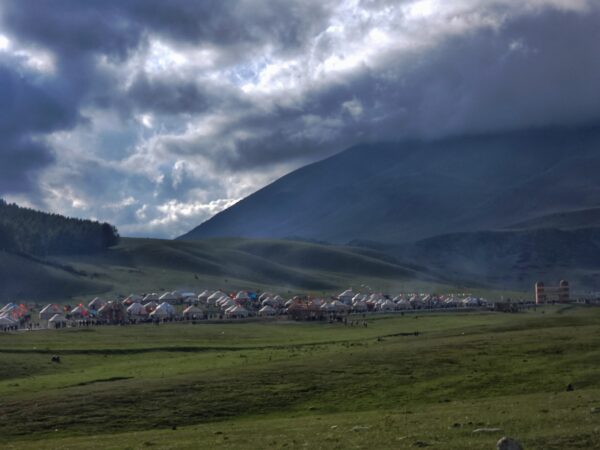
In early September, Kyrgyzstan hosted the World Nomad Games for the first time in eight years, and in the same week, the Shanghai Cooperation Organization (SCO) summit was held in the capital, Bishkek. These two major events served as a carefully choreographed opportunity to present Kyrgyzstan's national pride and nomadic culture to the international community. For the SCO summit, strict security measures were implemented in Bishkek. Main roads were sealed off for motorcades, and shopping centers along the routes were closed. Residents were advised to leave the city early, and numerous traffic restrictions were imposed, resulting in a deserted cityscape. In contrast, the Kyrchyn Gorge, a few hours east of the capital, was vibrant, with yurts covering the vast meadows and structures mimicking ancient Silk Road era fortresses being erected. According to organizers, 150,000 people visited on the first day, filling the area with excitement. Eight years ago, when the World Nomad Games were last held by Issyk-Kul Lake, similar restrictions and the event's focus were centered there. This time, however, the opening ceremony took place at the newly built Bishkek Arena, a 51,000-seat stadium, attended by leaders such as Russian President Putin, Chinese leader Xi Jinping, Indian Prime Minister Modi, and Turkish President Erdogan. At the opening, Kyrgyz President Sadyr Japarov stated, "Our foundation is independence, and our roots are in nomadic civilization. Our course is international friendship and partnership, and our future lies in building a developed, strong new Kyrgyzstan." He also announced that the next games would be hosted by Kazan, in Russia's Tatarstan, in 2028. The sports program for the games has nearly doubled since 2016, now featuring 43 disciplines. Women's participation has also increased, with 45 female athletes from 32 countries competing in horseback archery. However, beneath the surface-level progress of increased female participation, challenges remain. The Kyrgyz women's horseback archery team was assembled in just two weeks, and the coach was responsible for both men's and women's teams. The female athletes, despite facing issues such as equestrian sports still being largely male-dominated, insufficient preparation time, and being instructed to give up their horses to other riders just before their competition, strived to deliver strong performances. "We ride no worse. We shoot no worse. Sometimes better," said Aidana Usenbekova, 28, one of three Kyrgyz women on the horseback archery team. "All the horse sports are still seen as men’s sports. For the few girls who even get seen and make the national team, it’s twice as hard. We’re still fighting the stereotypes here. We didn’t even have time to prepare properly. We still put in a strong performance." Right before the start of the competition, their mounts were handed to other riders. "They told us those girls were guests, and we had to take whatever horses were left." Usenbekova cried, then and there, out of sheer frustration at the perceived insult. "That’s the attitude toward women in this sport. It’s contempt. It happened right before we went out. We all walked into the competition like that." The games needed the female archers. They look good in the frame: a woman on a horse, a bow, the mountains behind. On September 6, at the hippodrome in Cholpon-Ata, Kyrgyzstan beat Kazakhstan 12-0 in Kok Boru, then 7-2 in Kokpar the same day—the two games are similar, but the former is Kyrgyzstan’s traditional version and the latter Kazakhstan’s. The stands roared. This was the spectacle that organizers wanted. This event served not just as a festival of nomadic culture but as a national showcase for Kyrgyzstan to project its identity and influence on the international stage. The participation of top leaders from major countries at the SCO summit suggests Kyrgyzstan's intent to strengthen its role as a geopolitical linchpin in Central Asia. Source: The Diplomat Indonesia
Original source
The Diplomat Indonesia