General articles are free for 24 hours after publish.
Cambodia Proposes "Compulsory Conciliation" to Resolve Disputes with Thailand
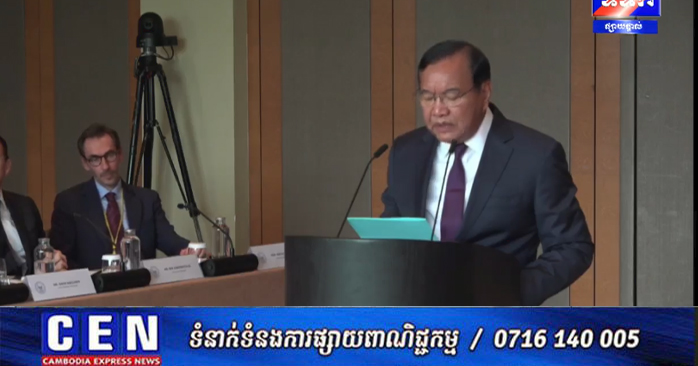
Cambodian Deputy Prime Minister Prak Sokhonn announced the initiation of "compulsory conciliation" proceedings under the UN Convention on the Law of the Sea (UNCLOS) to resolve maritime border disputes with Thailand. This move aims to foster mutual trust and contribute to regional peace and stability.
Deputy Prime Minister and Minister of Foreign Affairs and International Cooperation, Prak Sokhonn, announced the initiation of "compulsory conciliation" proceedings under the UN Convention on the Law of the Sea (UNCLOS) during the first meeting of the Conciliation Commission held in Singapore on September 15, 2026. This decision reflects the Cambodian government's commitment to seeking peaceful and lawful solutions in accordance with international law. Deputy Prime Minister Prak Sokhonn emphasized Cambodia's pursuit of a just and sustainable solution in line with international law, quoting a special statement by Prime Minister Hun Manet on June 2, 2026. He stated that a peaceful resolution would bring mutual benefits to both countries and contribute to regional peace and stability. The solution is expected to protect sovereignty, strengthen trust, facilitate the exploitation of energy resources, support development, and create new employment opportunities for present and future generations. Cambodia views this conciliation process as a means to restore trust, not to escalate tensions. It calls on Thailand to participate in the conciliation with a constructive spirit and to effectively improve existing bilateral agreements, including the Joint Statement of December 27, 2025. This is expected to facilitate the return of over 20,000 displaced persons to their homes, preserve important cultural sites damaged during clashes, and pave the way for the normalization of bilateral relations. Such efforts are considered crucial for reducing tensions and rebuilding trust. Cambodia's primary objective in the conciliation process is to achieve a solution that benefits the people of both nations and contributes to regional peace, cooperation, and shared prosperity. To this end, Cambodia intends to conclude a treaty with Thailand, with the support of the Commission and in accordance with international law, to establish a single, comprehensive maritime boundary between the two countries. Alternatively, Cambodia is prepared to enter into an agreement with Thailand for joint development and equitable sharing of resources between the two states while awaiting a final agreement on the maritime boundary. Should a final agreement on both the maritime boundary and joint development prove unattainable, Cambodia requests the Commission to prepare a report with recommendations for both parties to use as a basis for future negotiations, in accordance with their obligations under UNCLOS. Cambodia's deep-rooted experience has instilled a strong respect for international law, peaceful dispute resolution, and institutions that promote these principles. The pursuit of solutions through the International Court of Justice (ICJ) reflects confidence in international institutions as mechanisms for peacefully resolving complex interstate disputes in accordance with international law. This experience demonstrates that critical national issues can be resolved peacefully and multilaterally, rather than through the use of force, and that the international framework can provide a solid and lasting foundation for neighboring states to resolve their conflicts. Cambodia's commitment in this regard defines its approach to maintaining relations with the Kingdom of Thailand, which have been through difficult times. Cambodia hopes that the Conciliation Commission can help both parties open a new chapter for their mutual benefit. Cambodia has been encouraged by the successful conciliation of the Timor Sea issue between the Democratic Republic of Timor-Leste and Australia, which showed that compulsory conciliation under UNCLOS can resolve long-standing impasses between neighboring countries and lead to definitive treaty-based solutions. Cambodia is confident that the Conciliation Commission, with its distinguished composition, is capable of assisting Cambodia and Thailand in achieving similar outcomes that bring peace, stability, and shared prosperity to the region. Source: CEN Cambodia
Original source
CEN Cambodia