General articles are free for 24 hours after publish.
HCMC Doctors Brave Rough Seas to Rescue Russian Crew Member Suspected of Stroke
A medical team from Ho Chi Minh City braved rough seas to rescue a Russian crew member aboard a container ship. The team successfully transferred the patient, suspected of a stroke, from the vessel to the hospital for treatment, leading to his stable recovery and return home.
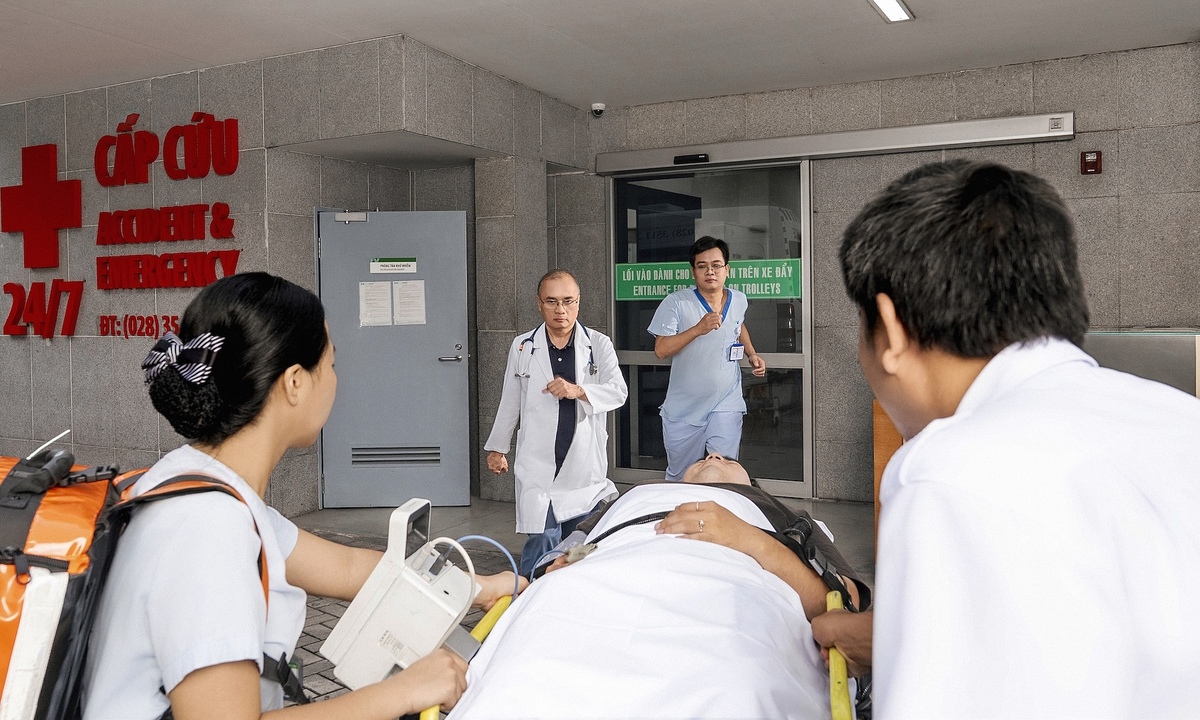
FV Hospital's medical team travelled more than 40 nautical miles at night, climbed a rope ladder onto the ship amid rough seas, and coordinated with other forces to safely transfer the patient to the hospital for successful treatment. The hospital announced on Aug. 4 that after nearly two weeks of treatment and rehabilitation, the patient, 46-year-old man Vakhitov Rena, had been discharged in stable condition. In mid-July, the hospital's Emergency and Trauma Department received an urgent call from a maritime agency. Initial information indicated that a Russian crew member aboard a container ship traveling on an international maritime route had suddenly developed weakness and paralysis on one side of his body, suspected of suffering a stroke. Late that night, an ambulance carrying an emergency medical team, including a doctor and a male nurse, departed from Ho Chi Minh City for Cau Da Port in Vung Tau, equipped with emergency medicines and life-saving medical supplies. From the port, the pair boarded a speedboat arranged by the shipping agent for the more than 40-nautical-mile trip to Buoy No. 0, the boundary between Vietnamese waters and the international shipping lane, where the container ship had agreed to meet them. Battling waves of up to 2-3 meters, the medical team reached the vessel to evacuate the patient and transport him safely back to shore. It was not until around 2 a.m. that the speedboat was able to come alongside the container ship. With no fixed gangway, the crew lowered a rope ladder from a height of about 10 meters. Timing their ascent with the swell as it lifted the speedboat, the doctor and nurse climbed aboard one after the other. After examining the patient, they found he remained conscious but needed to be brought ashore as quickly as possible for further treatment. The next challenge was transferring the patient from the ship's fifth deck to the speedboat. With no specialized evacuation system, the crew and medical team carried the stretcher down deck by deck before securing it and lowering it with the ship's crane. The stretcher had to be lowered into a space little more than one meter wide on the speedboat while the ship, crane and boat all pitched continuously in rough seas. To avoid collisions, the crew repeatedly tested the crane with the empty stretcher before lowering the patient. The operation alone took about 30 minutes. At around 5 a.m., the speedboat reached Cau Da Port, where the patient was immediately transferred to an ambulance for the roughly 100-kilometer journey to the hospital. He arrived at about 7 a.m. and was taken straight to the emergency department. A CT scan confirmed a haemorrhage in the patient's right basal ganglia, with an intracerebral hematoma of approximately 30 grams. Dr. Tran Luong Anh, Head of the Department of Neurosurgery and Spine Surgery, said the case was on the borderline between conservative management and surgical intervention. The medical team therefore prioritized blood pressure control, treatment to reduce cerebral oedema, close monitoring and multidisciplinary consultations before determining whether and when surgery would be necessary. Three days later, as the patient's headaches worsened and paralysis continued to progress, doctors decided to perform surgery to remove the hematoma. The operation lasted about 90 minutes. After surgery, the patient remained conscious, his leg movement began to recover, and he was able to grip objects with his hand after just one day. By the third day, he could independently hold light objects. After nearly two weeks of treatment and rehabilitation, the patient was discharged on July 30 and returned to Russia in stable condition. "While my life was hanging in the balance at sea, I was fortunate that the doctors crossed the sea to reach my vessel and bring me ashore for treatment. I am deeply grateful to the medical team for braving the hardships to save my life," the patient said.
Original source
VnExpress International