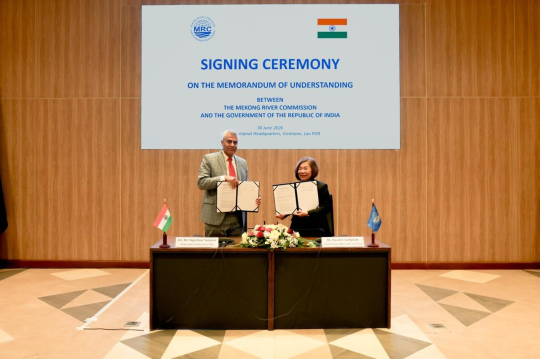
Lao PDR, India Ink Partnership to Bolster Water Security and Climate Resilience
The Mekong River Commission (MRC), based in Lao PDR, and India have signed a five-year cooperation agreement to enhance water resource management and climate change adaptation. This partnership aims to foster sustainable development and climate resilience in the region.
The Mekong River Commission (MRC), headquartered in Lao PDR, has signed a five-year partnership agreement with India aimed at strengthening water security and climate resilience. This collaboration is designed to address the growing climate risks, frequent floods and droughts, increasing energy demand, and mounting pressure on water resources faced by the Mekong region, providing a framework for practical solutions that support sustainable and inclusive development. Mr Yogeshwar Sangwan, Ambassador of India to Lao PDR, stated that the agreement reflects India’s commitment to deepening cooperation with the Mekong region through practical and mutually beneficial partnerships. “India and the Mekong countries share strong historical and cultural connections through the Mekong-Ganga relationship. Today’s MoU builds on that foundation and looks to the future, where cooperation on water, climate resilience, technology and sustainable development is more important than ever,” Ambassador Sangwan said. “India is pleased to work with the MRC to share experience, support capacity building, and explore solutions that respond to the real needs of the region.” The MoU identifies several areas of cooperation, including water resources development and management, technological applications related to water, climate change and disaster risk management, flood and drought mitigation, flood forecasting and early warning systems, clean energy technology, technical training, institutional cooperation, and community support. Ms Busadee Santipitaks, Chief Executive Officer of the MRC Secretariat, remarked, “The Mekong and the Ganga are different rivers, but the challenges we face are deeply connected, such as climate uncertainty, flood and drought risks, the need for reliable data, and the responsibility to manage water in a way that supports both people and ecosystems. This MoU gives us a practical framework to learn from each other, exchange technical knowledge, and turn cooperation into concrete activities that can strengthen water security and resilience in the Mekong region.” She added that India’s experience in river basin management, disaster risk reduction, digital technology, and clean energy offers valuable opportunities for knowledge exchange. The agreement also supports broader efforts to strengthen Mekong-Ganga cooperation and promote sustainable and inclusive economic growth in line with the Sustainable Development Goals. It recognizes the value of collaboration, technical exchange, and joint activities in areas of shared interest between the MRC and India.
多角的分析
ラオス経済は水力発電、農業、観光に大きく依存しており、これらはすべて水資源の安定供給と気候変動の影響に左右されます。インドとの水資源管理と気候変動への対応に関する連携は、これらの基幹産業の持続可能性を高める上で重要です。特に、洪水・干ばつ緩和や早期警報システムは、農業生産の安定化に貢献し、食料安全保障と経済的損失の軽減につながる可能性があります。また、クリーンエネルギー技術の協力は、ラオスがエネルギー輸出に依存する構造から脱却し、国内のエネルギーミックスを多様化する一助となるかもしれません。しかし、これらの技術移転やインフラ開発には多額の投資が必要であり、ラオスの財政状況を考慮すると、その実現可能性は慎重に評価されるべきです。
投資家にとって、この連携はラオスにおける水関連インフラ、再生可能エネルギー、および気候変動適応策への投資機会を示唆しています。インドの専門知識と技術支援は、プロジェクトのリスクを低減し、投資収益率を高める可能性があります。特に、メコン川流域の持続可能な開発は、長期的な視点を持つ投資家にとって魅力的であり、ESG(環境・社会・ガバナンス)投資の観点からも関心を集めるでしょう。ただし、ラオスの一党体制下での法制度の透明性や、中国への経済的依存度といった政治的リスクは、依然として投資判断における重要な考慮事項となります。
ラオス市民、特に農村部やメコン川沿岸のコミュニティは、気候変動による洪水や干ばつの影響を直接受けやすい立場にあります。今回のインドとの連携による洪水予測・早期警報システムの強化や、水資源管理の改善は、彼らの生活の安定に直接貢献する可能性があります。また、持続可能な水資源管理は、漁業資源の保全や農業用水の確保につながり、地域住民の生計維持に不可欠です。しかし、これらの取り組みが地域社会のニーズをどれだけ反映し、恩恵が公平に分配されるかは、実施段階での透明性と住民参加にかかっています。ラオス政府が、これらの技術や知識をどのように地域社会へ浸透させ、適応能力を高めるかが問われます。
今回のMRCとインドの連携は、ラオス国民、特にメコン川流域に暮らす人々の生活に、長期的には良い影響を与える可能性があります。頻発する洪水や干ばつは、農業に依存する多くの人々の生計を脅かしており、これらの災害への対応能力が向上することは、食料の安定供給や収入の確保に繋がります。また、水資源の持続可能な管理は、将来世代の水利用の安定にも寄与するでしょう。しかし、この連携の成果が、実際に地方の農民や漁師といった一般市民の手に届くかどうかは、政府の実施能力と透明性に大きく依存します。ラオスは、経済発展のために外国からの支援を必要としていますが、その恩恵が国民全体に行き渡ることが重要です。
背景・歴史的文脈
ラオスはメコン川流域に位置し、水資源の管理は国家の経済と国民生活の根幹をなしています。近年、気候変動による異常気象(洪水、干ばつ)が頻発し、農業生産や水力発電に深刻な影響を与えています。ラオスは一党体制下で、経済発展のために水力発電開発を推進しており、近隣諸国、特に中国やベトナムとの間で水資源に関する協力や摩擦が生じています。今回のインドとの連携は、ラオスがメコン川流域における水資源管理と気候変動適応において、中国・ベトナムへの依存度を軽減し、新たなパートナーシップを模索する動きと捉えられます。インドは、メコン・ガンジス川協力(MGC)を通じて、東南アジア諸国との関係強化を図っており、今回の合意は、その一環として、ラオスにおける影響力拡大を目指すものです。
原文ソース
KPL Laos News