Cambodia's 2026 Growth Forecast Cut to 2.5%; Stimulus and Tourism Revival Crucial
Economy
2026年7月2日
4
Cambodia Investment Review
Relations
🇰🇭Cambodia🇨🇳China

Cambodia's 2026 Growth Forecast Cut to 2.5%; Stimulus and Tourism Revival Crucial

AI サマリー

Cambodia's economic growth in 2026 is projected to be one of the weakest in nearly two decades, with forecasts cut to 2.5%. Government stimulus and a tourism revival are identified as crucial factors to avert a prolonged slowdown.

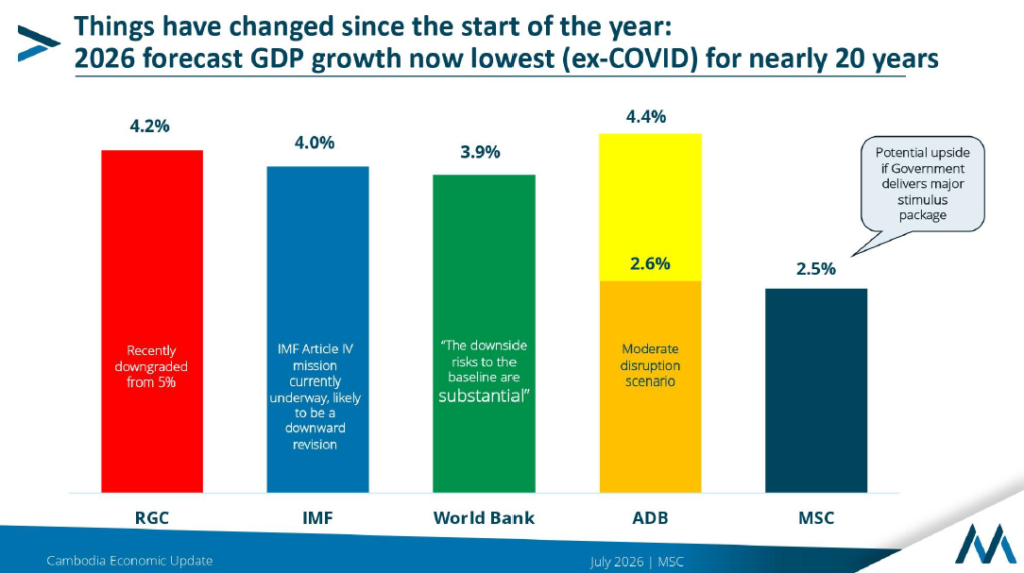
Cambodia's economic performance in 2026 may ultimately depend on whether the government can deliver meaningful fiscal stimulus and revive a struggling tourism sector, according to economist Stephen Higgins of Mekong Strategic Capital (MSC), who warned the Kingdom is on track for one of its weakest periods of economic growth in nearly two decades outside the COVID-19 pandemic. Presenting Mekong Strategic Capital’s latest economic outlook during the International Business Chamber (IBC) Open Meeting, Higgins lowered his 2026 GDP growth forecast to 2.5%, down from the firm’s earlier projection of around 4% made at the beginning of the year. He attributed the downgrade to a combination of geopolitical tensions, the Gulf conflict, the Thai border dispute, the ongoing crackdown on scam centres, a prolonged tourism downturn and continued weakness in Cambodia’s property market. While the near-term outlook has deteriorated, Higgins stressed that the economy’s trajectory is not set in stone, arguing that decisive policy action could still improve growth over the remainder of the year. Government Policy Could Shape the Second Half Higgins said the government’s response over the coming months could play a significant role in determining whether Cambodia avoids a prolonged slowdown. He pointed to the potential for a sizeable fiscal stimulus package to support domestic demand and business activity, while also calling for greater investment in tourism promotion to address one of the country’s weakest-performing sectors. “The potential upside exists if the Government delivers a major stimulus package,” Higgins said, noting that Cambodia’s tourism industry requires urgent attention after several years of underperformance. His presentation also highlighted that Cambodia’s economy has not experienced a “normal” year since 2019, having absorbed successive shocks from the pandemic, weakness in the property market, the dismantling of scam centres and more recently geopolitical tensions affecting regional trade and travel. Manufacturing Continues to Drive Growth Despite the weaker headline forecast, Cambodia’s manufacturing sector continues to outperform expectations. Goods exports increased 19% during the first five months of 2026, supported by strong growth across garments, furniture, rubber, fruit exports and sporting goods. Exports to the United States rose 32%, while shipments to Vietnam, Japan, China and Europe also recorded solid gains. Higgins described exports as one of Cambodia’s biggest economic success stories this year, arguing that manufacturing has remained remarkably resilient despite concerns surrounding global trade uncertainty and higher tariffs. He noted that Cambodia’s export performance is currently comparable with neighbouring Vietnam, providing an important source of support for the broader economy even as domestic sectors remain under pressure. Tourism and Property Continue to Weigh on the Economy The strongest warning in Higgins’ presentation centred on tourism, which he described as being in a “code-red” situation. Visitor arrivals remain well below pre-pandemic levels, while Angkor ticket sales have continued to weaken. Higgins argued that the downturn began before the recent escalation of the Thailand border dispute, suggesting the sector faces deeper structural challenges rather than simply temporary geopolitical disruptions. He said greater international marketing and investment in tourism promotion will be critical if Cambodia hopes to regain market share as neighbouring destinations continue to outperform. At the same time, financial pressures continue to build across households and businesses. According to Higgins, approximately US$13.5 billion, or 21.7% of outstanding loans, are now either more than 30 days overdue or have been restructured. While he said Cambodia’s banking system remains well-capitalised and capable of absorbing losses, he warned that continued stress within the property market is likely to delay a broader economic recovery. Long-Term Growth Story Remains Intact Despite the challenging outlook for 2026, Higgins maintained that Cambodia’s long-term economic fundamentals remain strong. He argued that the country’s current slowdown reflects several temporary shocks occurring simultaneously rather than a deterioration in its underlying growth potential. Removing the effects of the Gulf conflict, tourism weakness, border tensions and the economic adjustment following the crackdown on scam centres, Higgins estimated Cambodia’s underlying growth rate could still approach 8%. While acknowledging that 2026 is shaping up to be one of Cambodia’s most difficult economic years in recent memory, Higgins concluded that the country’s long-term growth story remains intact. The challenge now, he said, is navigating the current period through targeted government support, restoring tourism competitiveness and allowing the economy’s stronger underlying fundamentals to re-emerge.

多角的分析

経済的影響

カンボジア経済は、2026年に約20年ぶりの低成長(2.5%)に直面する可能性が指摘されている。これは、パンデミック以降、不動産市場の低迷、詐欺センター取り締まり後の調整、地政学的リスク、そして特に観光業の長期的な不振といった複数のショックが同時に発生しているためである。製造業の輸出(特に米国向け)は堅調に推移しており、経済を支える重要な柱となっているが、国内需要を喚起する景気刺激策と、国際競争力を失いつつある観光業の回復が、下半期の経済動向を左右する鍵となる。巨額の不良債権(融資残高の21.7%)は、金融システムの安定性への懸念は少ないものの、不動産市場の回復を遅らせる要因となりうる。

投資家心理

投資家にとって、カンボジア経済の短期的な見通しには不透明感が漂う。2026年の成長率予測の大幅な下方修正は、リスク回避的なセンチメントを招く可能性がある。しかし、製造業の輸出競争力は依然として魅力的であり、特に米国市場へのアクセスは強みとなる。重要なのは、政府が具体的な景気刺激策と観光振興策を打ち出せるかどうかにかかっている。これらの政策が効果を発揮すれば、投資環境は改善する可能性がある。不動産市場の低迷は、関連産業への投資には慎重な姿勢を求める一方、不良債権の増加は、金融セクターへの影響を注視する必要がある。

社会的影響

カンボジア市民にとって、経済の減速は生活に直接的な影響を与える可能性がある。特に、観光業の低迷は、関連産業で働く多くの人々の雇用や収入を圧迫する。また、不動産市場のストレスは、住宅ローンを抱える家計や、不動産関連ビジネスに携わる人々に不安をもたらす。政府による景気刺激策が、国内需要をどの程度支え、雇用を創出できるかが、市民生活の安定にとって重要となる。一方で、製造業の輸出堅調は、雇用維持に貢献する可能性があり、国民経済の基盤を支える。

市民の声

カンボジア市民は、経済の先行きに対する不安を感じている。特に、観光業の低迷は、土産物店やレストラン、ホテルなどで働く人々の生計に直接影響を及ぼしている。また、不動産市場の停滞は、住宅購入を検討している人々や、不動産関連の仕事に携わる人々の希望を削いでいる。政府が打ち出す景気刺激策や観光振興策が、どれだけ早く、そして効果的に市民の生活を支えるかが問われている。製造業の輸出が堅調であることは、一部の国民にとっては希望の光であるが、経済全体の停滞感は否めない。

背景・歴史的文脈

カンボジア経済は、2010年代以降、建設業と観光業を中心に高い成長を遂げてきた。特に、中国からの投資と観光客の増加が経済成長を牽引してきた。しかし、2019年以降、COVID-19パンデミックによる観光業への壊滅的な打撃、それに続く不動産市場の調整、そして近年では大規模なオンライン詐欺センターの取り締まりによる経済活動への影響、さらには地域的な地政学リスクの高まりなど、複合的な要因が経済に影を落としている。今回の成長率下方修正は、これらの短期的なショックが、カンボジア経済の潜在的な脆弱性を露呈させた形と言える。

原文ソース

Cambodia Investment Review

原文を読む