General articles are free for 24 hours after publish.
US Military Uniform at Vietnam's Independence Exhibition: A Symbol of Complex Early Diplomacy
A US soldier's uniform displayed at the Vietnam Military History Museum sheds light on the complex diplomatic landscape of Vietnam in 1945, following its declaration of independence. The exhibit highlights the pragmatic approach taken, considering potential cooperation with the US amidst evolving geopolitical alliances.
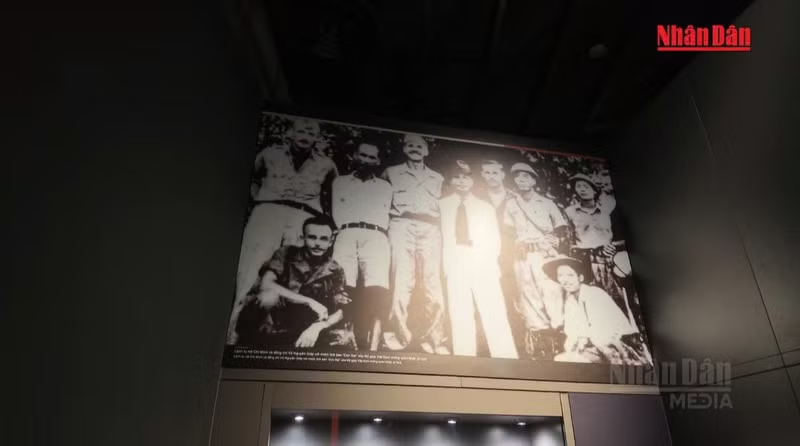
Within the exhibition space dedicated to the August Revolution and National Day on September 2nd at the Vietnam Military History Museum, there is an artifact that few people pay attention to: the military uniform of an American soldier. Why do Americans appear in the story of Vietnam's independence in 1945? The presence of this military uniform symbolizes the extremely complex and multi-layered diplomatic situation immediately after Vietnam declared its independence. At that time, the Democratic Republic of Vietnam (now the Socialist Republic of Vietnam) was seeking to establish relationships with various countries to gain international recognition and solidify its position on the world stage. Among these was the United States of America, which was increasing its influence in the Asia-Pacific region following the end of World War II. When President Ho Chi Minh read the Declaration of Independence on September 2, 1945, Vietnam had not yet received international recognition and its foundation as a nation was fragile. During this period, while Vietnam sought cooperation with the Soviet Union, it also considered improving relations with the United States. This is thought to be the result of pursuing realistic options for the nation's survival and development within the geopolitical maneuvering that preceded the formation of the Cold War structure. This US soldier's uniform carries more meaning than just being a historical relic. It suggests a facet of the shrewd diplomatic strategy employed by early independent Vietnam, striving to forge its own path amidst the power balance of great nations. The Vietnamese leadership at the time was exploring all possibilities, transcending ideological divides, to protect the nation's independence and sovereignty. This exhibit offers important insights into understanding the complexity of Vietnam's diplomatic history and its historical context.
Original source
Nhan Dan