General articles are free for 24 hours after publish.
Philippine, Brunei High Courts Forge Judicial Training Partnership
The Supreme Courts of the Philippines and Brunei have signed a memorandum of understanding to enhance judicial training collaboration, addressing emerging legal issues like AI, cybercrime, and climate-related disputes. The partnership aims to strengthen judicial systems through expertise exchange and joint training programs.
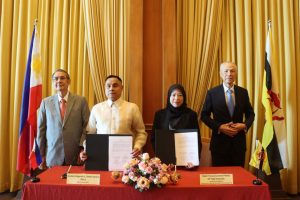
THE Supreme Courts (SC) of the Philippines and Brunei have partnered in pursuit of a stronger judicial training as emerging legal issues, such as artificial intelligence (AI), cybercrime, trafficking and climate-related disputes, require greater cross-border collaboration. Chief Justice Alexander G. Gesmundo said the rapid pace of change requires judges and court personnel to engage in continuous learning and greater collaboration across jurisdictions, the SC said in a statement on Monday. “Our courts today operate in an increasingly interconnected world. Legal disputes and criminal activities no longer remain neatly within territorial boundaries,” Mr. Gesmundo said during the signing of a memorandum of understanding (MoU) with the Supreme Court of Brunei Darussalam in Brunei on Sunday. “Technological advances have transformed the way evidence is created, preserved, and presented. Environmental and climate concerns increasingly find their way into courtrooms,” he said. AI, he added, is reshaping institutions and raising “profound questions” about fairness, accountability and the ethical exercise of judicial authority. The MoU designates the Philippine Judicial Academy and Brunei’s Judicial Education and Training Unit as implementing institutions. The two judiciaries will exchange expertise and best practices in judicial education and hold workshops, seminars, conferences, study visits and other capacity-building programs. They will also develop and share publications, research, bench books, training modules, and other educational materials. The two courts identified the study of Shari’ah, trafficking in persons, cybercrime and electronic evidence, and climate justice and environmental adjudication as areas for cooperation. Brunei Chief Justice Dato Seri Paduka Steven Chong said judicial education should not be limited to individual judiciaries. “[The MoU] reflects a shared recognition that judicial education is not simply an internal matter for individual judiciaries,” he said. “It is an endeavor in which we can learn from one another, benefit from one another’s experience, and work together to strengthen the administration of justice.” — Mark Joseph M. Sanchez
Original source
BusinessWorld Nation