General articles are free for 24 hours after publish.
Myanmar-Russia joint military drills signal need for resistance forces to stay alert, analysts warn
A joint military exercise between the Myanmar and Russia armies has underscored the need for resistance forces to adapt to evolving battlefield tactics and emerging weapons technologies, political and military analysts s
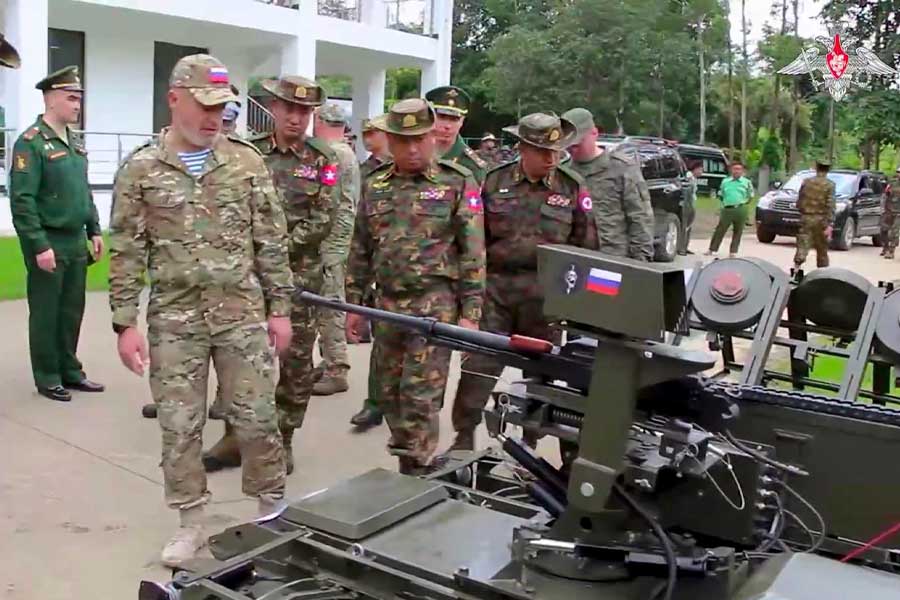
A joint military exercise between the Myanmar and Russia armies has underscored the need for resistance forces to adapt to evolving battlefield tactics and emerging weapons technologies, political and military analysts said. The exercise, held in Naypyidaw from July 6 to 17, focused on counterterrorism operations, anti-drone warfare and tactical raids in tropical environments. Analysts said the drills indicate the junta is preparing for the changing nature of future warfare and cautioned resistance forces against underestimating their significance. Russian-made advanced weapon systems and drones were also showcased during the exercise. Captain Zin Yaw, a former junta officer who joined the Civil Disobedience Movement (CDM)—the anti-coup campaign in which civil servants and members of the security forces refuse to serve the military regime—said resistance groups should develop countermeasures to respond to the junta's growing access to advanced military technology. "The capabilities they are displaying now won't necessarily be deployed on the battlefield overnight. I see this as preparation for future warfare. But resistance forces should not underestimate these developments. In the early days of the revolution, resistance groups gained the upper hand with drone technology and inflicted heavy losses on the junta. The military then adapted, expanded its own drone capabilities and established dedicated drone units," Captain Zin Yaw told DMG. He said the junta has also recently unveiled Unmanned Ground Vehicles (UGVs), but they have yet to be widely deployed in combat and appear intended mainly for ceremonial displays and security operations in Naypyidaw. "As the junta continues expanding its technological capabilities, resistance forces also need to gain access to more advanced technologies, including those developed by Ukraine, Russia's battlefield rival," he added. Analysts also said resistance forces should closely monitor the latest military exercise, which they believe involved more advanced training than previous joint engagements between Myanmar and Russia. The exercise reportedly involved at least 24 Russian military personnel. On the Myanmar side, Chief of Military Training Lt-Gen Pyae Sone Lin personally attended the drills, alongside troops from multiple military units. Although the junta continues to face shortages of weapons and ammunition amid the country's protracted armed conflicts, political and military analysts warned that resistance forces should remain vigilant, as the military could seek to acquire additional Russian-made equipment to strengthen its combat capabilities. DMG Editor-in-Chief and political analyst U Aung Min Oo said the junta still faces significant gaps in military technology and weaponry. "The junta still has major shortcomings in both military technology and weapon systems. It could begin using UGVs for reconnaissance missions inside territories controlled by ethnic armed organizations (EAOs). Based on the intelligence they gather, the military could then carry out follow-up airstrikes," he said. He also noted that the fighter jets currently used by the junta to conduct airstrikes are Russian-made, and predicted that the regime could deploy even more advanced Russian weapon systems in future offensives. "We need to closely watch how the junta applies the combat tactics it is learning from Russia in future offensive operations. Those developments could create new challenges for resistance forces and EAOs. In particular, the junta may introduce new technologies and advanced weapons on the frontlines in Arakan (Rakhine) State, so resistance groups need to remain especially cautious," U Aung Min Oo said. Russia remains one of the junta's closest international partners and one of its strongest backers. It is also a key supplier of fighter aircraft, drone technology and other military hardware to the regime’s armed forces. Myanmar has been engulfed in nationwide armed conflict since the 2021 military coup. After losing control of more than 100 towns to resistance forces and ethnic armed organizations, the junta has recently launched counteroffensives in Sagaing, Mandalay and Tanintharyi regions, as well as Kayin and Chin states, with support from China, another major power that maintains close ties with the regime.
Original source
BNI (Burma News International)