General articles are free for 24 hours after publish.
Filipino Distrust Towards China Reaches Record High, Survey Shows
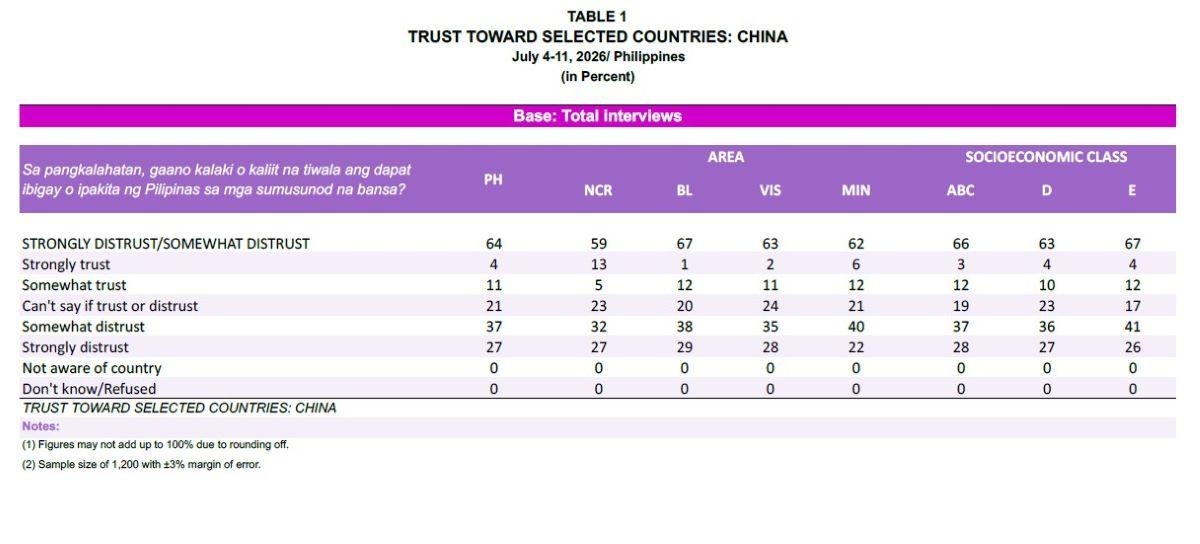
A recent OCTA Research survey reveals that 64% of Filipinos distrust China, a significant increase from 55% in March 2026. This heightened distrust is attributed to increased public attention on the West Philippine Sea developments.
The majority of Filipinos, or 64%, distrust China, according to the latest non-commissioned survey from OCTA Research. This figure represents an increase from the 55% recorded in March 2026. Of the 64% expressing distrust, 37% stated that the Philippines should "somewhat distrust" China, while 27% indicated they "strongly distrust" it. In contrast, only 14% of Filipinos expressed trust, and 21% remained undecided, according to OCTA Research's 2nd Quarter 2026 Tugon ng Masa survey. OCTA Research conducted the survey as the Philippines commemorated the 10th anniversary of the 2016 Permanent Court of Arbitration (PCA) ruling on the West Philippine Sea. "Trust toward China remained largely unchanged, declining only slightly to 14%, while the proportion of Filipinos who were undecided continued to fall. This suggests that more Filipinos are moving away from uncertainty and settling into a firmer—and increasingly distrustful—view of China," OCTA Research said. "The findings also suggest that Filipino public opinion is highly responsive to the information environment surrounding the West Philippine Sea. During the survey period, government transparency initiatives, civil society advocacy, and sustained media coverage collectively kept developments in the WPS at the forefront of national attention. While the survey cannot establish causality, the timing of the findings is consistent with the view that heightened public awareness of WPS developments may have contributed to the renewed increase in distrust toward China," it added. Geographical areas, socioeconomic class Distrust toward China was at 67% in Balance Luzon, 63% in Visayas, 62% in Mindanao, and 59% in the National Capital Region (NCR). "Although distrust is the dominant sentiment in all four areas, NCR records the highest proportion expressing strong trust at 13%, compared with only 1% in Balance Luzon, 2% in the Visayas, and 6% in Mindanao," OCTA Research said. Meanwhile, distrust is similarly widespread among socioeconomic classes, as follows: "The proportion unable to say whether the Philippines should trust or distrust China is highest among Class D at 23% and lowest among Class E at 17%," OCTA said. Among age groups, 73% of those aged 18 to 24 expressed distrust toward China, while it was 70% for those aged 65 to 74 and those aged 75 and above. Those aged 55 to 64 expressing distrust was at 69%, and 47% among those aged 25 to 34. Regions, areas, gender, education Among the regions, distrust toward China showed as follows: "Notably, the proportion of respondents who cannot say whether they trust or distrust China is relatively high in several of these lower-distrust regions, including CAR (48%), Central Visayas (38%), and BARMM (32%), suggesting that lower distrust in these areas does not necessarily correspond to higher trust," OCTA Research said. Distrust toward China was at 63% among urban respondents and 65% among rural respondents. Both male and female respondents registered 64% distrust. "However, the composition of distrust differs by gender: strong distrust is higher among males (31%) than females (23%), while somewhat distrust is higher among females (41%) than males (33%)," OCTA Research said. By educational attainment, distrust ratings were as follows: "Respondents with vocational education also record the highest level of uncertainty, with 34% unable to say whether the Philippines should trust or distrust China," OCTA Research said. Survey details The survey was conducted from July 4 to 11, 2026 via face-to-face interviews with 1,200 male and female adults. The margin of error is ±3% at a 95% confidence level. For geographical areas Metro Manila, Balance Luzon (the rest of Luzon outside Metro Manila), Visayas, and Mindanao, margin of error is ±6% at a 95% confidence level. —KG, GMA News
Original source
GMA News Philippines