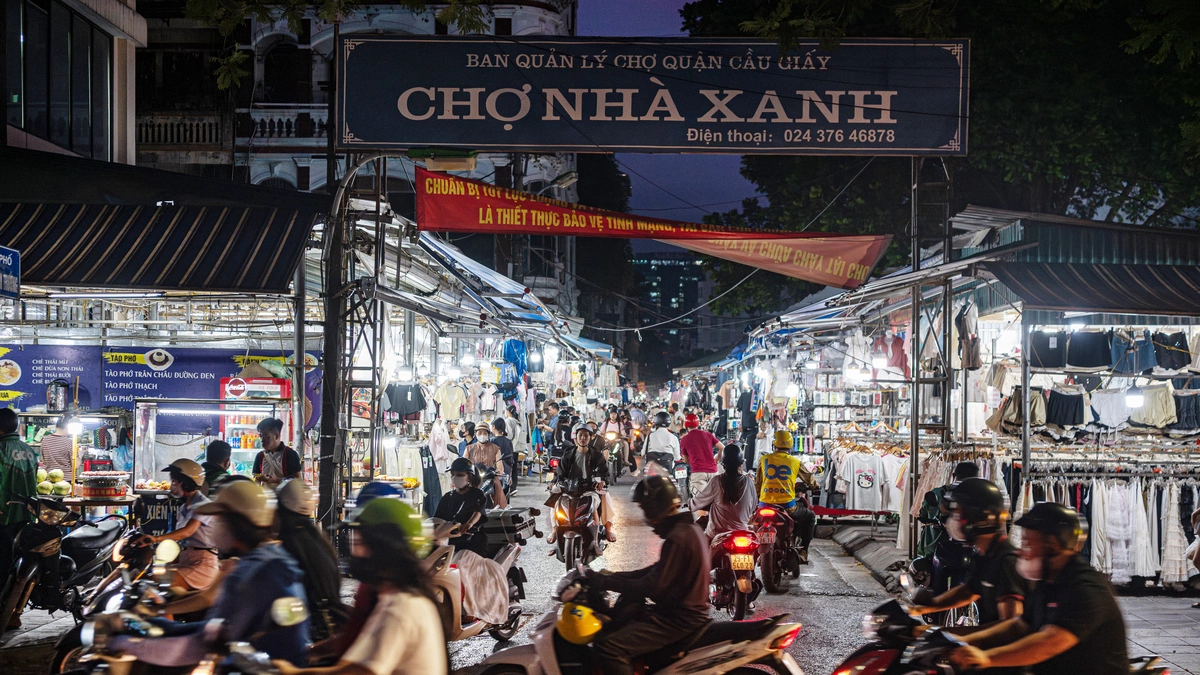
Hanoi's 40-Year-Old 'Green Market' Faces Relocation Amidst Decay and Urban Development
Hanoi's 'Green Market' (Chợ Nhà Xanh), a 40-year-old shopping hub popular with students, is under consideration for relocation due to its dilapidated state and urban development plans. While many vendors worry about their future, authorities cite traffic infrastructure improvement and urban beautification as reasons.
The 'Green Market' (Chợ Nhà Xanh), a 40-year-old establishment in Hanoi's Cầu Giấy district, is being considered for relocation as part of urban development plans and due to its dilapidated state. For decades, it has been a popular spot for students seeking affordable clothing and accessories. However, the market's infrastructure has deteriorated, prompting authorities to consider a move to improve urban aesthetics and widen the adjacent Phan Văn Trường street. The market, stretching about 300 meters along Phan Văn Trường street near the intersection with Xuân Thủy, comprises hundreds of stalls. It originated organically in the 1980s and underwent renovations in 2000. In 2010, it was recognized as a Class III market by the city and has since been included in Hanoi's wholesale and retail network planning. However, many stalls are now temporary structures made of steel frames and corrugated iron roofs, showing significant wear and tear. Interior stalls are often dark, requiring artificial lighting. Fire safety and electrical systems are not uniformly upgraded, and some infrastructure elements no longer meet user needs. Issues like using toilet areas for storing and displaying goods have also been noted, impacting aesthetics and management. The Hanoi People's Committee plans to coordinate the market's relocation and demolition with the expansion project of Phan Văn Trường street. This initiative aims to enhance urban landscaping, improve traffic infrastructure capacity, and complete the area's transportation network. The market's proximity to major universities, including Hanoi National University of Education, Vietnam National University, and Hanoi University of Business and Technology, has made it a familiar shopping destination for students for over 40 years, offering a diverse range of products at reasonable prices. Despite its history, many vendors face declining revenues due to the rise of online shopping. One vendor expressed anxiety, stating, "I've only heard about the relocation a few days ago but don't know the specifics. If the new location is inconvenient, business will be very difficult." Another vendor, who recently signed a one-year lease, worried that the new location's convenience would be crucial for their business. Long-time vendors agree with the relocation in principle but hope for a convenient new business site to maintain their primary source of income. While relocation rumors have circulated before, no concrete announcements have been made. Vendors report that the 'Green Market' is not as bustling as it was before the COVID-19 pandemic. Nevertheless, its location in a densely populated area close to universities has helped maintain a relatively stable customer base. However, revenues have gradually decreased over the years as consumers increasingly opt for online shopping platforms. Source: VnExpress
多角的分析
「緑の市場」の移転検討は、ハノイにおける伝統的な市場の役割の変化と、都市インフラ整備の必要性という経済的側面を浮き彫りにしている。市場の老朽化は、賃料収入の低下や衛生問題を引き起こし、経済的非効率性を招いている。一方で、道路拡幅は交通流の改善と物流コストの削減に繋がり、地域経済の活性化に寄与すると期待される。しかし、移転先の候補地や補償、新たな市場の運営形態によっては、露店商の生計に直接的な影響を与え、地域経済に一時的な混乱をもたらす可能性もある。これは、ベトナム経済が急速な都市化と近代化を進める中で、伝統的な商業形態と現代的な開発との間で生じる典型的な課題と言える。
「緑の市場」の移転は、直接的な大規模投資案件ではないが、周辺不動産市場への影響は無視できない。市場跡地の再開発や道路拡幅による交通利便性の向上は、当該地域の不動産価値の上昇を招く可能性がある。特に、大学が集まるエリアであることから、学生向けのアパートや商業施設への投資機会が生まれることも考えられる。しかし、移転先の市場の規模や立地、そして露店商の移転後の事業継続性といった不確実要素も存在するため、投資家は慎重な市場分析とリスク評価が求められる。また、オンラインショッピングの普及は、既存の小売業への投資リスクを高める要因ともなりうる。
「緑の市場」は、40年以上にわたりハノイの学生たちの生活の一部を担ってきた。安価で多様な商品が手に入るこの市場は、多くの学生にとって、限られた予算の中でファッションや日用品を調達する貴重な場であった。移転は、こうした学生たちの購買行動や、市場で働く露店商とその家族の生計に直接的な影響を与える。特に、長年市場で商売を続けてきた人々にとっては、生活基盤の喪失に繋がりかねない不安要素である。また、市場の老朽化や衛生問題は、都市の美観や公衆衛生という公共的な課題とも結びついている。移転によって、より近代的な都市空間が生まれる一方で、地域に根差したコミュニティや経済活動のあり方が問われることになる。
ハノイ市民、特に学生や近隣住民にとって、「緑の市場」は長年親しんできた身近な存在でした。安価で多様な商品が手に入ることから、多くの学生がここで買い物を楽しんできました。今回の移転検討は、長年市場で商売を営んできた露店商の方々にとって、生活の基盤が揺らぐ大きな不安材料となっています。彼らの多くは、移転先が現在の場所のように便利でなければ、商売を続けることが難しくなると懸念しています。また、市場の老朽化や周辺道路の混雑は、地域住民の生活の質にも影響を与えており、都市開発によるインフラ整備への期待と、地域コミュニティや経済活動への影響との間で、住民の間でも様々な意見があると考えられます。
背景・歴史的文脈
「緑の市場」(Chợ Nhà Xanh)は、1980年代にハノイの大学密集地域で自然発生的に形成された市場である。当初は露天商が集まる場所だったが、その後、規模が拡大し、1990年代後半から2000年代にかけて、区や市による改修・認定が進められた。これは、ベトナムが市場経済化を進める中で、都市部における非公式な商業活動を管理・組織化しようとする動きの一環であった。しかし、近年の急速な都市化とオンラインショッピングの普及により、多くの伝統的な市場が老朽化や集客力低下といった課題に直面しており、「緑の市場」もその例外ではない。今回の移転検討は、こうした変化に対応し、都市インフラの近代化と交通網の整備を進めるという、ベトナム政府の都市開発戦略と連動している。
原文ソース
VnExpress