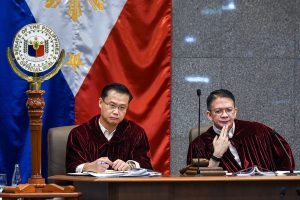
VP Sara's impeachment trial opens with Escudero elected to preside
Politics
2026年7月6日
6
BusinessWorld Nation

VP Sara's impeachment trial opens with Escudero elected to preside

AI サマリー

The impeachment trial against Philippine Vice President Sara Duterte-Carpio has commenced, with Senator Francis Joseph "Chiz" G. Escudero elected to preside. The Senate settled procedural disputes before prosecutors presented their case, alleging misuse of confidential funds.

By Kaela Patricia B. Gabriel THE Senate on Monday elected Senator Francis Joseph “Chiz” G. Escudero to preside over the impeachment trial of Vice-President (VP) Sara Duterte-Carpio, settling an early procedural dispute before prosecutors opened their case against the country’s second-highest official. Senators voted 12-8 to elect Mr. Escudero as presiding officer, replacing Senate President Sherwin T. Gatchalian, after a debate over whether the Constitution required the Senate president to lead the proceedings. “As presiding officer, I shall do my part to uphold the fairness and integrity of this process, and shall see it through to its proper conclusion,” Mr. Escudero said in Filipino after his election. Senate Minority Leader Alan Peter S. Cayetano opposed the move, arguing that the Constitution designates the Senate president as the presiding officer in impeachment trials except when the President is on trial, in which case the chief justice presides. “It is very clear in the Constitution that the presiding officer is the Senate president,” Mr. Cayetano said, warning that changing the arrangement could expose the proceedings to legal challenges. Mr. Escudero is one of the two senator-lawyers from the majority bloc, the other being Senator Francis Pancratius “Kiko” N. Pangilinan. Mr. Pangilinan countered that the Constitution does not expressly require the Senate president to preside over impeachment trials involving officials other than the President. Senator Panfilo “Ping” M. Lacson later moved to elect Mr. Escudero, whose nomination was approved by the chamber. In his opening remarks, Mr. Escudero also settled another procedural issue by ruling that conviction would require at least 16 votes, or two-thirds of the Senate’s full 24-member membership, despite the absence of some senator-judges. He said the impeachment court would follow the constitutional threshold unless the Supreme Court rules otherwise. The court then proceeded with opening statements after the House prosecution panel and the Vice-President’s legal team formally entered their appearances. Lead House of Representatives prosecutor and Batangas Rep. Gerville R. Luistro said the evidence would show that more than P612 million in confidential funds entrusted to the Office of the Vice-President and the Department of Education had been disbursed and liquidated under questionable circumstances. She said the prosecution would also present evidence supporting the other articles of impeachment, including allegations of unexplained wealth, bribery and grave threats. Lead defense counsel Sheila C. Sison argued that the impeachment complaint was constitutionally defective and cited a 2025 Supreme Court ruling that found earlier impeachment proceedings in the House tainted with grave abuse of discretion. Before the opening statements, Ms. Sison objected to the prosecution’s motion to read the four articles of impeachment and require a plea for each count. Mr. Escudero ruled that the articles would instead be read when the court votes on each charge at the end of the trial. The impeachment court also ordered the return of a sealed box containing the tax records of Ms. Duterte and her husband, lawyer Manases R. Carpio, to the Bureau of Internal Revenue after ruling that the records had not been formally offered as evidence during pretrial proceedings. Ms. Duterte did not attend Monday’s session and was represented by her lawyers. In a statement before the proceedings, Ms. Duterte said the integrity of her impeachment trial should be judged by adherence to the Constitution and due process rather than whether she personally takes the witness stand. She said the Constitution guarantees a respondent’s right to be represented by counsel and that deciding whether to testify is a matter of legal strategy. “Choosing to appear through counsel rather than testify personally does not diminish accountability or imply a lack of transparency,” she said, adding that the burden remains on the prosecution to prove its case. Ms. Duterte said public debate over whether she should personally appear before the impeachment court distracts from the legal issues. “The opinion of a President in an impeachment proceeding is of no importance,” she said. “Impeachment proceedings must be guided by the Constitution and due process.” Her remarks came after President Ferdinand R. Marcos, Jr. said over the weekend that the decision on whether the Vice-President would personally attend the trial rests with her and her legal team, though he added that he would choose to appear if he were in the same position. ‘WITHOUT DELAY’ She faces allegations including the misuse of confidential funds, unexplained wealth, bribery and grave threats against Mr. Marcos, First Lady Marie Louise “Liza” Araneta-Marcos and former Speaker Ferdinand Martin G. Romualdez. She has denied the allegations. A conviction by the impeachment court will remove her from office and disqualify her from holding public office in the future. Also on Monday, the National Union of Peoples’ Lawyers (NUPL) urged the Senate, sitting as an impeachment court, to conduct the trial without delay, saying the proceedings should remain transparent and free from political interference. The lawyers’ group said senator-judges should treat the proceedings as a constitutional process designed to uphold public accountability rather than a political exercise. “We expect the full and unhindered presentation of evidence before the impeachment court and, by extension, the Filipino public,” the group said. The NUPL said the Senate should ensure the trial proceeds “fully, transparently, and without delay,” adding that the proceedings must be insulated from “backroom deals or political accommodations.” “The impeachment court belongs to the people,” it said. “Impeachment is a constitutional mechanism for holding high-ranking public officials accountable for alleged violations of public trust.” The group also said the allegations involving confidential funds should not be viewed as an isolated case, arguing that accountability should extend beyond a single public official. “The brazen plunder of public funds is not an isolated aberration by a single official,” it said. The NUPL said it would continue monitoring the proceedings, adding that public vigilance should continue beyond the impeachment trial. The impeachment court adjourned at 5:12 p.m. and is scheduled to resume proceedings at 2 p.m. on Tuesday. — with Erika Mae P. Sinaking and Mark Joseph M. Sanchez

多角的分析

経済的影響

副大統領の弾劾裁判は、フィリピン経済への直接的な影響は限定的であるものの、政治的不安定さが増す可能性を示唆しており、投資家の信頼感に悪影響を与える可能性がある。特に、機密資金の流用疑惑は、公的資金の管理に対する懸念を高め、財政規律への信頼を損なう恐れがある。これは、将来的な財政政策や公共事業への投資判断に影響を与える可能性がある。 過去の類似事例として、政治的混乱が続いた時期には、外国直接投資(FDI)の伸びが鈍化する傾向が見られた。今回の裁判が長期化したり、政治的な対立が激化したりすれば、経済成長の鈍化や通貨ペソの変動につながるリスクも考えられる。

投資家心理

今回の弾劾裁判の開廷は、フィリピンの政治リスクを一段と高める要因となる。投資家は、政治的な不確実性が高まることで、将来の政策決定や経済運営の予測が困難になることを懸念するだろう。特に、機密資金の疑惑は、汚職や不正に対する懸念を浮き彫りにし、ガバナンス(企業統治)への信頼を揺るがしかねない。過去、フィリピンで政治的混乱が顕著になった際には、株式市場の低迷や為替レートの不安定化が見られた事例がある。投資家は、裁判の行方、特に有罪判決が出た場合の政治的余波を注視し、リスク回避の姿勢を強める可能性がある。

社会的影響

副大統領の弾劾裁判は、国民の政治への信頼と公的説明責任に対する期待を浮き彫りにしている。特に、機密資金の疑惑は、公的資金が国民の福祉のために適切に使用されているのかという根本的な疑問を投げかけている。マニラ首都圏の市民からは、物価高騰や生活費の増加が続く中で、政府の資金管理に対する不信感を示す声が聞かれる。また、地方都市の住民は、中央政府の政治的混乱が、地方への行政サービスや開発プロジェクトに遅延をもたらすのではないかと不安を感じている。国民弁護士連合(NUPL)が強調するように、この裁判は単なる個人の責任問題ではなく、公的資金の横領という、より広範な社会問題への意識を高める契機となる可能性がある。

市民の声

副大統領の弾劾裁判は、国民の政治への信頼と公的説明責任に対する期待を浮き彫りにしている。特に、機密資金の疑惑は、公的資金が国民の福祉のために適切に使用されているのかという根本的な疑問を投げかけている。マニラ首都圏の市民からは、物価高騰や生活費の増加が続く中で、政府の資金管理に対する不信感を示す声が聞かれる。また、地方都市の住民は、中央政府の政治的混乱が、地方への行政サービスや開発プロジェクトに遅延をもたらすのではないかと不安を感じている。国民弁護士連合(NUPL)が強調するように、この裁判は単なる個人の責任問題ではなく、公的資金の横領という、より広範な社会問題への意識を高める契機となる可能性がある。

背景・歴史的文脈

フィリピンにおける弾劾手続きは、大統領、副大統領、最高裁判事、憲法裁判所長官、監査官などの高官に対する責任追及のための憲法上のメカニズムである。弾劾申し立ては下院で行われ、過半数の賛成で弾劾訴追が決議されると、上院が弾劾裁判所として審理を行う。有罪評決には上院議員の3分の2以上の賛成が必要となる。副大統領サラ・ドゥテルテ・カルピオ氏に対する今回の弾劾申し立ては、主に彼女が教育大臣も兼任していた際の機密資金の流用疑惑、および説明不能な資産、贈賄、重大な脅迫といった疑惑に基づいている。これらの疑惑は、フィリピンの政治における長年の課題である汚職や説明責任の欠如といった問題と関連している。

原文ソース

BusinessWorld Nation

原文を読む