General articles are free for 24 hours after publish.
Indonesia Promotes Strengthening Resilience and Reforming Multilateral Systems at BRICS Summit
Indonesian President Prabowo Subianto, attending the BRICS Summit in India, emphasized the importance of strengthening resilience to face global challenges and advocated for the reform of multilateral institutions like the UN and WTO. He cited ASEAN's experience as an example of regional cooperation's significance.
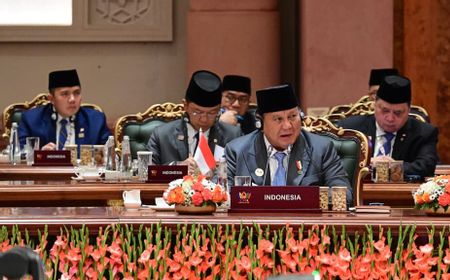
JAKARTA - Coordinating Minister for Economic Affairs Airlangga Hartarto also accompanied President Prabowo Subianto to attend the first day of the 18th BRICS Summit at Bharat Mandapam, New Delhi, India, Saturday, September 12. The 2026 BRICS Summit under the Chairmanship of India carries the theme "Building for Resilience, Innovation, Cooperation and Sustainability." On the first day of the Summit, President Prabowo participated in a special session for BRICS member countries with the theme "Inclusive Global Governance and Strengthening Multilateralism." The session was held in closed session and was attended by leaders from BRICS full member countries. On this occasion, Prabowo conveyed Indonesia's view on the importance of building resilience as a foundation in facing various global challenges. He added that resilience needs to be built in stages, starting at the national level, strengthened through regional cooperation, and then developed into collective resilience at the global level. Prabowo emphasized the importance of the collective strength of BRICS to strengthen global governance, ensure food and energy security, and create development opportunities. "BRICS represents half of humanity and a large part of global economies and trade. BRICS brings together the largest markets and major energy producers in the world. This creates a very large collective power," said President Prabowo. On this occasion, the President also emphasized that ASEAN's experience is one example of how regional cooperation can contribute to building resilience. Amid various geopolitical and geoeconomic dynamics, ASEAN has become a forum for countries in the region to strengthen dialogue, cooperation, and maintain regional stability and economic growth. Prabowo also reiterated the importance of reforming various multilateral institutions so that they are more responsive to changes in the global landscape and able to represent the interests of developing countries more fairly. The reforms include the United Nations (UN), the World Trade Organization (WTO), and the International Financial Institutions (IFIs). In the economic field, reform of the multilateral system is becoming increasingly important amid increasing fragmentation of the global economy, trade uncertainty, and various challenges to supply chains. Indonesia continues to encourage an open, inclusive, transparent, rule-based multilateral trading system, and provide adequate development space for developing countries. The active participation of developing countries in the reform process is crucial. Indonesia believes that developing countries need to be part of the process of forming and negotiating global governance, not just being recipients of the provisions that have been established. "If we are not part of the negotiation process, then the provisions will eventually be determined and applied to us. Therefore, Indonesia needs to continue to take an active role in shaping a more inclusive, representative and just global governance," said Airlangga. During India's Chairmanship in 2026, various strategic substances were also discussed by BRICS, including strengthening the BRICS institutional framework, economy and trade, international finance, peace and security, energy, food security and agriculture, digitization and technology, as well as climate change and environment. In the economic field, discussions include strengthening financial cooperation, developing a Local Currency Settlement (LCS) mechanism, efforts to build a resilient global supply chain, and strengthening an open, inclusive, transparent, and rules-based trading system. The 2026 BRICS Summit will continue on the second day with an agenda that includes discussing the theme "Resilience, Innovation, Cooperation and Sustainability: Shaping the Future for Inclusive Global Growth" involving BRICS member countries and partners.
Original source
VOI English