General articles are free for 24 hours after publish.
Hanoi Housing Shifts Outward, Jobs Remain Central, Worsening Traffic Congestion
Hanoi's new apartment supply is shifting to suburban areas due to rising housing prices. However, most workplaces remain concentrated in the city center, increasing residents' commuting burden and exacerbating traffic congestion.
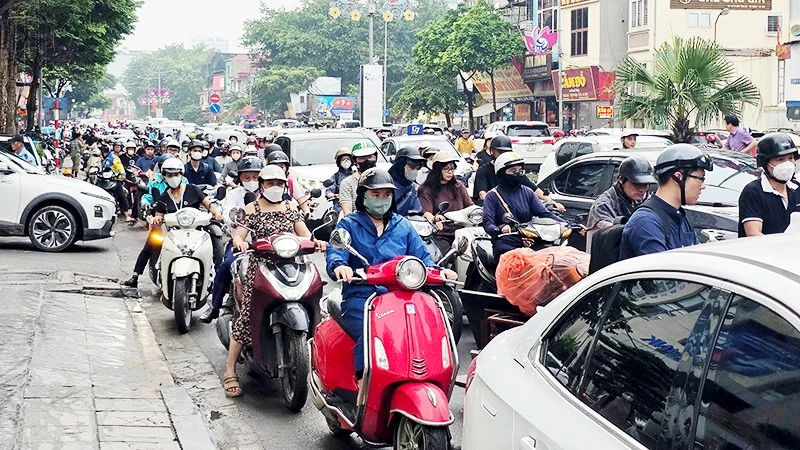
In Hanoi, the capital of Vietnam, a geographical disconnect between housing and employment is causing severe traffic congestion. According to real estate consulting firm Cushman & Wakefield, of the approximately 11,000 new apartments to be supplied in Hanoi in the first half of 2026, 48% will be located in suburban areas and 44% in the outskirts of the city center. This is due to housing prices in the city center reaching levels unaffordable for many residents. Specifically, there is a significant shortage of affordable apartment supply, with social housing emerging as a viable option. However, most of these are also being built in suburban areas. Experts predict that as Hanoi promotes population dispersal and multi-polar urban development, housing supply will continue to expand in the suburbs. Suburban areas offer more development potential and are more advantageous in terms of price compared to the inner city. However, the shift of housing supply to the suburbs is outpacing the movement of employment centers, which remain concentrated in the city center. Many businesses, offices, and commercial facilities are still located in the core of the city. Consequently, even if residents move to more affordable suburban areas, they are forced to commute to the city center for work, study, and services, leading to a continuous increase in traffic flow towards the inner city. To address this issue, Hanoi needs to create incentives for businesses to relocate to suburban areas and generate employment opportunities there. When choosing a location, businesses consider not only land prices but also access to labor, transportation infrastructure, support services, and operating costs. Therefore, satellite cities can only attract businesses if they meet these conditions. Former Deputy Minister of Natural Resources and Environment, Professor Dang Hung Vo, points out that job creation capacity is the "lifeline" of a city. For urban development, connectivity with other economic centers and the formation of attractive service systems for residents are also crucial. This will enable satellite cities to evolve from mere population dispersal areas into poles of development with their own economic momentum. The housing issue should be viewed not just as a geographical migration but as a test of Hanoi's ability to create new living choices. If residents can choose where to live based on environmental quality, amenities, and development opportunities rather than just the distance to the city center, the urban landscape will begin to change. As a result, traffic congestion, especially during rush hours, continues to persist. Hanoi's challenge is not merely how many apartments to build, but how to rationally reorganize the relationship between residences, workplaces, and the transportation system. Source: Nhan Dan
Original source
Nhan Dan