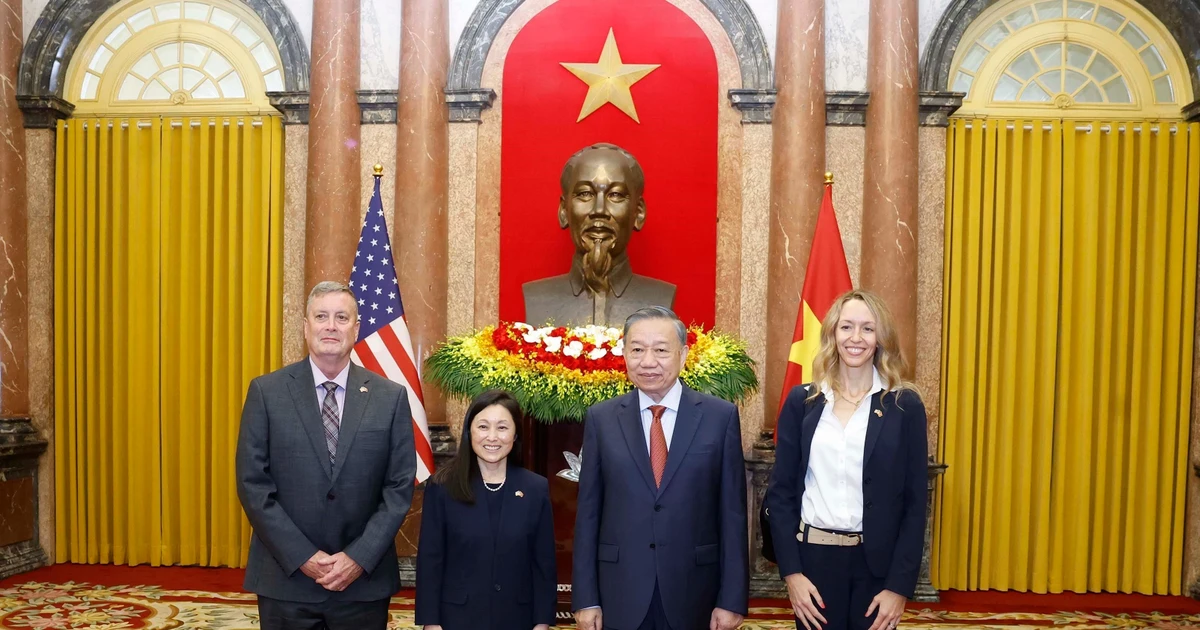
Vietnam Receives New Ambassadors Amidst Diverse Domestic Developments
Vietnam welcomed newly accredited ambassadors from Portugal, Iran, Mongolia, the US, and Myanmar. Domestically, developments include strengthening security forces' technical capabilities, disaster relief efforts, AI city initiatives, cross-border QR payment launch with Singapore, government meetings on economic growth targets, and expansion of low-emission rice farming.
Party General Secretary and President To Lam received in Hanoi on July 6 the newly accredited ambassadors of Portugal, Iran, Mongolia, the US and Myanmar, as they presented their credentials, officially beginning their diplomatic missions in Vietnam. Party General Secretary and State President To Lam on July 6 requested the Ministry of Public Security's technical services force to become a highly disciplined, loyal and people-oriented corps of top science and technology experts capable of meeting increasingly complex security challenges. On the fourth day of operations in Venezuela, Vietnam's rescue team continued searching for victims despite dangerous conditions and repeated aftershock warnings. The Vietnamese search and rescue team recovered seven more victims' bodies on the fourth day of operations, bringing the total number of recoveries to 30 since it began field operations. While recovering a victim’s body, a member of the Venezuelan rescue team became dizzy after prolonged exposure to toxic decomposition gases. Speaking to a Vietnam News Agency correspondent at the disaster site, local residents expressed their heartfelt gratitude for the support provided by Vietnam and the international community. As Hanoi moves to realise its long-term development vision for a new era, the capital is stepping up efforts to attract investment. By signing 50 memoranda of understanding with leading domestic and international corporations and organisations, the city aims not only to expand infrastructure but also to lay the foundation for becoming a modern AI city, with technology serving as a key driver of growth. Vietnam and Singapore officially launched cross-border QR payments from July 2. The service allows Singaporean visitors to pay via VietQRGlobal in Vietnam and is expected to enable Vietnamese travellers to use their domestic banking apps for payments in Singapore from the third quarter. Low-emission rice farming is rapidly expanding across Vietnam and has become an important part of the country’s Net Zero strategy. Through a programme aimed at developing one million hectares of high-quality, low-emission rice by 2030, Vietnam seeks not only to reduce emissions but also to enhance the value of its rice sector and improve farmers’ incomes. Business sentiment in Vietnam is rebounding strongly despite a challenging operating environment marked by rising costs and growing global uncertainties, including prolonged geopolitical tensions and trade-related pressures, according to the recently released Business Outlook Study 2026 by the United Overseas Bank (UOB). Tropical storm Maysak, the first storm to enter the East Sea this year, is approaching the Gulf of Tonkin with wind gusts of up to level 11, prompting northern Vietnam to step up disaster preparedness. On July 3, the Ministry of Agriculture and Environment held an emergency meeting with local authorities to coordinate response measures. Half a century has passed since Saigon-Gia Dinh was renamed Ho Chi Minh City in honour of President Ho Chi Minh. Today, the city has not only maintained its role as Vietnam's economic powerhouse but has also gradually established itself as a regional hub for finance, industry and innovation. French newspaper La Voix du Nord has described Vietnam as a “gem” of Southeast Asia in a recent article, citing its striking natural landscapes, rich history, vibrant cultural identity and cuisine regarded as among the world’s most appealing. Source: VietnamPlus English
多角的分析
ベトナム経済は、国際的な不確実性やコスト上昇にもかかわらず、力強い回復傾向を示しています。政府は二桁成長という野心的な目標を掲げ、インフラ投資やAI都市構想、そして低排出米栽培のような持続可能な農業への注力を通じて、経済の多角化と高度化を図っています。越シンガポール間のQR決済開始は、デジタル経済の進展と地域経済統合の深化を示す象徴的な動きであり、今後の国際貿易・観光における決済インフラの重要性を浮き彫りにしています。
ベトナムのビジネスセンチメントの回復と、AIや持続可能な農業といった新興分野への投資誘致努力は、投資家にとって魅力的な兆候です。特に、ハノイ市のAI都市構想や、低排出米栽培プログラムは、長期的な成長ポテンシャルを持つ分野として注目に値します。ただし、国際的な地政学的緊張や貿易圧力が依然としてリスク要因であるため、投資判断においては慎重なリスク評価が求められます。
ベトナムの災害救援活動への献身は、国民の連帯感と国際社会への貢献意欲を示しています。一方で、北部の熱帯低気圧接近は、気候変動の影響とそれに対する社会インフラの脆弱性を再認識させます。また、女性が手刺繍で収入を得ている事例は、地方における経済的自立とジェンダー平等の進展を示す好例ですが、依然として地方と都市部、あるいは伝統産業と先端技術の間には、経済的機会の格差が存在すると考えられます。
ベトナム国民は、国際社会からの支援への感謝を示す一方で、災害や気候変動の影響に直面しています。新任大使の受け入れは、国際関係の安定化への期待感をもたらすでしょう。ハノイ市のAI都市構想は、将来的な雇用機会や生活の質の向上への期待を高める一方、デジタルデバイドやインフラ整備の遅れといった課題も懸念されます。低排出米栽培は、農家の所得向上に繋がる可能性があり、食料安全保障と環境保護の両面で国民生活に影響を与えます。
背景・歴史的文脈
ベトナムは、ドイモイ政策以降、市場経済化と国際社会との関係強化を進めてきました。特に近年は、米中貿易摩擦を背景に、サプライチェーンの代替先として注目を集め、外国直接投資(FDI)を積極的に誘致しています。一党体制下で、経済成長を最優先課題としつつ、社会の安定維持と国家主権の確保に努めています。中国との関係は、経済的には緊密である一方、南シナ海問題など安全保障上の課題も抱えています。今回の新任大使受け入れは、こうした複雑な国際環境の中で、ベトナムが自国の国益を最大化しようとする外交戦略の一環と見られます。
原文ソース
VietnamPlus English