General articles are free for 24 hours after publish.
Kyrgyzstan Rebuilds National Narrative at World Nomad Games
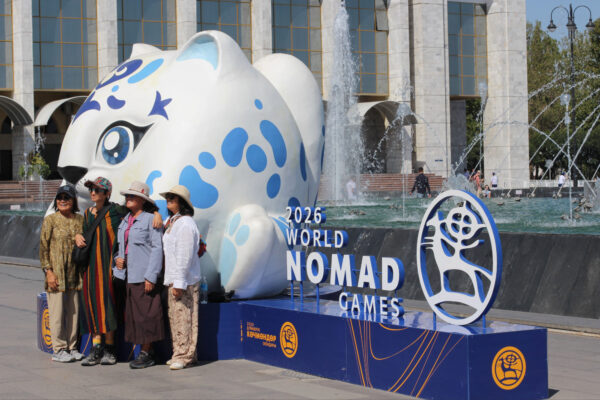
Kyrgyzstan celebrated its 35th independence anniversary and hosted a SCO summit alongside the 6th World Nomad Games. The games, conceived to improve the country's image abroad, have also fostered a domestic resurgence of nomadic culture and ethno-themed fashion.
Kyrgyzstan marked 35 years of independence in grandiose fashion on August 31. More than 20 world leaders arrived in Bishkek throughout the day ahead of a landmark Shanghai Cooperation Organization (SCO) summit, before the curtain rose on the sixth World Nomad Games with a glamorous opening ceremony in the evening. Considering the games’ moniker as the “Olympics of the nomadic world,” the spectacle more than befit the occasion. It took place at the city’s newly built 51,000-seater Bishkek Arena, the largest stadium in Central Asia, and featured an impressive array of dignitaries, such as Russia’s President Vladimir Putin and India’s Prime Minister Narendra Modi. The event was reminiscent of the 2012 Summer Olympics in London in its blend of national culture, history, and showmanship. National Epic Including a lengthy pre-show program, the ceremony lasted nearly seven hours. It began with a series of performances by some of the biggest names in Kyrgyz music, young and old. Then came the 18 heads of state, each personally welcomed by President Sadyr Japarov, with every greeting shown on screens around the stadium. A 29,000-person crowd awaits the opening ceremony’s main event, as Indian Prime Minister Narendra Modi and Russian President Vladimir Putin arrive at Bishkek Arena. Photo by Oliver Fisk. Then came the Kyrgyz national anthem, a processional roll call of the 104 countries taking part in this year’s games, and a speech by Japarov, who theatrically rose out of the floor via an elevator platform before delivering his remarks. At that point, there were still nearly 2 more hours’ worth of ceremony to go. What followed was a vast dramatic journey through Kyrgyz and nomadic heritage, consisting of a succession of dance routines put on by some 3,000 performers and 300 horsemen, and a non-stop background show of glitzy visual effects. The show depicted a variety of scenes, from the symbolic collection of water at Issyk-kul to an episode that ominously appeared at first to represent the Mongol invasion of Kyrgyzstan. (However, the would-be conquerors were eventually revealed to be athletes looking for a game of Kok Boru, one of the country’s traditional sports.) Horsemen and performers arrange themselves in the shape of a tunduk, the circular crown of a traditional yur, which makes up the center of the Kyrgyz flag. Photo by Oliver Fisk. Altogether, the performance was impressive in its ambition and exhilarating in its execution — and that was before it was capped off with a fireworks show and short concert given by Nicole Scherzinger from the Pussycat Dolls. Home and Away In many ways, the ceremony encapsulated a broader tendency of the games: conceived by Kyrgyzstan’s government in the early 2010s as a way to improve the country’s image abroad, they have also helped refashion its national identity at home. “Following coups in 2005 and 2010, and that year’s violence in Osh, Kyrgyzstan was most commonly associated with inter-ethnic tensions, conflict, and other negative things,” Dr. Arzuu Sheranova, an independent researcher based in Germany, told The Diplomat. “Although the government was initially skeptical of the idea, [they realized] eventually that the games could be used to attract foreign investments [and] rebrand the country as a safe destination for foreign tourists,” she explained. What followed was a model, if not entirely intentional, case study in nation-building. Because the Kyrgyz government began to emphasize nomadic self-branding so heavily when preparing to welcome an international audience during the Nomad Games in 2014, 2016, and 2018, the campaign ended up having significant knock-on effects domestically. “20 years ago, nomadic culture was viewed as backwards, generally looked down upon, and, for the government, was not at all a priority,” Sheranova said. “But the emphasis on nomadic and ethnic elements helped fuel a boom in Kyrgyzstan’s fashion industry, and nomadism and ethno-themed culture have since become a movement in both men’s and women’s fashion.” Eventually, she said, this nomadic identity surpassed the government’s long-standing official vision for the country, Kyrgyz Jarany, or “Kyrgyz citizen,” which promotes a shared civic identity and emphasizes multi-ethnic social co-existence, and makes little mention of nomadic heritage. According to Dr. Shairbek Juraev, a political scientist who heads Crossroads Central Asia, an independent research institute based in Bishkek, Kyrgyz Jarany was also born of the Osh interethnic violence in 2010, and is similar to how “Kazakh” is used in neighboring Kazakhstan to refer to ethnic Kazakhs, while “Kazakhstani” denotes citizens of the country more broadly. But while Kyrgyz Jarany is supposed to make room for Kyrgyzstan’s national minorities, “such as Uyghurs or Uzbeks,” Juraev said, “it is pretty much dead,” thanks in part to the “turn towards increasing the role of Kyrgyz language” that has taken place under the Japarov presidency. Indeed, signs of the cultural phenomena described by Juraev and Sheranova appeared at Monday’s opening ceremony. Many of the locals, who made up the majority of the estimated 29,000 people in attendance, were dressed in ethno-themed clothing in Kyrgyzstan’s national colors, or in both. In a similar vein, Japarov began his speech by praising Kyrgyzstan’s “past, present and future.” He hailed the convergence of events on August 31 as an appropriate way of both marking 35 years of the country’s independence and “glorifying” the legacy of the “nomadic civilization” created by its citizens’ ancestors. Kyrgyz President Sadyr Japarov delivers remarks from center-stage. Photo by Oliver Fisk. Power Play Beyond these references to history, however, Japarov’s remarks were more focused on the present. The 10-minute speech featured a catalog of major forthcoming government-supported projects, such as the China-Kyrgyzstan-Uzbekistan (CKU) railway and the Ala-Too ski resort. That emphasis on development was fitting, given how the games have served as a deadline for major infrastructure initiatives. The Bishkek Arena, for example, is now Central Asia’s largest stadium, having been completed just days before it hosted the opening ceremony. Similarly, the hippodrome in the lakeside resort town of Cholpon-Ata, which hosts most of this week’s sporting events, has been renovated to accommodate 10,000 spectators. Manas International Airport, the country’s largest, has also undergone major reconstruction, while roads around Issyk-kul have been upgraded, including a new 15.64-kilometer, four-lane ringroad around Cholpon-Ata designed to ease congestion. In this sense, the games ha
Original source
The Diplomat Indonesia