General articles are free for 24 hours after publish.
Cambodia's Bamboo Craft 'Rongoun' Supports Rural Livelihoods
In Tamul village, Kampong Cham province, Cambodia, the traditional weaving technique for bamboo rice granaries, known as 'Rongoun,' supports the livelihoods of local residents. Passed down through generations, this craft has been expanded into businesses by some families, contributing to improved living standards.
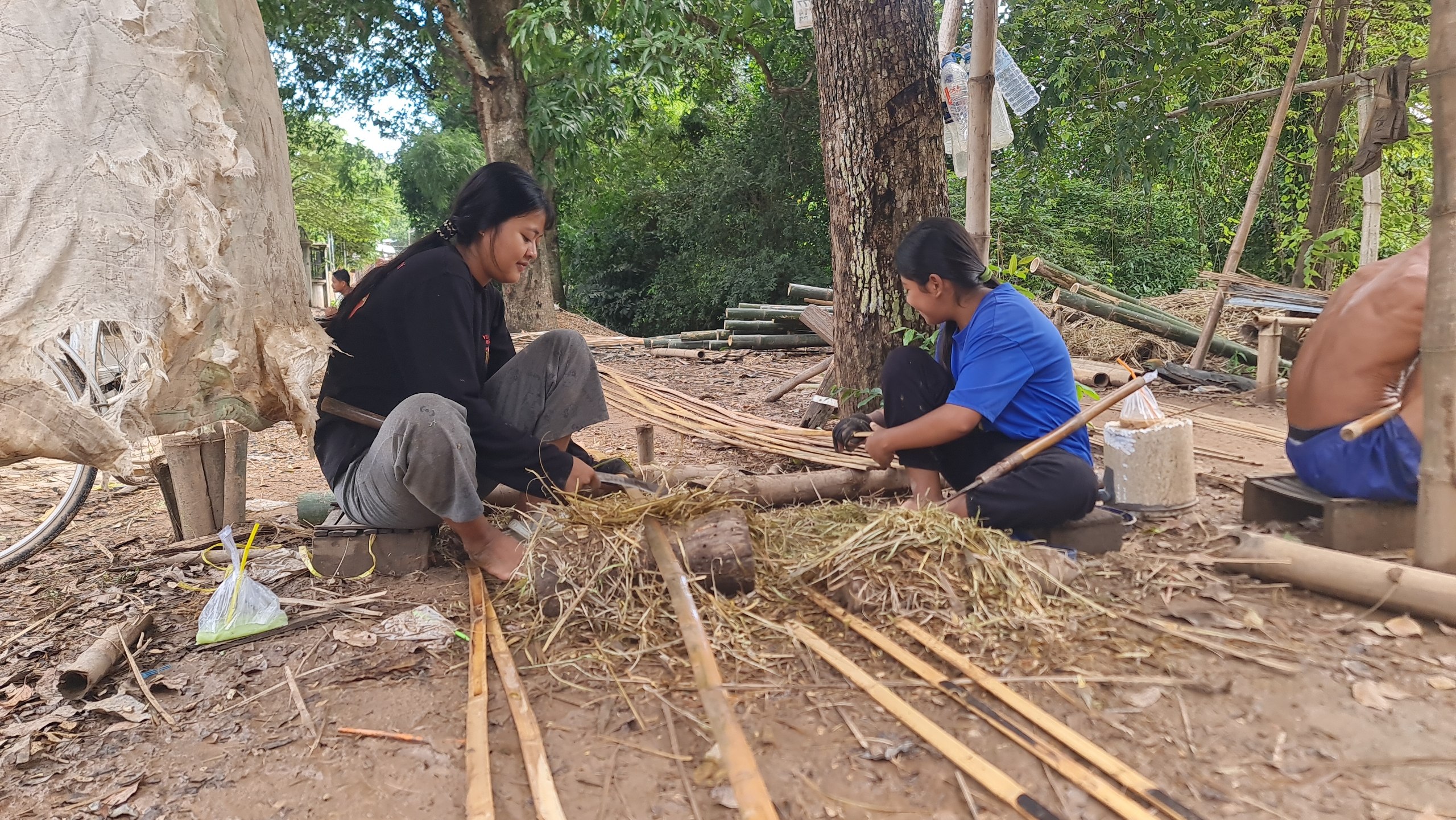
Residents of Tamul village, Prek Dambok commune, Srey Santhor district, Kampong Cham province, are diligently preserving the traditional bamboo weaving craft of 'Rongoun' (rice granary), passed down from their ancestors, ensuring it is not lost. For some families, this traditional craft has expanded into a business, contributing to improved living standards. Pu Chhun Yae, 60, who lives in Tamul village, recounted that since he was old enough to remember, he saw his parents weaving 'Rongoun' by hand from bamboo. These were sold to farmers in Kampong],” and other provinces, capable of storing tons of rice. When grain ran out, people could harvest rice from these granaries to mill into rice for their families' meals. Mr. Yae further explained that the bamboo is ordered from residents in Kratié province and transported by truck, with each truckload carrying approximately 500 stalks, costing over 10,000 riels per stalk. Upon arrival at his home, the bamboo is submerged in the river for 10 to 15 days to prevent insect damage. Afterward, it is removed, split into thin strips, and his sons and daughters help weave them diligently. They can weave three 'Rongoun' per day, with each selling for over 30,000 riels. Nowadays, it is not difficult as buyers drive their cars to pick up the products directly from their homes. Sometimes, they transport them to buyers in Phnom Penh via motorcycle remorque, carrying 50 to 100 'Rongoun' per trip. Mr. Yae mentioned that previously, almost 100% of his villagers practiced weaving 'Rongoun' to make a living. Currently, only about 40% of his villagers continue this ancestral profession, while the rest have taken up other occupations. A truckload of bamboo takes nearly a month to be fully utilized. This craft has significantly improved his family's livelihood. Mrs. Sok Leng, 49, also from Tamul village, stated that she has been in the business of making bamboo wall panels ('runab') for over 30 years. Located under her wooden house by the river, she employs a modest number of workers. On average, they can produce about 500 panels per day, including 5-meter and 9-meter types. The produced panels are bought by middlemen who resell them in Kampong Thom, Siem Reap, Kampong Speu, and many other provinces. She learned to make wall panels and 'Rongoun' from her parents, continuing the tradition from her ancestors. She emphasizes preserving this heritage because proficiency in it brings income to support her family. She has expanded her business by hiring many workers; when buyers order more, she hires additional staff to meet demand. It is noteworthy that over 20 years ago, when residents wove 'Rongoun', family members would cycle to sell them in distant districts, taking 5 to 10 days for a round trip. Today, with the country's development, vehicles are used to transport the 'Rongoun' for sale, saving considerable time.
Original source
Koh Santepheap Khmer