General articles are free for 24 hours after publish.
Archaeological dig challenges 1903 battle narrative in Lanao del Sur
A recent archaeological excavation in Lanao del Sur, Philippines, is challenging the historical account of the 1903 "Battle of Kota Kalawi." Findings show no evidence of the intense fighting described in American records, suggesting the battle may have been a "historical hoax."
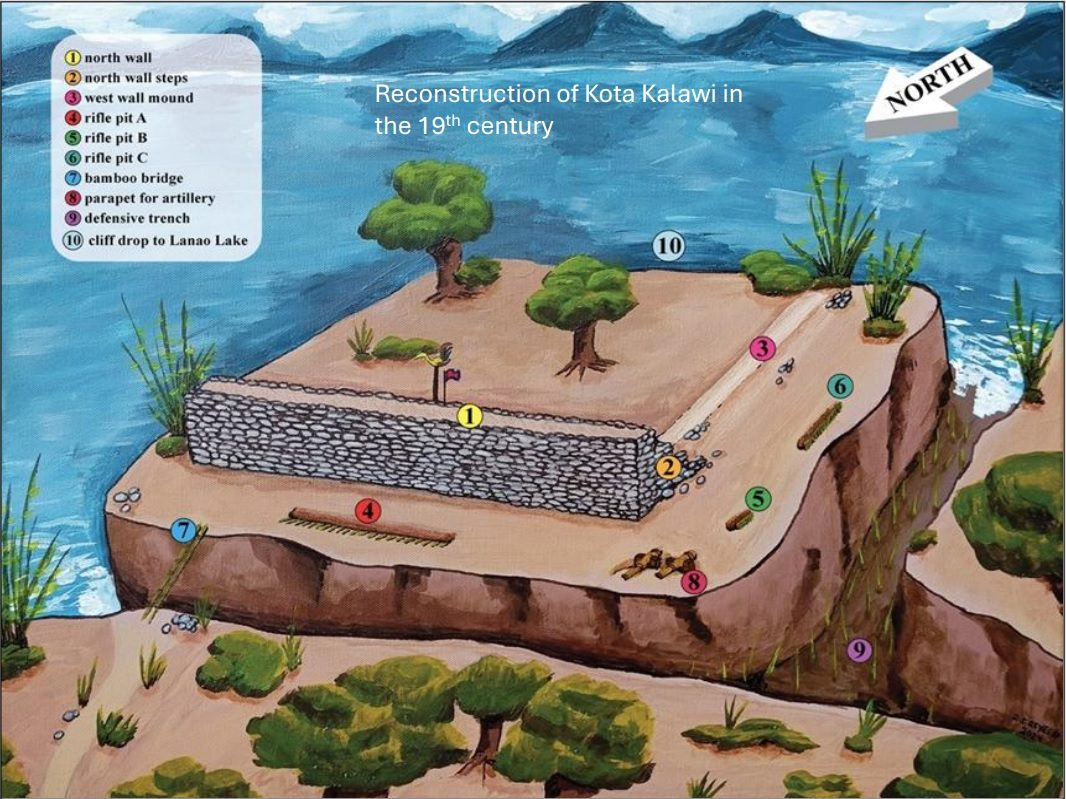
CAGAYAN DE ORO, Philippines – For decades, the Battle of Kota Kalawi has stood in the historical record as a bloody encounter between American forces and Meranaw defenders along the shores of Lake Lanao. Now, an archaeological excavation is challenging that account, raising questions about one of the most consequential episodes attributed to the US military campaign in Mindanao. At the presentation and turnover of the Kota Kalawi Archaeological and Historical Project on August 24 at the Lanao del Sur Provincial Capitol, project team leader Leee Anthony Neri, dean of the University of the Philippines’ School of Archaeology (UPSA), delivered this assessment: the battle was a “historical hoax” written by Americans in the 20th century. Neri said the archaeological dig, commissioned by the Bangsamoro Commission for the Preservation of Cultural Heritage (BCPCH) and conducted by a team from UPSA from July 29 to August 19, 2024, showed no evidence that the purported Battle of Kalawi ever took place. This was the first formal archaeological excavation in Lanao del Sur. The project was a collaboration among the UP School of Archaeology (UPSA), Mindanao State University-main campus and Mindanao State University-Iligan Institute of Technology (MSU-IIT), organized by the BCPCH. “Of the six trenches we dug on the Kota Kalawi site, we found only a single bullet and no evidence of bullet penetration on the North Wall from the purported machine gun fire or mortar fire,” Neri noted. “There’s also simply no space within the kota (earthen/stone forts) to accommodate a hundred defenders.” “Archeologically, this does not support the historical narrative,” Neri stressed. Iligan historian Ricardo Jorge Caluen said the excavation was the first formal archaeological re-examination of the accepted narrative surrounding the Battle of Kota Kalawi. “Neri’s assertion is therefore a bold challenge to the traditionally-accepted events of the battle that could alter its historiography,” Caluen said. “It is difficult to challenge findings of archaeology that are based solely on material evidence.” American account The American account dated June 30, 1903 was written by American Brigadier General Samuel S. Sumner, commander of the Department of Mindanao, and included as Appendix II in the Annual Report of Major General George W. Davis, United States Army commanding Division of the Philippines from October 1, 1902 to July 26, 1903. According to Sumner’s report, the Battle of Kota Kalawi – often referenced alongside the Battle of Bacolod Grande – was a violent clash that took place at Bacolod Grande from April 6 to 8, 1903, and at Kalawi on April 9, along the shores of Lake Lanao. Kalawi is also spelled Calahui in the American account. At the time of the battle, then-captain John J. Pershing, who later commanded the American Expeditionary Forces (AEF) on the Western Front during World War I, was newly promoted as commander of Camp Vicars, overseeing the early American pacification campaigns in the Meranaw and Iranun areas surrounding Lake Lanao. The defensive fortifications, or kota, served as vital strongholds during local resistance against foreign invaders around Lake Lanao. Built strategically on plateaus and along the shores of the lake to control movement and trade, they were constructed with heavy timber, stone, earth and bamboo, and often bristled with sharp bamboo spike pits (surung) and high walls. Defenders used indigenous blades such as the kris and kampilan, along with swivel cannons called lantakas. Sumner described Kota o Panondiongan as “the strongest fort in Mindanao.” Based on his account, the Americans’ superior firepower, including machine guns, mountain artillery and mortars, gave US forces a decisive advantage over traditional Meranaw defenses. The American field expedition was led on the ground by Pershing, commanding roughly 700 soldiers composed of four companies from the 27th Infantry, three troops of the 15th Cavalry, and two mountain artillery batteries. Sumner recounted that American forces surrounded the earthen walls of Kota o Panondiongan, with initial bombardments from Vickers-Maxim mountain guns countered by traditional Meranaw lantakas (brass cannons). He wrote that the US tightened the siege using 3.6-inch mortars, dropping shells directly into the fort. Despite a water-filled moat and heavy fire from hidden loopholes, Meranaw defenders repeatedly drove back infantry advances and rejected all offers of surrender. Relentless artillery fire, based on the account, breached the front wall, allowing US forces to overrun Kota o Panondiongan. Supposedly, a quick body count taken in the still-burning fort showed 30 Moro warriors dead on the top floor, with one American killed and 14 wounded. The following day, April 9, 1903, the Americans supposedly bombarded Kota Kalawi with mortars and Maxim-Vickers machine guns. Sumner claimed the Meranaw defenders abandoned their positions after suffering 23 casualties. For over a century, the American account has shaped the history of Kota Kalawi. But the archaeological findings merely showed a single bullet, and no physical evidence of the intense exchange of gunfire and artillery described in Sumner’s report. The findings have raised questions about what really happened at Kota Kalawi in 1903 and prompted a closer examination of the account that for generations was seen as established history. – Rappler.com
Original source
Rappler Philippines