Vietnamese Priest Beatified as Martyr Amidst Historical Interpretation Debate
The Catholic Church has beatified Father Truong Buu Diep, who died in 1946 in southern Vietnam, recognizing him as a martyr. This event has sparked debate over the interpretation of his death during the turbulent post-WWII period.
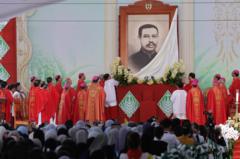
Thousands of Vietnamese Catholics gathered at Tac Say Church in Ca Mau province on July 2nd for the beatification ceremony of Father Truong Buu Diep. Cardinal Luis Antonio G. Tagle, the Pope's envoy, officially conferred the title of "Blessed" upon Father Phanxicô Truong Buu Diep, recognizing his life of holiness and sacrifice for the faith. Beatification is a title granted by the Catholic Church to a deceased person who is confirmed to have lived a holy life or sacrificed their life for the faith, and is now believed to be enjoying happiness with God. It is a step towards canonization. Cardinal Tagle quoted a passage from the Gospel of Matthew, stating, "Blessed are the peacemakers, for they will be called children of God. Blessed are those who are persecuted for righteousness' sake, for theirs is the kingdom of heaven." He added, "Thus, those who are persecuted for the Name of God, rejected by the world but accepted by God, are the blessed ones." Father Truong Buu Diep, born in 1897, was ordained a priest in 1924 and spent many years serving parishes in the Mekong Delta, most notably Tac Say. On March 12, 1946, amidst the turbulent post-World War II period in southern Vietnam, about 70 people, including both Catholics and non-Catholics, were detained. Father Diep remained with his flock despite being advised to leave for safety. During his detention, he continued to care for the religious life of those held captive and administered baptisms. Shortly after being detained, he was taken away and murdered on March 12, 1946. The Dicastery for the Causes of Saints at the Vatican concluded after years of investigation that his death was a case of "martyrdom in odium fidei" (martyrdom in hatred of the faith), providing the basis for the Pope's approval of his beatification. Vatican News has published articles describing him as having "laid down his life for his flock," refusing to abandon his community in times of danger and ultimately being killed. Vatican considers this evidence of a shepherd sacrificing his life to protect his sheep. According to Vatican News, for decades, there were various versions of the circumstances surrounding Father Truong Buu Diep's death, including a popular view that he was killed by Viet Minh forces. The Diocese of Can Tho conducted its own investigation from 2011 to 2017. A Historical Committee was formed to study related documents, and 23 witnesses were interviewed. The investigation concluded that he was killed by two renegade Japanese soldiers amidst the post-war chaos. Following his murder, the site of his burial and reburial at Tac Say Church has become a pilgrimage destination for hundreds of thousands of people annually. In the period leading up to and around the beatification ceremony on July 2nd, some Facebook pages and YouTube channels have featured opinions regarding Father Truong Buu Diep. Notably, YouTube channels Thăng Long Tv and Én Bạc, which often post content critical of "dissidents" and "historical revisionism," recently published videos claiming Father Truong Buu Diep was a French collaborator and suggesting that if he had truly rendered service, he would have been honored with statues and street names in Vietnam. These claims were made without providing evidence. The videos are no longer visible on the original YouTube accounts of Thăng Long Tv and Én Bạc but have been re-uploaded on other accounts. Vietnam is a one-party socialist republic where religious activities are subject to government oversight. While the Catholic Church is one of the largest religious denominations in Vietnam and the government guarantees freedom of religion, its practice is subject to certain limitations. Father Diep's beatification is a significant event for Catholics but also highlights a quiet debate over the interpretation of complex historical events in Vietnam.
多角的分析
このニュース自体に直接的な経済的影響は少ないが、ベトナムにおける宗教組織の活動と政府の統制という文脈は、外国からの投資家にとって、ベトナムの社会・政治的安定性に対する間接的なリスク要因として認識される可能性がある。特に、歴史解釈を巡る論争が社会的な不安定化につながる兆候が見られれば、投資環境への懸念が生じうる。ベトナム経済は輸出主導型であり、社会の安定は経済成長の基盤であるため、こうした動きは注視されるべきである。
投資家にとって、このニュースは直接的な投資機会やリスクを示すものではない。しかし、ベトナムにおける宗教的・歴史的解釈を巡る議論は、国内の社会的な緊張の兆候となり得る。ベトナム政府は経済成長を最優先しており、社会の安定を維持しようとするが、歴史認識の相違が広がることは、国内の不安定化リスクを高める可能性がある。これは、特に長期的な投資を検討する上で、政治的・社会的なリスク評価の一環として考慮されるべき要素である。
ディエップ神父の列福は、カトリック教徒にとっては信仰の拠り所となる出来事だが、一方で、彼の死因に関する歴史解釈を巡る論争は、ベトナム社会における異なる意見の存在を示唆している。特に、一部のYouTubeチャンネルが過去の政治的立場や功績を巡って神父を批判する動きは、歴史認識の多様性、あるいは政治的な意図を持った情報発信の可能性を示唆している。これは、ベトナム社会が、過去の出来事に対して多様な見解を持ちうることを示しており、特に若い世代がSNSを通じてこうした情報に触れる機会が増えている背景がある。
ディエップ神父の列福は、カトリック信者にとっては敬意と信仰の対象となるが、一部のオンラインメディアによる批判は、ベトナム国民の間で歴史認識や過去の出来事に対する異なる見解が存在することを示している。特に、SNSを通じてこうした情報が拡散されることで、国民の間で議論が巻き起こる可能性がある。神父の死因に関する公式見解と、一部で流布される批判との間には、情報へのアクセスや解釈の違いが存在し、これが社会的な関心事となることも考えられる。
背景・歴史的文脈
ベトナムは1945年の独立宣言後、フランスとの第一次インドシナ戦争、そしてアメリカとのベトナム戦争を経験した。これらの激動の時代、特に1946年の第一次インドシナ戦争勃発前後の南ベトナムは、政治的混乱と武装勢力の活動が活発だった。ディエップ神父が殺害されたとされる1946年3月は、まさにこの混乱期にあたる。カトリック教会はベトナムにおいて歴史的に重要な役割を担ってきたが、その活動はベトナム共産党による一党支配体制下で、国家の統制を受けている。歴史解釈を巡る論争は、過去の出来事に対する公式見解と、異なる視点との間の緊張関係を示唆している。
原文ソース
BBC Vietnamese