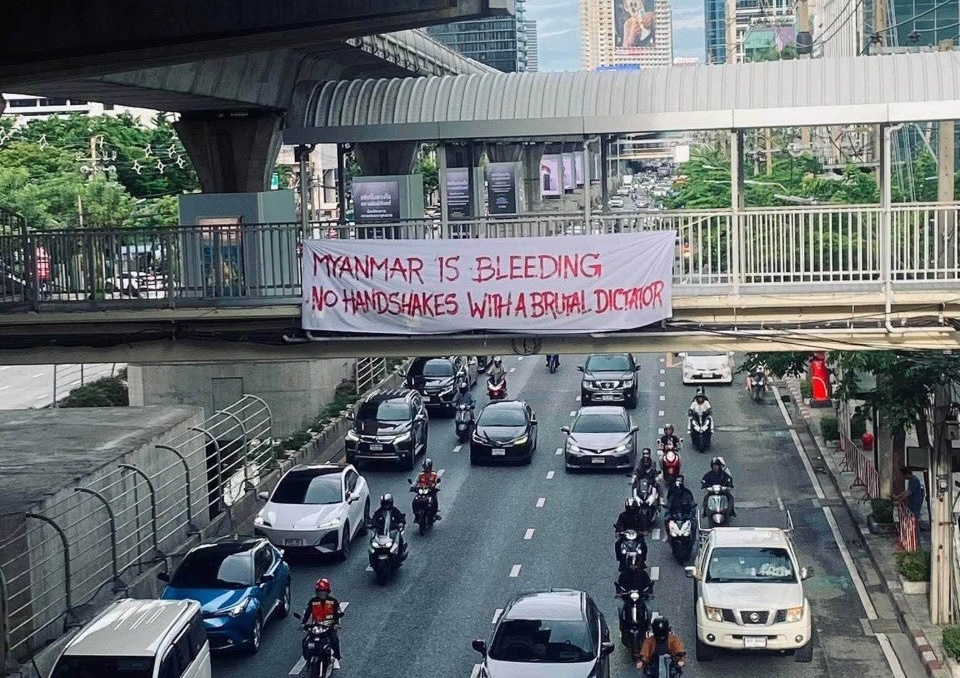
Min Aung Hlaing concludes two-day visit to Bangkok amid protests and parliamentary disruption
Myanmar regime leader Min Aung Hlaing concluded an official two-day state visit to Thailand on Friday. The summit—hosted by Thai Prime Minister Anutin Charnvirakul—resulted in several bilateral agreements on trade, borde
This article requires PRO
This article is outside the free access window or is a special report. PRO unlocks it and the full archive.
Related articles
- Myanmar junta chief draws online criticism after Bangkok visit
Images of Myanmar military chief Min Aung Hlaing’s red-carpet welcome in Bangkok dominated online discussion this week, as his two-day visit to Thailand on 6-7 August drew sharp criticism from social media users questioning whether the reception helps him gain political legitimacy. Min Aung Hlaing, who led Myanmar’s 2021 military coup, was sworn in as president in April. Thailand, pursuing what it calls “calibrated re-engagement,” welcomed him with an honour guard at Government House and hosted him at a business forum with Prime Minister Anutin Charnvirakul. On Facebook, some Myanmar users mocked the visit, with one saying the photos were meant to send the message “See? I’m normal,” while another wrote “Everything is so rigged.” Posts questioned whether Thailand’s practical gains, such as cooperation on migrant labour, were worth handing Min Aung Hlaing valuable images of international acceptance. Discussion also revived doubts over ASEAN’s five-point peace plan. During the welcome ceremony at parliament, an opposition Thai MP was removed after chanting for peace. Separately, migrant worker groups and Thai citizens protested outside the UN office in Bangkok, and Thai civil society organisations issued a joint statement opposing the visit. Myanmar’s military-backed government has been barred from ASEAN’s top meetings since 2021 over stalled progress on the peace plan, making Bangkok’s formal welcome a rare exception for a leader still shunned by much of the world.
- Thailand and Myanmar issue a joint statement on the official visit of the Myanmar junta leader to Bangkok
Thailand’s Ministry of Foreign Affairs has released a joint statement on the occasion of the official visit of Myanmar junta leader Min Aung Hlaing to Thailand on 6 August. The following is the statement: Joint Statement
- Thailand backs greater ASEAN role for Myanmar junta as Min Aung Hlaing visits Bangkok
The two countries agree to push for greater economic cooperation, as critics blast the visit for legitimising and enriching the regime. . . Thailand has backed a greater role for Myanmar’s military junta in the Associati
- Min Aung Hlaing visits Thailand on quest for legitimacy as Bangkok backs engagement
Myanmar’s regime leader Min Aung Hlaing will make an official visit to Thailand on Thursday, as Bangkok makes a push for re-engagement between its war-torn neighbour and the Association of Southeast Asian Nations (ASEA