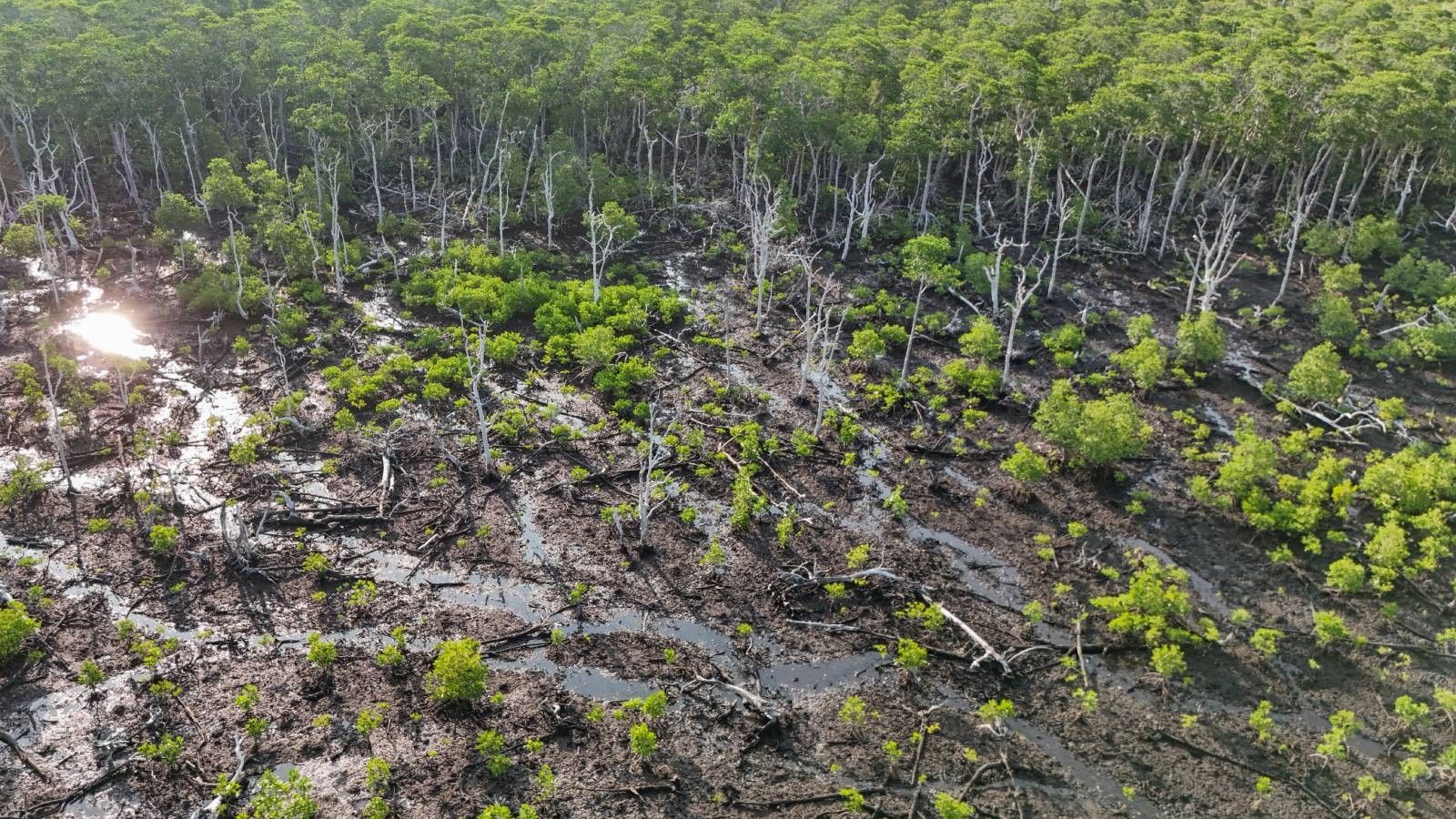
Protecting the protectors: Racing to save Philippine mangroves
As typhoons intensify and climate change impacts grow, vital natural defenses in the Philippines – mangrove forests – are under threat. Local communities and environmental groups are undertaking urgent protection and rehabilitation efforts, including the construction of bamboo barriers.
MASBATE, Philippines — Standing knee-deep in coastal waters, environmentalist Andrea Pimentel guides workers as they drive bamboo poles into the seabed to block sediment from choking the tidal channel sustaining a mangrove forest. Mangroves are a key natural defence against storm surges and coastal erosion in the Philippines, which is hit by around 20 typhoons each year. But the country has lost over 60 percent of its mangrove cover since 1918, government data shows, and increasingly powerful storms are threatening what remains by stirring up sediment that clogs water channels and suffocates mangroves at the roots. "Our typhoons are becoming frequent and getting stronger," said Andrea Pimentel, project manager for environmental organization WWF-Philippines. "Even (if) mangroves are resilient, they can also be affected, and eventually they could die," she added, shortly before heading by boat to a mangrove site in Masbate province's Batuan town. Pimentel works with local communities to rehabilitate mangroves across 245 hectares, including a two-hectare stretch where repeated typhoons have left bare patches in a once-dense forest. Park ranger Bernard Almogera, who fished at the site with his father decades ago, has witnessed the mangroves deteriorate over the years. "Some of them were snapped off, others like this one were uprooted," the 58-year-old told AFP, pointing to a tree with branches broken by previous storms. Sweating under the morning sun, men hauled bamboo across the exposed mudflat while Almogera knelt nearby, cutting the stalks into 1.5-metre poles before driving them deep into the seabed with a heavier bamboo pole. The fence they are building is intended to slow incoming waves so suspended sediment settles before reaching the tidal channel carrying seawater through the mangrove forest. If the channel becomes clogged, water stagnates and the mangrove's roots are deprived of oxygen, eventually suffocating and killing them. "We're really scared, because if the mangroves disappear and a strong typhoon comes, our houses will surely be knocked down," Almogera said. "There'll be nothing left to protect us." Scientists warn that while bamboo fences are a cheap way to protect mangroves, they can rot within three years, unlike more expensive permeable concrete designs, leaving debris that may affect the trees they are meant to shield. But they remain a quick, affordable way to protect mangroves in one of the world's most climate-vulnerable countries. And the urgency is growing. Warming waters caused by climate change can produce stronger tropical storms. The world's oceans experienced their hottest June on record, and could reach new highs in coming months as a strong El Nino weather pattern takes hold. Pimentel said mangroves need immediate protection and rehabilitation, even if bamboo fences must be replaced before they deteriorate. "If we don't act now, our mangroves will be vulnerable to climate change," she said. The urgency extends beyond Masbate province. A 2024 study by the International Union for Conservation of Nature found that half the world's mangrove ecosystems are at risk of collapse due to climate change, rising sea levels and human activity, with about a quarter potentially submerged by 2050 without proper conservation. The Philippines suffered the second-highest mangrove losses, according to a 2023 survey of 10 Southeast Asian countries led by Filipino scientist Severino Salmo, with climate change impacts and the conversion of mangrove sites to seafood ponds largely to blame. "It will be more difficult (for the mangroves) to adjust now because of the massive losses in the past," Salmo, who has been studying mangroves in the archipelago for more than three decades, told AFP. Salmo warned they will only "decline more" in the coming years without proper restoration projects and better government policies. "It's disappointing that we keep losing mangroves given how important they are," he said. "For now, (the best response) should be to conserve whatever is left." As workers continued assembling the bamboo fence, Pimentel looked around the forest and pointed to trees whose once grey-brown roots had turned charcoal black due to suffocation. "Mangroves have always protected us from typhoons," she said. "It's time we protect them too."
多角的分析
フィリピン経済は、農業や漁業といった第一次産業が依然として重要な役割を担っており、これらの産業はマングローブのような自然生態系に大きく依存している。マングローブの減少は、沿岸漁業の生産性低下、漁獲量の減少、さらには養殖業への悪影響をもたらす可能性がある。これは、地域経済の停滞や食料安全保障への懸念につながりうる。また、マングローブは観光資源としても価値があり、その損失は観光収入の減少にもつながる。さらに、自然災害に対する脆弱性の増大は、復旧・復興にかかる経済的負担を増大させる。
投資家にとって、マングローブの減少は、インフラ開発や沿岸部の不動産投資におけるリスク要因となる。自然災害による被害が増加すれば、資産価値の低下や保険コストの上昇を招く可能性がある。一方で、環境保全や気候変動対策への投資、例えば再生可能エネルギーや持続可能な農業・漁業への投資機会も生まれている。マングローブ保護への取り組みは、ESG投資の観点からも注目される可能性があるが、その効果と持続可能性には不確実性が伴う。
マングローブの減少は、沿岸地域に住む人々の生活に直接的な影響を与える。彼らは、台風や高潮からの保護を失い、家屋の損壊や浸水の危険にさらされる。また、漁業への依存度が高いコミュニティでは、漁獲量の減少が収入の喪失に直結し、生活困窮につながる。マングローブの再生作業へのコミュニティ参加は、雇用創機や連帯感の醸成に寄与する可能性があるが、長期的な生計の安定には、より包括的な政策が必要となる。マニラ首都圏のような都市部でも、食料価格への影響や、自然災害時の避難場所の不足といった間接的な影響が懸念される。
沿岸部で暮らす人々にとって、マングローブは文字通りの「壁」であり、生活を守る最後の砦です。台風が強まるたびに、家が流されるのではないか、家族が安全でいられるのかという不安が募ります。マングローブがなくなれば、その不安は現実のものとなります。漁師である父の代からこの海で漁をしてきましたが、最近は魚が減り、生活が苦しくなっています。マングローブを守るための仕事はありがたいですが、根本的な解決にはならないと感じています。政府には、もっと長期的な視点で、私たちの生活を守るための具体的な対策を講じてほしいと願っています。
背景・歴史的文脈
フィリピンは、世界有数のマングローブ分布国であり、その生態系は古くから沿岸コミュニティの生活と深く結びついてきた。しかし、20世紀初頭から、経済発展の名の下での埋め立て、水産養殖池への転換、過剰な伐採などにより、マングローブ林は急速に減少してきた。特に、1970年代以降、エビ養殖ブームなどにより、その破壊は加速した。近年、気候変動による海面上昇や台風の激甚化が、残されたマングローブ林をさらに脅かすようになり、その保護と再生が喫緊の課題となっている。
原文ソース
Philstar Nation