General articles are free for 24 hours after publish.
How the 800km Drake Passage Regulates Antarctic Climate and Life
The 800km Drake Passage, connecting the Pacific and Atlantic oceans, is a notoriously rough sea route crucial for regulating Antarctic climate and ecosystems. Its powerful currents and massive waves significantly influence global climate patterns.
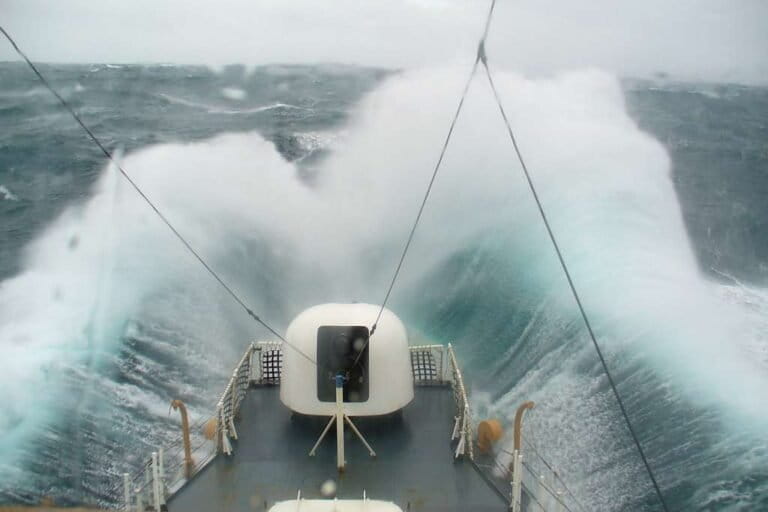
Stretching approximately 800 kilometers between the southern tip of South America and the Antarctic Peninsula, the Drake Passage is renowned as one of the world's most formidable sea routes, connecting the Pacific and Atlantic oceans. Its turbulent waves have earned it the moniker "Drake Shake" among mariners. The passage's ferocity is attributed to its unique geographical conditions. It experiences "infinite fetch," where winds and waves can gather energy over thousands of kilometers without landmass obstruction. Furthermore, its location between 50 and 60 degrees south latitude, in regions known as the "Furious Fifties" and "Screaming Sixties," allows low-pressure systems to circle Antarctica almost unimpeded, strengthening before reaching the Drake Passage. The seafloor topography also contributes to increased turbulence. The Shackleton Fracture Zone forces deep-sea currents from thousands of meters to rise near the surface, creating eddies and irregular waves. The Antarctic Circumpolar Current, the only ocean current to encircle the Earth without obstruction by continents, flows through this strait. Its transport volume is estimated at 141–173 million cubic meters per second, making it one of the largest currents on the planet. However, the Drake Passage's notoriety for rough seas represents only one aspect of its character. Less than a quarter of crossings are reported as truly violent, with the remainder being relatively calm, referred to as the "Drake Lake." Modern expedition ships are equipped with stabilizers to mitigate the motion. Beneath its rough surface, the seafloor of the Drake Passage holds sediments that record 140,000 years of climate change. These records aid scientists in tracking variations in the Antarctic Circumpolar Current's speed. While often perceived solely for its danger, the Drake Passage plays a critical role in understanding Antarctic climate systems and global environmental patterns.
Original source
Mongabay Indonesia