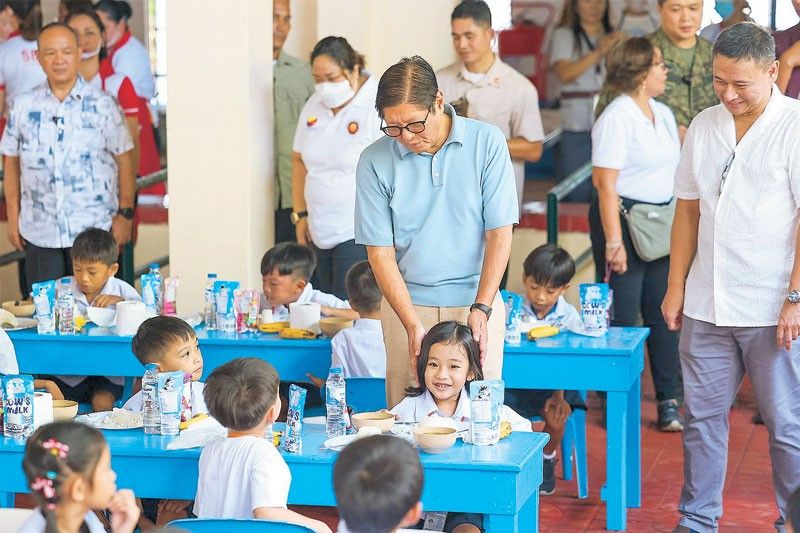
Philippines Launches Nationwide Expanded School Feeding Program to Combat Malnutrition
Philippine President Marcos launched the nationwide expansion of the School-Based Feeding Program (SBFP) to combat child malnutrition and improve academic performance, extending universal feeding to all Kindergarten and Grade 1 public school learners.
MANILA, Philippines — President Marcos launched yesterday the nationwide expansion of the School-Based Feeding Program (SBFP) to address child malnutrition and to promote the health, well-being and academic success of Filipino learners. The launch, held under the theme “Creating a Future Where No Child Goes Hungry” at Pulilan Central School in Bulacan, coincided with the national observance of Nutrition Month and marked the national kick-off of the SBFP and milk feeding activity. In his remarks during the program’s launch, Marcos said hunger remains one of the factors affecting children’s ability to learn. “We used to have a feeding program, but it was inadequate because we had to be selective – choosing only those who lacked food or weren’t eating well enough. Let us not be selective about who receives aid and who is excluded from the feeding program,” he said. Education Secretary Sonny Angara and Agriculture Secretary Francisco Tiu Laurel Jr. also attended the launch. The expanded program introduces universal feeding for all Kindergarten and Grade 1 public school learners nationwide while continuing to provide hot meals, nutritious food products and milk to Kindergarten learners and Grades 1 to 6 learners identified as severely wasted or wasted. In the Philippines, “severely wasted” refers to children with extremely low weight-for-height, indicating acute malnutrition and placing children at high health and developmental risks. “Wasted,” meanwhile, means moderately low weight-for-height. Angara said the initiative is complemented by targeted nutritional support for undernourished learners in Grades 2 through 6, ensuring that the most vulnerable students receive the critical resources needed to thrive academically. The expansion comes amid findings that the stunting rate among children under five years old has reached 25.3 percent, equivalent to roughly one in four children. “Every percentage point represents a Filipino child whose potential is being compromised. This expanded feeding program is our decisive commitment to reversing these numbers and ensuring that our learners have the foundation they need to thrive in the classroom and in life,” Angara said, adding that it will provide meals to beneficiaries for at least 180 school days throughout the academic year. About P26 billion has been earmarked for the program’s implementation this year. To ensure the program’s long-term sustainability, Angara and Laurel signed a joint administrative order institutionalizing the partnership between the Department of Education and the Department of Agriculture. “From now on, (our farmers’) market is guaranteed, because this is where we will bring their produce to feed our youth,” Marcos said. The agreement taps the expertise of the National Dairy Authority and the Philippine Carabao Center in implementing the milk-feeding component of the program. Simultaneous regional kick-off events were held nationwide to signal the program’s extensive rollout. At Pulilan Central School, 775 learners benefited from the program yesterday, including all 294 Kindergarten pupils, 369 Grade 1 learners and severely wasted or wasted learners from Grades 2 to 6. The expanded SBFP is being implemented under Republic Act 11037 or the Masustansyang Pagkain para sa Batang Pilipino Act. As the government rolls out the expanded SBFP, lawmakers are pursuing further reforms to broaden its coverage. The House of Representatives has approved a bill seeking to transform the National Feeding Program into a comprehensive National Nutrition Program to further combat hunger and malnutrition among children. Pasig Rep. Roman Romulo said the proposed measure broadens coverage to all public school learners from Kindergarten to Grade 3 and undernourished students up to Grade 12. “The measure provides an alternative feeding program as we don’t have enough cows and carabaos. Even if we have enough numbers, we don’t have a storage facility,” he said, adding that the House is awaiting Senate action on a counterpart measure. – Bella Cariaso, Ramon Efren Lazaro
多角的分析
学童給食プログラムの全国展開は、食料生産者(特に農業部門)への需要創出という点で経済効果が期待できる。農業省との連携は、国内農産物の安定的な市場を確保し、農家所得の向上に寄与する可能性がある。しかし、約260億ペソという巨額の予算がどのように調達・執行されるか、そしてその経済波及効果が持続可能かどうかが鍵となる。また、食料価格の変動がプログラムのコストに与える影響も注視する必要がある。
このプログラムは、長期的な人的資本への投資と見なすことができる。健康で学業成績の良い子供たちは、将来の労働力として経済成長に貢献する。投資家にとっては、食料供給チェーン、栄養補助食品、教育関連サービスなど、関連分野でのビジネスチャンスが増加する可能性がある。ただし、政府予算への依存度が高いため、財政状況の安定性が投資リスクとなりうる。
発育不全(Stunting)率が25.3%に達している現状は、フィリピン社会における栄養問題の深刻さを示している。このプログラムは、特に貧困層や地方の子供たちにとって、栄養改善と教育機会の均等化に大きく貢献する。しかし、プログラムの恩恵が全国の全ての対象者に公平に行き渡るか、また、給食の質と安全性が維持されるかが、社会的な課題となる。保護者からは、子供たちの健康状態の改善への期待とともに、学校給食の安定供給への要望が出ている。
このプログラムは、全国の幼稚園児と小学1年生全員に給食を提供するという点で、多くの子供たちの食生活を直接改善する。特に、家庭での食事が十分でない子供たちにとっては、学校給食が健康的な成長と学習のための重要な栄養源となる。保護者からは、子供たちの健康状態の改善への期待とともに、給食の質と安定供給への懸念も聞かれる。また、地方では、学校給食が子供たちの通学の動機付けにもなりうる。
背景・歴史的文脈
フィリピンでは、長年にわたり子供たちの栄養失調問題が深刻な社会課題となっている。特に、発育不全(Stunting)は、身体的・認知的な発達に長期的な悪影響を及ぼし、国の人的資本の低下につながる。過去にも学校給食プログラムは存在したが、対象や予算が限定的であり、全ての子供を網羅するには至っていなかった。2018年に制定された「Masustansyang Pagkain para sa Batang Pilipino Act」(子供のための栄養ある食事法、RA 11037)は、学校給食プログラムの実施を法制化し、栄養失調対策を強化する基盤となった。今回のプログラム拡大は、この法律の実施をさらに進め、より広範な子供たちに栄養を届けるための政権の決断である。
原文ソース
Philstar Nation