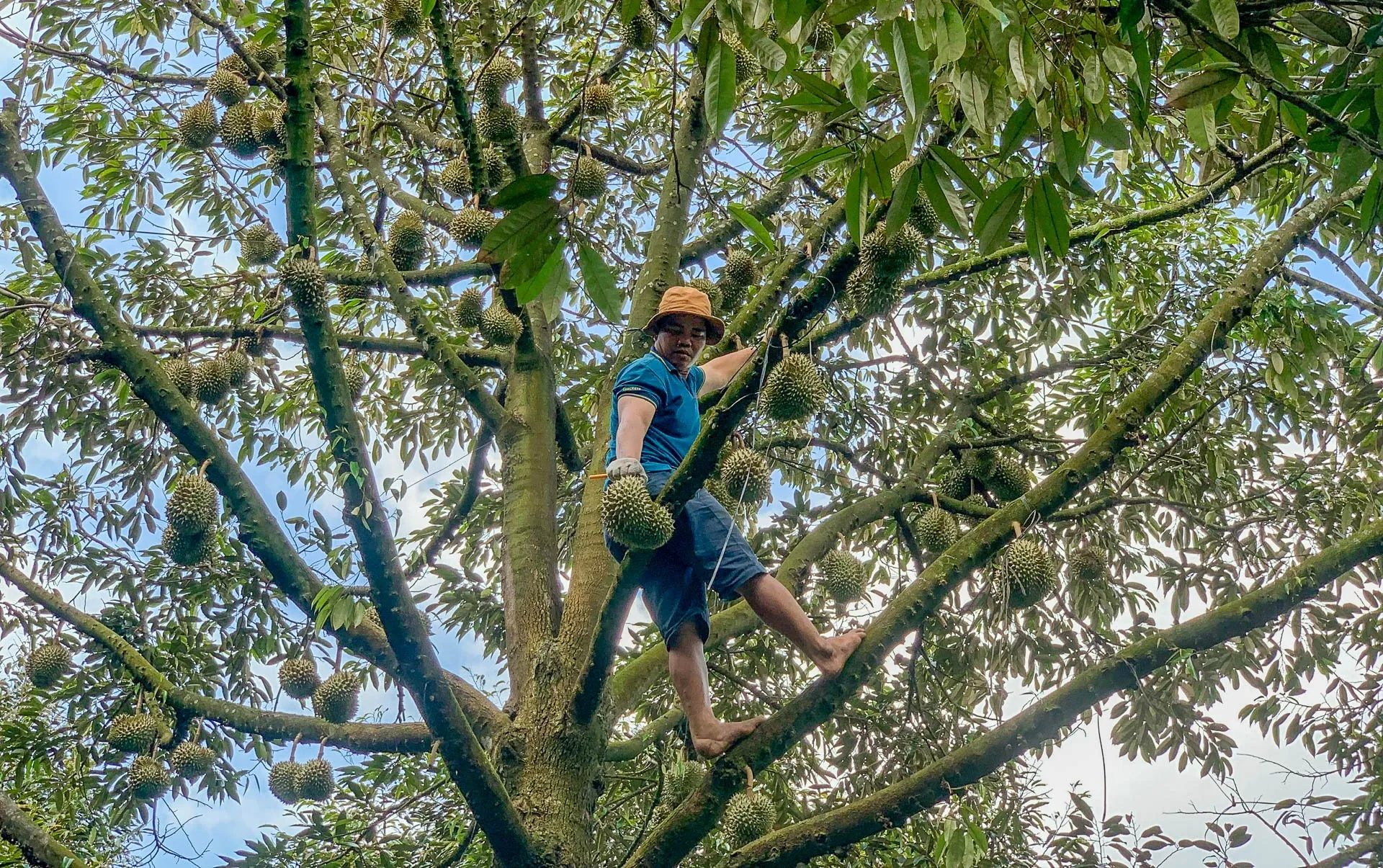
Ancient Durian Trees in Vietnam's Mekong Delta Yield Millions of Dong Daily for Harvesters
Economy
2026年7月28日
5
Vietnam Insider
Relations
🇻🇳Vietnam🇨🇳China

General articles are free for 24 hours after publish.

Ancient Durian Trees in Vietnam's Mekong Delta Yield Millions of Dong Daily for Harvesters

Share
AI Summary

The harvest season for nearly 30-year-old Ri6 durian trees in Can Tho City, Vietnam, is in full swing. Skilled harvesting teams, employing advanced techniques to prevent damage from high falls, are earning between 700,000 and 2 million VND daily.

Amid the intense western sunshine, Mr. Bay Nho’s orchard of over 150 Ri6 durian trees—nearly 30 years old, located in Phong Dien commune, Can Tho city—has entered its busiest harvest season of the year. From early morning, cheerful shouts, the sound of touching bamboo poles, and the thud of durian fruit hitting catching nets create a vibrant atmosphere across the entire orchard. Harvesting teams work continuously into the afternoon to keep pace with trader delivery schedules. Mr. Bay Nho’s nearly 30-year-old Ri6 durian orchard in Phong Dien commune, Can Tho city, enters its main harvest season. A bustling harvest atmosphere engulfs the durian orchard as many people hustle from early morning. Harvesting ancient durian trees resembles a circus performance, requiring split-second coordination between the cutter high up in the tree and the catcher down on the ground. What leaves many first-time spectators breathless is watching 3 to 5 kg durians—sometimes even larger—dropped from dozens of meters high while remaining entirely intact, free of scratches or cracked husks. To achieve this, each tree typically requires two workers cooperating smoothly. One climbs the tree with a bamboo pole to spot ripe fruit and cut the stem. Down below, the other worker stays on high alert, eyes fixed on the canopy to maneuver the catching net right under the falling fruit. Just a few seconds of hesitation or a miscalculated landing spot can send the durian crashing to the ground, causing bruises and cracks that destroy its value. A harvester climbs dozens of meters high into the tree to cut ripe durians. Mr. Nguyen Anh Tuan, a veteran durian harvester, notes that the job looks simple from afar but carries immense pressure. The worker below keeps his eyes locked on the canopy, quickly adjusting the catching net to securely catch the falling durian. Mr. Nguyen Anh Tuan (30 years old), a harvester with many years of experience, explains that the job looks simple from afar but carries immense pressure. “Every single durian holds high value. If we let one drop hard, crack, or bruise its thorns, the orchard owner takes an immediate loss, so we must be extremely careful and perfectly coordinated,” he says. Fruits located near ditches or hidden deep inside the canopy demand even higher precision. After cutting the stem, the worker must calculate the exact fall trajectory, sometimes using a net to guide the fruit safely and prevent collisions or falls into the water. Alongside the harvesting crew, “durian tappers” work frantically all season long. Their job is not to cut the fruit, but to pinpoint the exact moment of harvest. This craft demands deep expertise, because a miscalculation of just a few days can ruin the quality of the durian flesh. Before tapping, workers usually ask the owner how many days have passed since fruit set. Depending on the variety, some take about 90 days, while others require 110 to 120 days. Next, they inspect the stem, husk color, and thorns. By experience, a darker husk and slightly wrinkled thorns signal that the fruit has reached maturity. The most crucial step is the tapping technique. Workers gently tap the husk with a knife handle or a metal rod. A hollow “bop-bop” sound indicates optimal ripeness, whereas a heavy, solid sound means the fruit remains unripe. According to skilled workers, just a few taps are enough to determine whether a fruit is ready to be cut. Mr. Thanh, a Can Tho local with years of experience tapping durians, admits that telling ripe fruit from green fruit is not too difficult, but identifying “mature,” “near-mature,” and “underripe” fruit is a rare skill. “Some Ri6 orchards are extremely tricky to gauge. A fruit might sound completely ready, but once opened, the flesh is still immature because the tree lacked water or dropped leaves, altering the ripening pattern,” he shares. After harvesting, workers count and sort the durians by size before loading them onto vehicles bound for collection points. Harvested durians are loaded onto wheelbarrows to be transported to the collection point. Harvested durians are gathered into large piles to be counted and sorted. During peak days, harvesting teams work almost nonstop. Many start early in the morning and labor until late at night to fulfill orders. In return, the pay is quite attractive. Some orchard owners pay based on volume, while others hire workers monthly with productivity bonuses. On average, each worker earns between 700,000 VND and 2 million VND daily. The skilled trade of “tapping” on durians brings in a daily income of millions of VND for local workers during the harvest. Mr. Duong Dinh Tuyen, nephew of orchard owner Bay Nho, shares that the over 150 Ri6 durian trees in the family orchard have been rooted there for nearly three decades. Despite weathering many rainy and sunny seasons, the orchard yields steady crops and serves as the family’s main source of income. “Every season, seeing the trees loaded with fruit brings immense joy. It provides our family with an income while creating jobs for local workers throughout the harvest,” Mr. Tuyen expresses. Mr. Duong Dinh Tuyen, nephew of orchard owner Bay Nho, stands beside a pile of freshly harvested durians. The Ri6 durian orchard, with over 150 trees nearly 30 years old, is entering its main harvest season of the year. Photo: Collected Subscribe to get the latest posts sent to your email. Type your email… Subscribe

0

Original source

Vietnam Insider

原文を読む