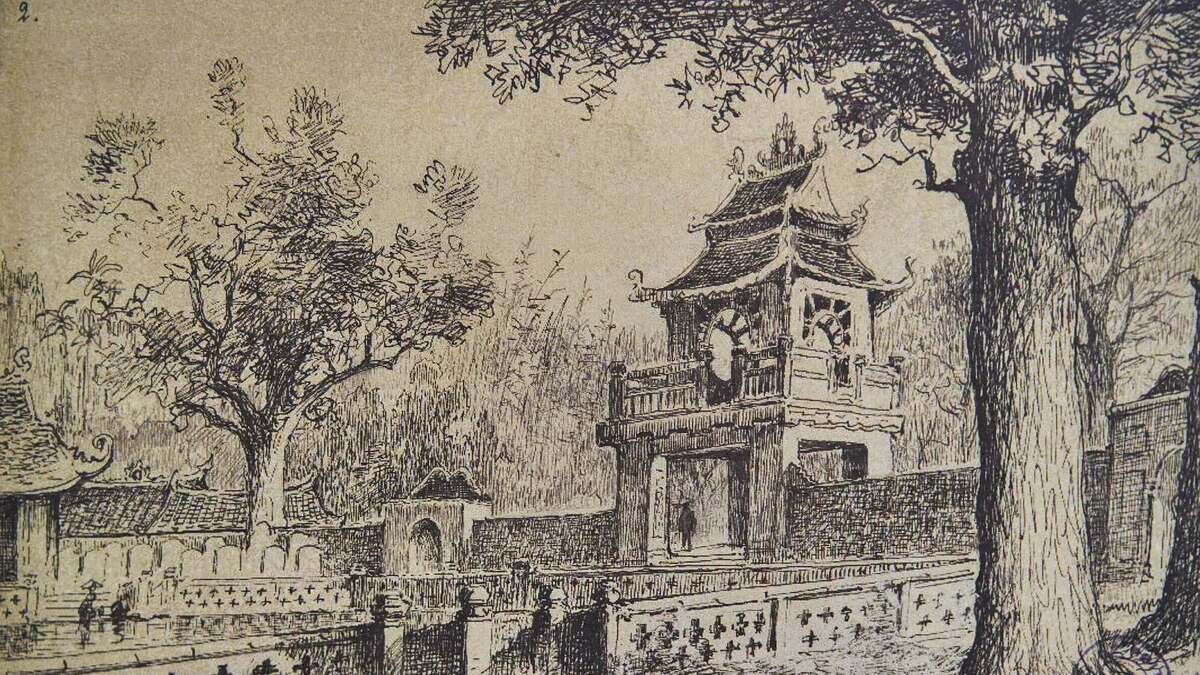
Vietnam's Sacred Site Depicted Through Art Across Eras
Health
2026年7月13日
5
VnExpress

Vietnam's Sacred Site Depicted Through Art Across Eras

AI サマリー

An exhibition in Hanoi's Temple of Literature and Imperial Academy showcases artworks from the late 19th century to the present, featuring French and Vietnamese artists. It highlights the site's historical evolution and diverse artistic interpretations.

An exhibition in Hanoi's Temple of Literature and Imperial Academy is showcasing artworks that capture the historical site's past, primarily featuring French artists from the late 19th and early 20th centuries. This collection offers a glimpse into the evolution of one of Vietnam's most significant cultural and educational landmarks. The exhibition includes an early sketch of the Temple of Literature by French artist Gaston Roullet, created during his travels in Vietnam between 1885 and 1886. Roullet described Hanoi at the time as "a place that is lively and bustling everywhere, no matter how hard I try, I cannot capture it; it is a truly incomprehensible, bustling scene. Hanoi is very crowded, with at least 100,000 inhabitants." A painting titled "Landscape of the Temple of Literature" by François de Marliave, dated 1920, depicts the site during a period of decline for Confucian scholarship. As it was no longer the vibrant center of academic education, the Temple of Literature had become a place of solemnity and desolation, leading the French to refer to it as the "Pagoda of Crows." The artist was drawn to the tranquil atmosphere of the relic and its moss-covered walls hidden under the shade of ancient trees. Works by other artists, including Jos-Henri Ponchin and Alix Aymé, a female painter who developed a deep connection with Vietnamese culture, are also on display. Aymé taught art in Hanoi and was also a lecturer at the Indochina School of Fine Arts. The 20th-century appearance of the steles of the laureates at the Temple of Literature and Imperial Academy is rendered through the brushstrokes of Henry Emile Vollet, a French painter who received an honorary award at the Salon des Artistes Français in 1888. Bùi Xuân Phái, a renowned Vietnamese painter, contributed "Visiting the Temple of Literature" in 1984. This work signifies a shift in his style from nostalgic reminiscence to expressing faith in the future. Unlike the often somber and contemplative "Phố Phái" (Phái's Streets), this oil painting features bright colors, conveying a love for life and an optimistic outlook. Trịnh Hữu Ngọc, trained at the Indochina School of Fine Arts, created "Within the Area of the Steles" in 1975. He is known for numerous works depicting the simple, rustic life of the Hanoi countryside. His son, artist Trịnh Lữ, recently launched a book about his father's career. According to curator Nguyễn Thế Sơn, many artists from the Indochina art generation have depicted the Temple of Literature and Imperial Academy, with Trịnh Hữu Ngọc being the most prolific, producing dozens of works on this theme. The exhibition also features contemporary artists' creations in diverse mediums such as silk, lacquer, photography, and multimedia installations. "Sketch of the Imperial Academy Garden" by Phạm Ngọc Trâm, made with silk embroidery on silk, captures the artist's impressions during an early morning stroll through the garden. Nguyễn Thế Sơn stated that the exhibition, prepared over several months, aims to be a gathering and artistic dialogue among generations of artists and architects, both domestic and international. He hopes the nearly 60 works will offer a compelling perspective on this historical and cultural space. Source: VnExpress

多角的分析

経済的影響

このニュースは直接的な経済活動を扱っているわけではないが、文廟・国子監のような文化遺産への関心は、国内観光の活性化や文化産業の発展に間接的に寄与する可能性がある。特に、歴史的建造物の保存・修復には継続的な投資が必要であり、その経済的価値を再認識させる契機となりうる。また、過去の芸術作品の評価や取引は、文化市場の動向を示す指標ともなりうる。

投資家心理

文化遺産や芸術作品への投資は、伝統的な金融市場とは異なるリスク・リターン特性を持つ。文廟・国子監のような歴史的価値の高い遺産は、長期的な資産価値の維持・向上に繋がる可能性があるが、その評価は専門家の鑑定や市場の需要に大きく左右される。今回の展覧会は、ベトナムの文化資産への関心を高め、文化関連分野への投資機会を探るきっかけとなるかもしれない。

社会的影響

文廟・国子監は、ベトナムの学問と教育の象徴であり、国民のアイデンティティに深く根差している。今回の展覧会は、過去の芸術作品を通して、この聖地の歴史的変遷と、時代と共に変化する人々の文廟への関わり方を可視化する。特に、フランス人画家による植民地時代の視点と、ベトナム人画家による現代的な解釈の対比は、歴史認識や文化の継承のあり方について、社会的な議論を促す可能性がある。また、現代アーティストの作品は、若い世代が伝統的な遺産とどのように向き合っているかを示す。

市民の声

今回の展覧会は、ハノイ市民にとって、身近な歴史的建造物である文廟・国子監の新たな一面を発見する機会となるだろう。特に、かつて教育の中心であった場所が、時代を経てどのように姿を変え、そして芸術家たちにインスピレーションを与え続けているのかを知ることは、地域への愛着を深めることに繋がる。また、フランス人画家が描いた賑やかな当時のハノイの様子は、現代の都市生活とは異なる活気を感じさせ、過去への想像力を掻き立てるだろう。

背景・歴史的文脈

文廟・国子監は、1070年に李朝の皇帝により創建され、ベトナム最古の大学として科挙制度の中心を担った。1075年には最初の科挙が実施され、多くの知識人や官僚を輩出した。しかし、19世紀末のフランス植民地時代に入ると、西洋式の教育制度が導入され、伝統的な科挙制度は徐々に衰退していった。文廟・国子監はその教育的役割を失い、一時的に荒廃したが、その歴史的・文化的重要性から保存され、現在は国の特別な史跡として保護されている。今回の展覧会は、こうした歴史的変遷を、芸術作品を通して浮き彫りにしている。

原文ソース

VnExpress

原文を読む