Hanoi Residents Endure Life in 'Truncated' Homes Amid Infrastructure Projects
Infrastructure
2026年7月3日
5
VnExpress

Hanoi Residents Endure Life in 'Truncated' Homes Amid Infrastructure Projects

AI サマリー

In Hanoi, numerous residents continue to live in 'truncated' homes, with parts of their houses cut off due to land acquisition for major infrastructure projects. Despite facing inconveniences, some express understanding for the nation's development.

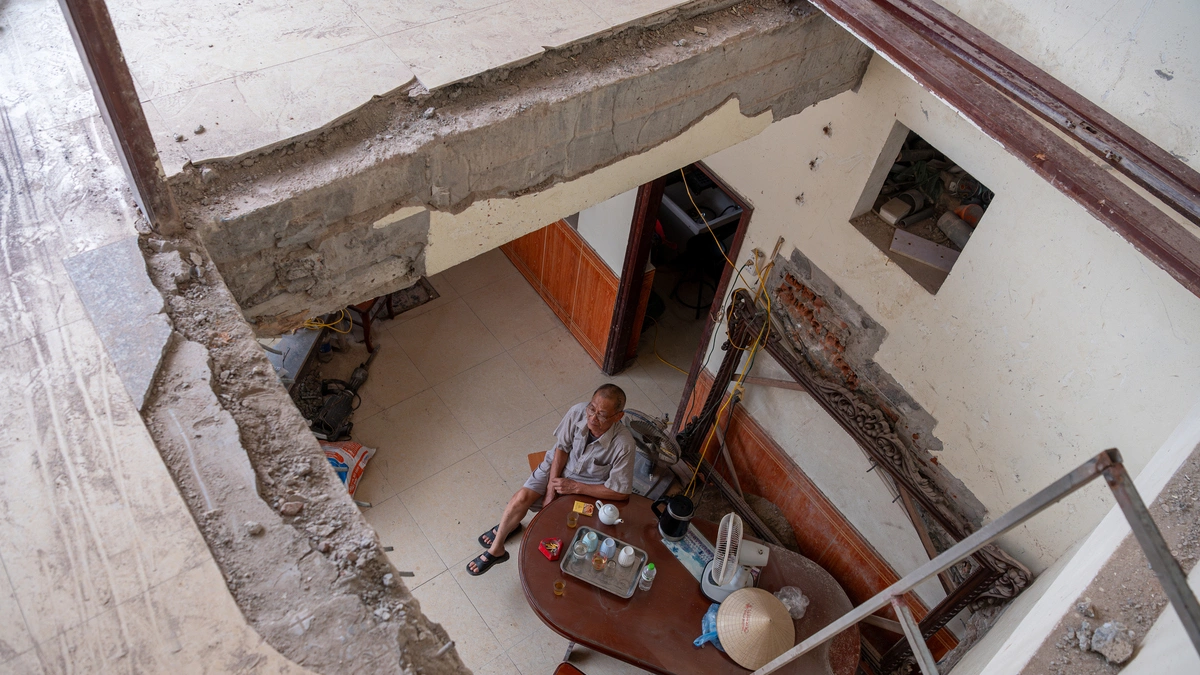
As Hanoi pushes forward with ambitious infrastructure development, a stark reality emerges: numerous residents are forced to live in 'truncated' homes, their houses partially demolished to make way for progress. The ongoing construction of key transportation and infrastructure projects, including the Tran Hung Dao Bridge and sections of Ring Road 1 and Ring Road 2.5, is transforming the urban landscape. However, this transformation often leaves behind homes with gaping holes where rooms once stood, as residents grapple with inconvenient living conditions. For instance, a five-story house that once spanned nearly 300 square meters along Ring Road 1 has been significantly reduced, leaving only a provisional structure. Residents continue to inhabit these incomplete dwellings as they await permits for repairs and renovations. Nguyen Trong Hung, whose nearly 200-square-meter house was reduced to a small fraction after land acquisition for the Linh Nam road expansion, still lives there, though his elderly parents have moved elsewhere for more comfortable living, away from the construction dust. Hung himself often keeps his windows shut to mitigate noise and pollution from the site. Similarly, Mr. Nguyen Quang, 70, had nearly 30 square meters of his home on Trung Kinh Ha, Yen Hoa ward, reclaimed for Ring Road 2.5, leaving him with 51 square meters. He and his wife are undertaking repairs, but the simultaneous construction boom in Hanoi has led to a shortage of labor, delaying their progress. The estimated cost for renovation runs into hundreds of millions of Vietnamese dong, including plans to remove and rebuild the staircase to optimize floor space. What was once a home for ten family members has now been reduced to just the elderly couple, with younger generations relocating. Another resident, Mr. Nguyen Anh Tu, lives in a home where over 10 square meters, previously his kitchen and bathroom, were handed over for the Tran Hung Dao Bridge project, causing significant inconvenience. His actual usable living space is less than 30 square meters, despite the remaining area being around 51 square meters, due to exposed sections from the demolition. Mr. Hoang Van Thuan, 68, now occupies just 29 square meters after land acquisition for a project, having lost his staircase, kitchen, and bathroom. Personal hygiene is managed temporarily in the cleared ground in front of his house, which remains littered with debris. While his family members have moved to rented accommodation for convenience, Thuan remains to guard the property, enduring the difficult conditions. He expresses support for the government's large-scale projects, acknowledging that his situation is better than many others facing greater hardship. In another case, a house was reduced to less than 7 square meters from nearly 33 square meters, with three sibling families now sharing the remaining small plot. The cramped conditions severely limit their daily activities, forcing cooking, dining, and sleeping within the minimal remaining area or the debris-strewn front yard. These situations highlight the complex trade-offs between rapid urban development and the daily lives of residents in Hanoi. While many residents show understanding for the nation's development goals, the challenges of balancing infrastructure needs with the well-being and living conditions of the affected population remain a pressing issue.

多角的分析

経済的影響

ハノイにおけるインフラ開発は、都市の機能性向上と経済成長の推進を目的としている。しかし、土地収用に伴う住民の住居への影響は、短期的な経済的損失(補償不足、改修費用)と長期的な生活の質の低下を招く可能性がある。特に、職人不足による改修遅延は、経済活動への間接的な影響も示唆している。これは、開発と住民生活の間の経済的バランスの難しさを示している。

投資家心理

インフラ開発は、投資家にとって長期的な成長機会を提供する一方で、このような住民生活への影響は、プロジェクトの遅延リスクや、地域社会からの反発といった潜在的なリスク要因となりうる。直接的な投資対象ではないが、社会的な安定性は、外国投資を呼び込む上での重要な要素であるため、無視できない。

社会的影響

インフラ開発の恩恵を受ける層と、その犠牲を強いられる層との間に、新たな社会的な格差が生じている。特に、高齢者や大家族は、不便な住居環境への適応や、移転先探しに苦慮する可能性が高い。一方で、開発を支持する声は、国家発展への期待と、個人の負担を相対化する意識の表れとも考えられる。これは、社会全体の利益と個人の権利との間で生じる摩擦である。

市民の声

環状道路建設のために家屋の一部が失われた住民は、粉塵や騒音に悩まされ、日常生活に大きな支障をきたしている。改修が遅れることで、生活空間の確保や衛生状態の維持が困難になっている。しかし、彼らの多くは、国の発展のために不可欠なプロジェクトであると理解を示し、不便ながらも生活を続けている。これは、公共の利益のために個人的な犠牲を甘受する、ベトナム社会に根付く価値観の一端を示唆している。

背景・歴史的文脈

ベトナムでは、経済改革(Đổi Mới)以降、都市化とインフラ整備が急速に進展している。特にハノイのような大都市では、人口増加と経済成長に対応するため、道路網の拡充や公共交通機関の整備が喫緊の課題となっている。これに伴い、広範な土地収用が行われるが、そのプロセスにおいては、土地所有権や補償に関する住民との合意形成が、しばしば課題となる。過去にも同様のインフラプロジェクトで、住民の移転や住居の改修を巡る問題が報告されており、開発のスピードと住民生活の安定化との間のバランスが常に問われている。

原文ソース

VnExpress

原文を読む