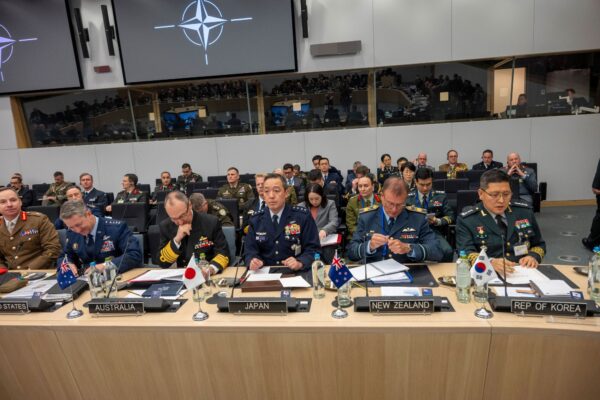
NATO-IP4 Relations Remain Strong Despite Leader Absence
The absence of Indo-Pacific partner (IP4) leaders at the 2026 NATO Summit, for the second consecutive year, is attributed to structural changes in the summit format and the practicalities of US presidential engagement, rather than a decline in interest. Deepened cooperation at the working level remains key to maintaining the relationship.
This article requires PRO
This article is outside the free access window or is a special report. PRO unlocks it and the full archive.
Related articles
- MK Finds No Proof of Gibran's High School Diploma, Romli Stresses Moral Responsibility
Indonesia's Constitutional Court (MK) found no evidence that Gibran Rakabuming Raka, President Joko Widodo's eldest son and Mayor of Surakarta, possesses a high school diploma or equivalent. Political activist Guntur Romli emphasized the importance of moral responsibility in this situation.
- MK's Ruling on Gibran's High School Diploma, Deputy Speaker Dasco: 'Not Yet Studied'
Indonesia's Constitutional Court (MK) has made a ruling regarding Gibran Rakabuming Raka's high school diploma. However, the Deputy Speaker of the House of Representatives stated they have 'not yet studied' the decision, drawing attention to future developments.
- Gibran Resignation Debate: A 'Hot Potato' from Constitutional Court to Parliament
Following the Constitutional Court's (MK) ruling on presidential candidate age requirements, the debate over whether young politician Gibran Rakabuming should resign has been passed to the People's Consultative Assembly (MPR). This decision marks a critical juncture in determining the future of the upcoming presidential election.
- Indonesia's Climate Diplomacy Questioned Amidst Oil & Gas Deal Linked to Presidential Envoy
Indonesia's decision to award the Natuna D-Alpha oil and gas block to a company linked to Presidential Envoy for Climate Change, Hashim Djojohadikusumo, is raising concerns about weakening its international climate diplomacy. The block, with its high CO2 content, is seen as a potential 'carbon bomb'.