General articles are free for 24 hours after publish.
Central Vietnam's $1.9B Inter-Regional Road Project Accelerates Amid Progress Hurdles
Construction of the Khanh Son - Khanh Vinh inter-regional road project, valued at over VND 1.9 trillion (approximately $77 million), is accelerating in Vietnam's central Khanh Hoa province. Efforts to resolve land acquisition and policy issues are progressing, with contractors speeding up remaining work. The road aims to connect three provinces and boost regional economic development.
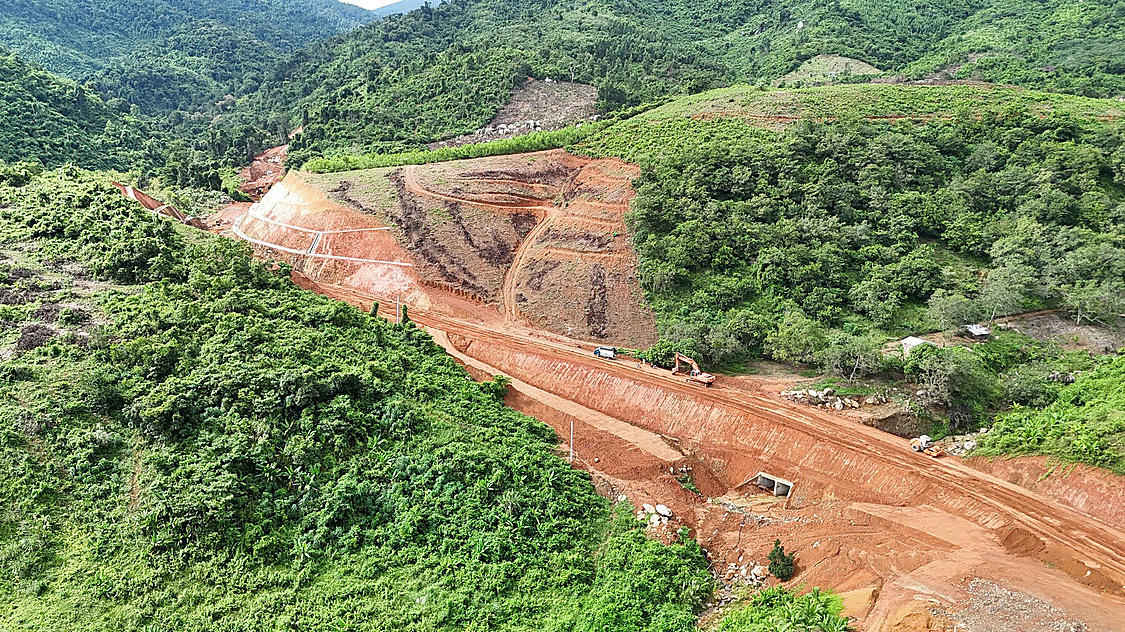
Khanh Hoa province in central Vietnam is accelerating the progress of the Khanh Son - Khanh Vinh inter-regional road construction project, with a total investment of over VND 1.9 trillion (approximately $77 million). Efforts to resolve land acquisition and policy issues are progressing, prompting contractors to speed up remaining work. The road project aims to connect National Highway 27C with Provincial Road 656, linking Khanh Hoa, Lam Dong, and Ninh Thuan provinces. Scheduled for implementation from 2023 to 2027, the project's total investment is VND 1.93 trillion, funded by VND 1 trillion from the central budget's medium-term public investment plan for 2021-2025 and VND 930 billion from the local budget. The project will occupy approximately 128.96 hectares of land, with about 75.58 hectares requiring a change in forest land use. The project is divided into three sections: Section 1 is approximately 12 km long, Section 2 is about 30 km and passes through natural forests, protected forests, and mountainous terrain, while Section 3 is 14.7 km. To date, compensation, support, and resettlement plans for Sections 1 and 3 have been approved, with payments completed for 1,043 out of 1,061 cases (98.30%). Remaining cases are due to recipients being located far away. For Section 2, the change in forest land use has been approved, and the processing of timber from harvested forests will be conducted through auctions. Relocation of medium and low-voltage power lines is 99% complete, streetlights are 90% relocated, and water pipeline systems are about 45% moved. In terms of construction, Sections 1 and 3 have seen 20.5 km out of 26.7 km of land cleared (76.78%), with earth filling, culvert, and bridge construction underway. Section 2 is in the process of roadbed excavation and filling, forming the road shape, and constructing culverts and subgrade excavation. Le Huyen, Vice Chairman of the Khanh Hoa Provincial People's Committee, acknowledged the project's delays but noted that many past issues, including policy and land acquisition, have been gradually resolved. Contractors are focusing on overcoming delays and accelerating remaining tasks. The province plans to develop detailed weekly and monthly progress schedules, specifying tasks and required work volumes. Immediate goals include completing remaining tasks for 2026, followed by specific targets for work volume and progress in 2027. The oversight delegation from the National Assembly's Committee for Science, Technology and Environment praised the province's efforts in overcoming difficulties and achieving notable results. However, they pointed out discrepancies between the compensation payment completion rate and the actual handed-over land, as well as between handed-over land and construction volume and quality. They stressed that disbursement rates should not substitute for construction completion rates. The delegation urged the province to definitively resolve site clearance and material supply issues in Section 2 and adhere to the principle of handing over land as logging progresses. For areas cleared for handover, clear records of scope, timing, and responsibility should be made, without waiting for the entire area to be logged. Furthermore, the delegation instructed the project investor to direct contractors to organize the clearing and opening of access roads on suitable land, combining timber transport with access to excavation sites to maximize stone utilization. Stone exploitation, recovery, processing, and use must comply with approved plans, technical requirements, and environmental standards.
Original source
VnExpress