General articles are free for 24 hours after publish.
Cambodia Opens Former Scam Compound to Media Ahead of International Conference
Cambodia's government granted media access to the massive former online scam compound "No. 8 Park" ahead of an international anti-scam conference. While authorities tout their crackdown, questions remain about the involvement of influential figures.
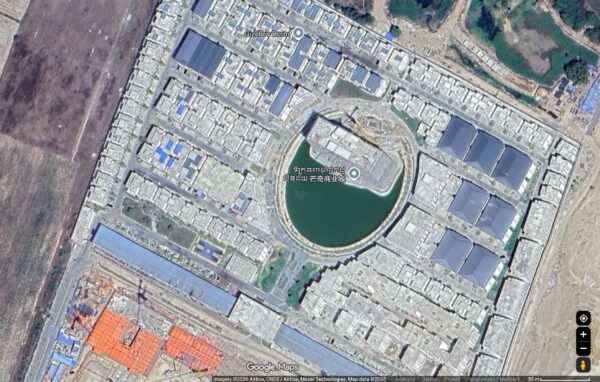
Read The Diplomat, Know The Asia-Pacific Despite touting its anti-scam credentials, it is unclear whether Phnom Penh will investigate prominent individuals who allegedly enabled and profited from the industry. A Google Maps satellite image of the No. 8 Park online scamming complex in Kamchea Mea district, Prey Veng province, Cambodia. Cambodia’s government yesterday granted the media access to a massive former online scam compound in the country’s southeast, as it prepares to host a high-profile international anti-scam conference later this week. Journalists from 39 domestic and international media organizations visited the former cyberscam compound known as “No. 8 Park,” a fortified and self-contained compound in Prey Veng province capable of housing around 20,000 people. According to a report in the Phnom Penh Post, the No. 8 Park, also known as the Meun Chey Commercial Center, began construction in 2023. The compound covers about 120 hectares and “contains numerous buildings, including residential blocks, offices, a market and shops, with a casino at its center.” It added, “The sheer scale of the site resembled a small, enclosed town.” Authorities say that they raided the No. 8 Park complex in February, based on information from China’s Ministry of Public Security, the U.S. Federal Bureau of Investigation and tips and allegations made by individuals who had escaped from the compound. Inside the complex, journalists were shown evidence of the sophisticated online scams that were recently carried out by No. 8 Park’s huge staff of trafficked workers. According to a report by The Standard, rooms were set up to resemble foreign law enforcement offices, including one with signage for the “Singapore Police Force Commercial Affairs Department” that was used by scammers posing as police and financial crime investigators. Another room featured a Chinese slogan: “Please don’t pretend to work hard, because the result won’t act with you.” The media visit was intended as a prelude to the two-day International Conference on Combating Online Scams, which opens in Phnom Penh tomorrow, and is set to be attended by representatives from more than 20 countries. The conference, which will be co-hosted by Interpol, the U.N. Office on Drugs and Crime, and China’s Lancang Mekong Cooperation mechanism, is intended to showcase the extent of the government’s ongoing anti-scam crackdown. Phnom Penh launched the crackdown last year in response to the growing international scrutiny of Cambodia’s central role in Southeast Asia’s scamming economy, which Thailand attempted to weaponize during the two nations’ border conflict last year. As part of the campaign, the government set up an ad hoc Commission for Combating Online Scams, passed a law outlawing cyberfraud, and launched raids on dozens of scamming compounds across the country. The government claims that it has now investigated over 830 suspected scam sites and dismantled 86 large compounds since July 2025. It also says it has deported more than 20,000 foreign suspects, and Cambodian newspapers have been filled with reports of the arrests of low- and mid-ranking officials for involvement in scams. Late last month, Senior Minister Chhay Sinarith, who heads the government’s ad hoc Commission for Combating Online Scams, declared that “large-scale scam activities have been brought fully under control, and there are currently no online scam compounds remaining in the country.” While the current crackdown is serious and has far exceeded authorities’ previous efforts, there are good reasons to believe that the political economy that facilitated the country’s takeover by criminal scamming gangs remains more or less intact. For decades, Cambodia’s political system has conferred special privileges on those with close connections to the ruling Cambodian People’s Party (CPP) and to the family of long-ruling Prime Minister Hun Sen. As I detailed in my 2014 book on Cambodia under Hun Sen, this system grants powerful individuals considerable autonomy to amass wealth – even from business of an illicit nature – and liberates them from the constraints of the law, as long as they remain politically loyal to the CPP and provide the party with financial backing when required. While the Cambodian authorities were happy to fling open the gates of No. 8 Park to the press yesterday, they are much less keen to trace the threads of accountability for this and other compounds upwards. Over the past five years, reporters and rights groups have assembled an abundant corpus of evidence that scamming operations have flourished in Cambodia due to the protection or backing of powerful businesspeople linked to the CPP. The businessmen Ly Yong Phat and Kok An, both close allies of the Hun family going back decades, have been sanctioned by the U.S. for their alleged involvement in running scam centers. There have been many others. Last week, two leading U.S. congressmen called on the Trump administration to investigate 28 individuals and entities, most of them Cambodian, for possible links to scam operations and to impose sanctions if warranted. They claimed that “corrupt” senior government officials in Cambodia, as well as in Myanmar and Laos, had “turned a blind eye to this criminal activity at a shocking scale.” Among the most prominent Cambodian names on the list were Interior Minister Sar Sokha, Deputy Prime Minister and former national police chief Neth Savoeun, and deputy Cambodian police chief Dy Vichea, a son-in-law of former Prime Minister Hun Sen. Also listed was the name of Hun To, a cousin of Cambodian Prime Minister Hun Manet, who has acknowledged owning a 30 percent share in Huione Pay PLC, a digital payments platform sanctioned by the U.S. government for alleged money laundering and ties to transnational scam operations. There are also connections between No. 8 Park and Cambodia’s elite. The Blockchain analysis firm Elliptic reported in February that Huione Group’s payment and logistics businesses operated a physical store within the No. 8 Park compound, with the crypto addresses of 10 merchants receiving about $393,000 in Tether in January alone. Legend Innovation, the Cambodian company that ran No. 8 Park, has also been linked to Prince Group, a sprawling conglomerate that was jointly sanctioned by the United States and U.K. in October for running a “criminal empire built on forced labor and deception.” The sanctions targeted 146 individuals and entities connected to Prince, including its 38-year-old chairman Chen Zhi, who served as an advisor to both former Cambodian Prime Minister Hun Sen and his son and successor Hun Manet, and was the recipient of the neak oknha honorific, which is granted to the ruling CPP’s most generous benefactors. (The U.S. State Department yesterday announced visa restrictions against 32 additional unnamed individuals linked to Prince Group.) While the Cambodian authorities did arrest and extradite Chen to China in J
Original source
The Diplomat Indonesia