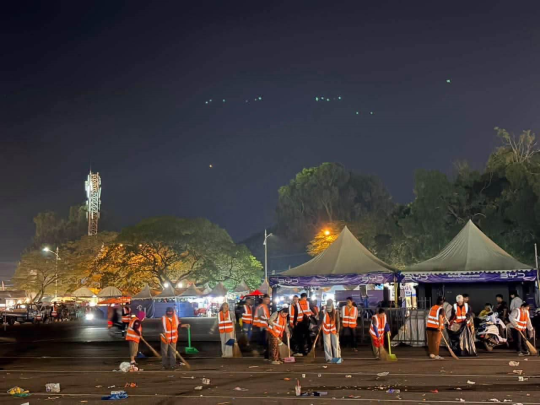
Over 200 Sanitation Workers Deployed for Luang Festival Cleanliness
A waste management company deployed 280 sanitation workers and specialized equipment, operating 24/7, to maintain cleanliness during the Luang Festival in Vientiane, Laos. The initiative aimed to ensure smooth festival operations and environmental preservation.
This article requires PRO
This article is outside the free access window or is a special report. PRO unlocks it and the full archive.
Related articles
- Houaphanh Villagers Seek New Livelihoods as River Remains Unusable After Mine Spill
Residents in Houaphanh Province, northern Laos, are facing severe impacts on their water supply and fishing due to a mud spill from a rare earth mine. They struggle to secure alternative water sources, with no clear timeline for compensation or environmental recovery.
- Laos Rail Workers Launch Work-to-Rule Campaign, Disruptions Feared
Unionized workers of Korea Railroad Corp. (KORAIL) in Laos have launched a work-to-rule campaign starting November 26, demanding improvements to the promotion system and other benefits. This action is likely to cause delays and disruptions across national rail services, including KTX and SR high-speed trains. The union has threatened an indefinite general strike on December 10 if their demands are not met.
- Laos and Thailand Review Labour Cooperation, Seek to Improve Worker Protection
Laos and Thailand held a technical-level meeting in Vientiane on November 25, 2026, to review progress in labour cooperation and discuss measures to improve worker protection. The meeting reviewed the implementation of labour agreements between the two countries, confirming their contribution to worker rights protection and socio-economic development.
- Asia-Pacific Youth Face Future Gaps Between Potential and Opportunity, UNFPA Report Highlights
A UNFPA report reveals that nearly a billion young people in Asia and the Pacific are facing a disconnect between their potential and available opportunities, citing economic insecurity and inequality. It calls for investment in education, jobs, sexual and reproductive health, and meaningful youth participation in decision-making.