General articles are free for 24 hours after publish.
Communal Violence Spills Over India's Border into Nepal
Hindu-Muslim tensions and violence are escalating in Nepal's Tarai-Madhesh region, bordering India, fueled by the growing influence of Indian Hindu nationalist groups like the RSS. This trend, once rare in Nepal, is increasingly mirroring dynamics seen in northern India.
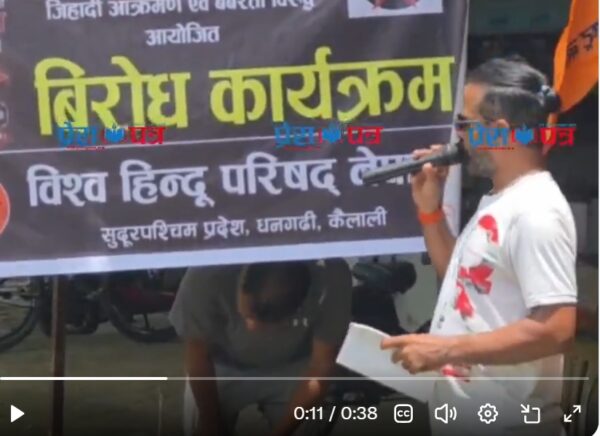
Read The Diplomat, Know The Asia-Pacific With the RSS steadily building on Nepali soil, Hindu-Muslim tensions and violence are growing, especially in Nepal’s Tarai-Madhesh region bordering India Screenshot of a video of a Vishwa Hindu Parishad meeting Dhangadi in Nepal on August 2, 2026, where activists shouted anti-Muslim slogans and called for the restoration of a Hindu state. Nepal’s Tarai-Madhesh region abutting India appears increasingly prone to religious strife. With the sway of India’s Hindu nationalist groups like the Rashtriya Swayamsevak Sangh (RSS) steadily building on Nepali soil, the country is also witnessing more Hindu-Muslim tensions. While common in north India, such incidents had been rare in Nepal until recently. Earlier this month, four Nepali youths were killed in clashes with police. The immediate cause of the incident was a Hindu procession passing through Dewanjung in Sunsari district, blasting loud music. The local Muslims protested. A clash ensued, police intervened and three youths were killed. (A fourth died in related protests in another district.) Local accounts suggest the Hindus in the area were already angry as the organizers of Muharram — a festival that marks the start of the Islamic calendar — had yet to remove some green pennants planted for the festival a month before. According to one newspaper investigation, there were at least 17 such incidents of Hindu-Muslim tensions in the Tarai belt in the past eight years. Earlier, Nepali Hindus seldom felt the need to publicly assert their religious identity. But as the Hindu forces in India started the rather brazen display of anti-Muslim activities starting in the early 1990s — most infamous of which was the 1992 demolition of the Babri Masjid in Ayodhya — the observation of Hindu festivals and rituals also began to change in Nepal. By the time of the inauguration of the Ram Temple in India’s Ayodhya in January 2024, rooftop saffron flags had become a common sight in Hindu homes in the Tarai-Madhesh. As religious identities became more publicly politicized, saffron flags were increasingly answered by green pennants in Muslim households. Again emulating practices across the border, elaborate religious processions accompanied by loud music also became common among Nepali Hindus and Muslims alike. The BJP’s rhetoric that all Muslims are basically anti-Hindu and must thus be resisted has also taken root thanks to the vocal advocacy of pro-Hindu, BJP-linked groups active in Nepal. They often cite reports of growing radicalization of madrassas in the region and entry of Rohingya refugees to justify their activism. The Indian security establishment under the BJP in particular has consistently pushed this line. Nepal’s interim constitution promulgated in 2007 following the end of the Maoist insurgency had declared Nepal a secular state. Yet by 2015, the demand for a Hindu state had again started gaining traction. One reason for India’s imposition of a months-long blockade on Nepal at the time of the promulgation of the new constitution in 2015 was that the Nepali political class had ignored the BJP-led government’s wish that the new charter restore Nepal as a Hindu state. Come 2026, the risk of the use of religion as a political tool is growing in Nepal. The country’s constitution bans the registration of political parties along religious lines. But if the polarization between Hindus on the one hand and Muslims (and even Christians) on the other keeps rising, major parties could face greater electoral pressure to more publicly embrace Hinduism: 81 percent of Nepalis are Hindu. There are already significant pro-Hindu state constituencies in all of Nepal’s major parties. The 2015 constitution, while declaring that the country is a secular state, added the rider that secularism also means “protection of religion and culture handed down from time immemorial.” As the phrase is commonly understood to refer primarily to Hindu traditions, the provision gives the majority faith an implicit constitutional privilege. This definition of secularism was a fudge to accommodate both pro-Hindu and secular constituencies. Yet such vagueness does not seem to be helping the cause of any community: A substantial share of Hindus want a de jure Hindu state; religious minorities, including Muslims who make up just over five percent of the population, feel more and more marginalized and want the Nepali state’s unconditional commitment to secularism. The risk is that these sporadic clashes will become systemic and more difficult for Kathmandu to control. The Balendra Shah government’s handling of recent tensions left a lot to be desired. At the start, the incident in Sunsari was treated as a law and order problem and Nepal Police used disproportionate force to contain rioters—which paradoxically inflamed the whole region. As communal tensions heightened across the Tarai-Madhesh belt, Prime Minister Shah refused to address the nation and appeal for calm. It was only when things threatened to spiral out of control that Shah finally addressed the country on the fifth day of the Sunsari police firing. Tensions began to die down the very next day. But to maintain lasting religious harmony and preserve Nepal’s secular character, there must be broad political consensus in favor of separation of religion and politics. This can include an explicit commitment by political parties not to campaign on religious lines and greater representation of minorities in local administration and policing. Unlike in India, Nepali political parties have a track record of setting aside their differences and uniting in the national interest during times of crisis. This time too all the major parties came together to appeal for communal harmony. Yet when political competition becomes centered on faith, compromise becomes far harder. As India’s example suggests, parties can bargain over policies and power, but rarely over sacred identities. Subscribe today and join thousands of diplomats, analysts, policy professionals and business readers who rely on The Diplomat for expert Asia-Pacific coverage. Get unlimited access to in-depth analysis you won't find anywhere else, from South China Sea tensions to ASEAN diplomacy to India-Pakistan relations. More than 5,000 articles a year. Already have an account? Log in. Biswas Baral is a senior journalist and a columnist for The Diplomat. He writes on Nepal’s domestic politics and foreign policy. Get briefed on the story of the week, and developing stories to watch across the Asia-Pacific.
Original source
The Diplomat Indonesia