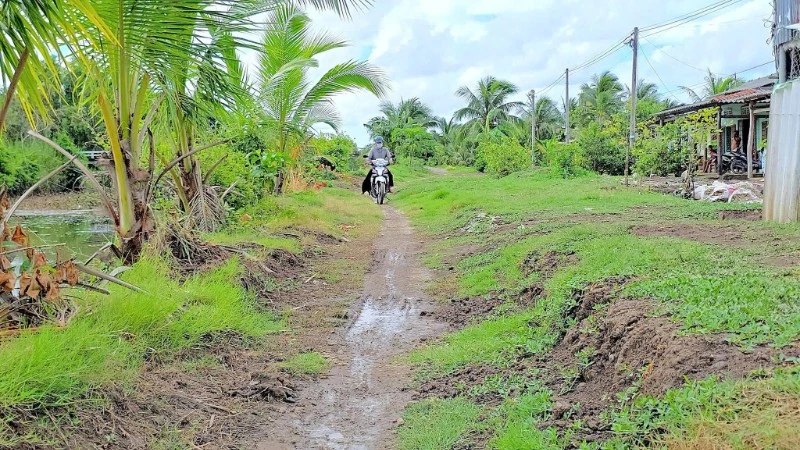
Can Mau Province: Residents Yearn for Paved Roads After 40 Years of Mud
Residents in Khanh Hung commune, Ca Mau Province, southern Vietnam, are desperately calling for the construction of concrete roads after over 40 years of struggling with muddy paths. Local authorities acknowledge the need but face budget constraints, leaving the project's realization uncertain.
Residents in Khanh Hung commune, Ca Mau Province, in Vietnam's Mekong Delta, are struggling with muddy, impassable roads that have persisted for over 40 years. They are appealing to local authorities for the construction of paved concrete roads, a long-held aspiration. The East Canal Embankment Road, spanning 3.3 km in the Khanh Hung A hamlet of Khanh Hung commune, serves as the lifeline for over 80 households. These residents, who settled in the area in the 1980s with dreams of pioneering and establishing their livelihoods, have seen three generations navigate these muddy paths. During the rainy season, the road turns into a quagmire, making even walking difficult. Tran Thi Dinh, a resident, lamented, "I've worked diligently in this land for over half my life, but the path to my home is still a muddy dirt road. It becomes slippery when it rains." The poor road conditions severely impact residents' lives. Medical transport for the elderly and sick is extremely challenging. Children must trek one to two kilometers through mud to reach school. This limited access to higher education locally has led many young people to leave their hometowns after graduation. Tran Trung Hieu, who works far from his village after completing university, shared his sorrow: "I've been away from home for over a decade, but the village road remains the same. When I visit during the rainy season and see people wading through mud, I feel immense sadness. Everyone wishes for a clean, easy-to-traverse road, but why is it so difficult?" Farmers also face significant hurdles in transporting their produce. Large trucks cannot access the hamlet due to the poor road conditions, and the canals are too shallow for boat transport. Consequently, agricultural products are sold at prices 10% lower than the market rate. Residents have made efforts to improve the road by contributing funds and labor to widen it with soil and mud, but these measures have not provided a fundamental solution. Nguyen Vu Bang, Vice Chairman of the Khanh Hung Commune People's Committee, acknowledges the necessity and urgency of road development and indicated its inclusion in the 2026 investment plan. However, the estimated cost for constructing the 3.3 km road and a 3.2 m wide bridge is approximately 9 billion VND (around $360,000 USD), a sum beyond the local government's limited budget. "Although it's on paper, there's a significant gap between the plan and actual construction. With limited local funds, we are unable to proceed," Bang admitted. Residents are earnestly appealing to the relevant authorities in Ca Mau Province for timely allocation of funds to invest in essential transport infrastructure, aiming to fulfill their 40-year-old dream of settling and thriving in their homeland. Source: Nhan Dan
多角的分析
ベトナムにおけるインフラ整備の遅れは、地方経済の発展を阻害する主要因の一つである。特に農業生産物の流通コスト増加や、市場へのアクセス制限は、農家の収入を圧迫し、地域経済の活性化を妨げている。カマウ省の事例は、メコンデルタ地域におけるインフラ投資の必要性を示唆している。中央政府は、地方の財政難を補うための財政支援や、PPP(官民連携)モデルの導入などを通じて、インフラ整備を加速させる必要がある。これは、国内経済の均質化と、農村部からの人材流出抑制にも繋がる。
このニュースは、ベトナムの地方におけるインフラ投資の潜在的な機会とリスクを示唆している。カマウ省のような地域では、道路、橋梁、水路などの基本的なインフラが不足しており、これらを整備することで物流効率の向上、産業誘致、観光開発などが期待できる。しかし、地方政府の財政能力の限界や、プロジェクトの実行における官僚的な手続き、土地収用などの問題は、投資家にとってリスク要因となりうる。特に、インフラプロジェクトは長期的な視点が必要であり、政治的安定性や規制環境の透明性が重要となる。日本企業は、PPPやODA(政府開発援助)を通じた参画を検討する余地がある。
カインフン xã の住民たちは、40年以上も泥濘の道路に苦しみ、日常生活、教育、医療、経済活動の全てにおいて不便を強いられている。特に、子供たちが泥道を歩いて通学する姿や、病人の搬送が困難な状況は、地域社会の発展と住民の福祉を著しく阻害している。これは、地方部におけるインフラ格差が、教育機会の不均等や医療アクセスの悪化といった社会的な不平等を拡大させている典型的な例である。住民たちが自助努力で道路の改善を試みるも、限界がある現状は、行政による継続的な支援の必要性を示している。
カインフン A 地区の住民たちは、長年にわたり泥濘の道路という厳しい現実と向き合ってきた。雨季には、子供たちは泥まみれになって学校へ向かい、病人を運ぶ際には親族や近隣住民が担架やハンモックで運ぶという、想像を絶する苦労を強いられている。農産物の運搬も困難を極め、収益性が低下するという経済的な打撃も受けている。住民たちは、舗装された道路という「当たり前のインフラ」を渇望しており、その実現を地方政府に強く訴え続けている。彼らの生活実感は、インフラ整備の遅れがもたらす具体的な困難を浮き彫りにしている。
背景・歴史的文脈
ベトナムでは、1986年のドイモイ(刷新)政策以降、経済成長が著しく進展し、インフラ整備も一部地域で急速に進められてきた。しかし、広大な国土と多様な地理的条件を持つベトナムにおいて、特にメコンデルタのような河川が多く、地盤が軟弱な地域では、インフラ整備が追いついていない。カマウ省カインフン xã のように、長年インフラ整備から取り残されてきた地域が存在し、住民の生活や経済活動に深刻な影響を与えている。地方政府の財政的制約や、中央政府からの予算配分の偏りなどが、こうした格差を生む構造的な要因となっている。近年、ベトナム政府はインフラ投資の重要性を認識し、国家目標に掲げているが、具体的な地域への支援が十分に進んでいない実態が示唆される。
原文ソース
Nhan Dan