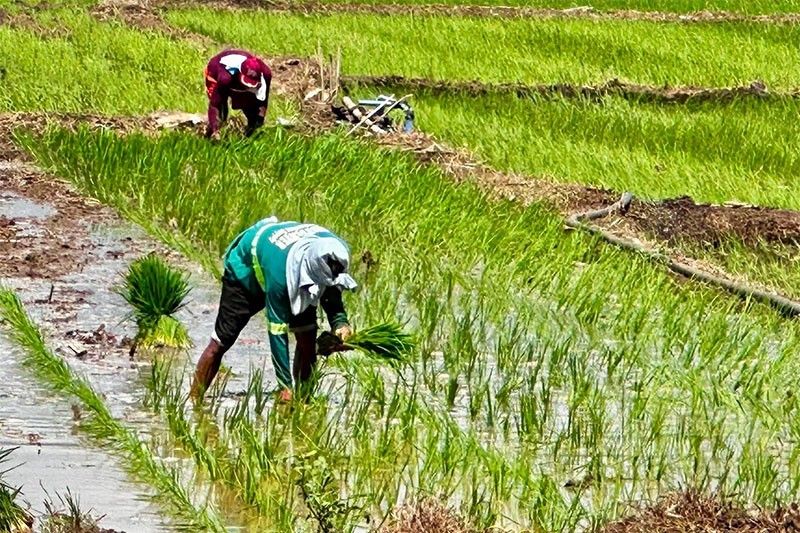
Farmer groups seek 30% safeguard duty on imported rice
Economy
2026年8月4日
6
Philstar Business

General articles are free for 24 hours after publish.

Farmer groups seek 30% safeguard duty on imported rice

Share
AI Summary

Philippine farmer groups have petitioned the government to impose a 30% safeguard duty on imported rice, citing the impact of surging imports on local producers. This would be in addition to the current 15% tariff.

MANILA, Philippines — Farmer groups yesterday asked the government to impose a 30-percent safeguard duty on imported rice, as local producers continue to be impacted by surging rice imports. The Federation of Free Farmers (FFF) and the Magsasaka party-list said a formal request has been submitted to the Tariff Commission (TC) to impose safeguard duties on rice imports. The proposed safeguard duty would be in addition to the current 15 percent rate for imported rice. In its submission to the TC, the groups also recommended imposing a revised minimum access volume (MAV) system that would enable the government to more proactively regulate the entry of imports while remaining aligned with the rules of the World Trade Organization. FFF national manager Raul Montemayor said the country still needs to import rice as local production is not enough to meet demand. “The problem is that we are importing much more than we need. This results in oversupply, which in turn brings down palay prices for farmers,” he added. The groups argued that import surges, particularly in the harvest season, has resulted in about P50 billion in annual losses to domestic rice farmers. Under Republic Act 8800 or the Safeguard Measures Act, a safeguard is imposed to protect the country’s producers by raising tariffs or limiting import arrivals after a formal investigation determined that the entry of imported commodities has caused substantial harm to local sectors. The FFF said rice imports had increased to an average of 3.45 million metric tons (MT) per year since the Rice Tariffication Law was enacted in 2019, noting that shipments tripled from the annual average before the passage of the RTL. It also cited data from the Bureau of Plant Industry, which showed that rice imports surged to a record-high of 2.75 million MT in the first half of 2026, nearly 83 percent of the average annual arrivals in the previous seven years. The FFF added that the excess volume being brought in by rice importers has been growing over the years, with a peak of almost two million MT in 2024. “Even in 2025 when an import ban was imposed in the last quarter, total arrivals still exceeded the supply gap, inclusive of a two-month buffer stock allowance, by almost one million MT,” it said. The TC has been conducting an investigation into the imposition of safeguard measures against rice imports, following the petition from the FFF and Magsasaka Partylist. Likewise, the Department of Agriculture issued Department Order 18, requesting the TC to launch an investigation into surging rice imports. An initial probe by the agency found the existence of a causal link between increased imports and serious injury to the domestic rice industry. The commission is expected to issue its findings and recommendations by September. The Philippines remains the world’s top rice importer, with an estimated 5.7 million MT in rice imports this year amid lower production forecasts due to El Niño, the US Department of Agriculture said.

0

Original source

Philstar Business

原文を読む