General articles are free for 24 hours after publish.
Takaichi's Pre-emptive Diplomacy: Japan's Taiwan Concerns Ahead of Trump-Xi Summit
Japanese Prime Minister Takaichi conveyed Japan's security concerns, particularly regarding Taiwan, to U.S. President Trump prior to the US-China summit. Tokyo fears economic deals could alter Washington's stance on Taiwan, highlighting Japan's delicate diplomatic balancing act between strengthening its alliance with the U.S. and avoiding further deterioration of ties with China.
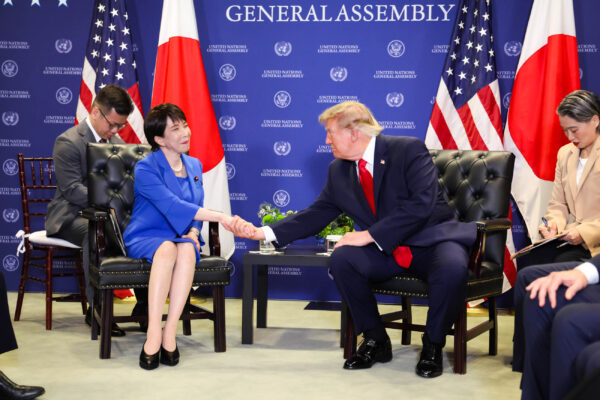
Japanese Prime Minister Takaichi Sanae met with U.S. President Donald Trump in New York on September 22, 2026, conveying Japan's concerns ahead of the summit with Chinese President Xi Jinping scheduled for the following day in Washington. This meeting, while demonstrating the strength of the Japan-U.S. alliance, also appeared aimed at ensuring President Trump understood Japan's position. Tokyo's primary concern is the situation surrounding Taiwan. China strongly opposes U.S. arms sales to Taiwan, and there is apprehension in Tokyo that President Trump might leverage this as a bargaining chip in economic negotiations. Any perceived weakening of U.S. support for Taiwan could have direct implications for Japan's security and deterrence across the Western Pacific, making Taiwan a critical security issue for Japan. Discussions during the meeting also covered economic issues, China-related matters including economic security, AI, semiconductors, and critical minerals, as well as North Korea. Prime Minister Takaichi expressed hope that stable U.S.-China relations would contribute to international stability. Separately, in her UN General Assembly address on the same day, Prime Minister Takaichi warned that the international order based on the rule of law faces serious challenges. While she explicitly named Russia for its invasion of Ukraine and North Korea for its nuclear and missile programs, she did not name China directly, stating instead that "unilateral attempts to change the status quo by force or coercion must not be tolerated anywhere in the world." This suggests Japan's complex diplomatic strategy: seeking firm action from the U.S. against Chinese pressure while simultaneously aiming to avoid further deterioration of its own ties with Beijing. Despite fierce competition over trade, technology, and AI, both Washington and Beijing appear interested in managing their rivalry rather than allowing it to escalate into confrontation. President Xi's message that the two countries should be "partners, not rivals," and the extension of the trade truce, both point in this direction. For Japan, stable U.S.-China relations are desirable. However, if that stability is achieved through a bargain that alters Washington's approach to Taiwan, Tokyo would face an entirely different strategic calculation. Prime Minister Takaichi's clear communication of Japan's concerns before the summit will reveal how those concerns factor into President Trump's calculations and how his pursuit of deals with Beijing reshapes the strategic environment Japan must navigate. Source: The Diplomat Indonesia
Original source
The Diplomat Indonesia