International Law Backs PH Claim to West Philippine Sea: Fact-Checking Disinformation
A former Philippine congressman's claim that the Philippines has no legal basis for its West Philippine Sea claims has been rated FALSE by Rappler. The report highlights the UN Convention on the Law of the Sea and the 2016 Arbitral Tribunal ruling as strong legal backing for Manila's position.
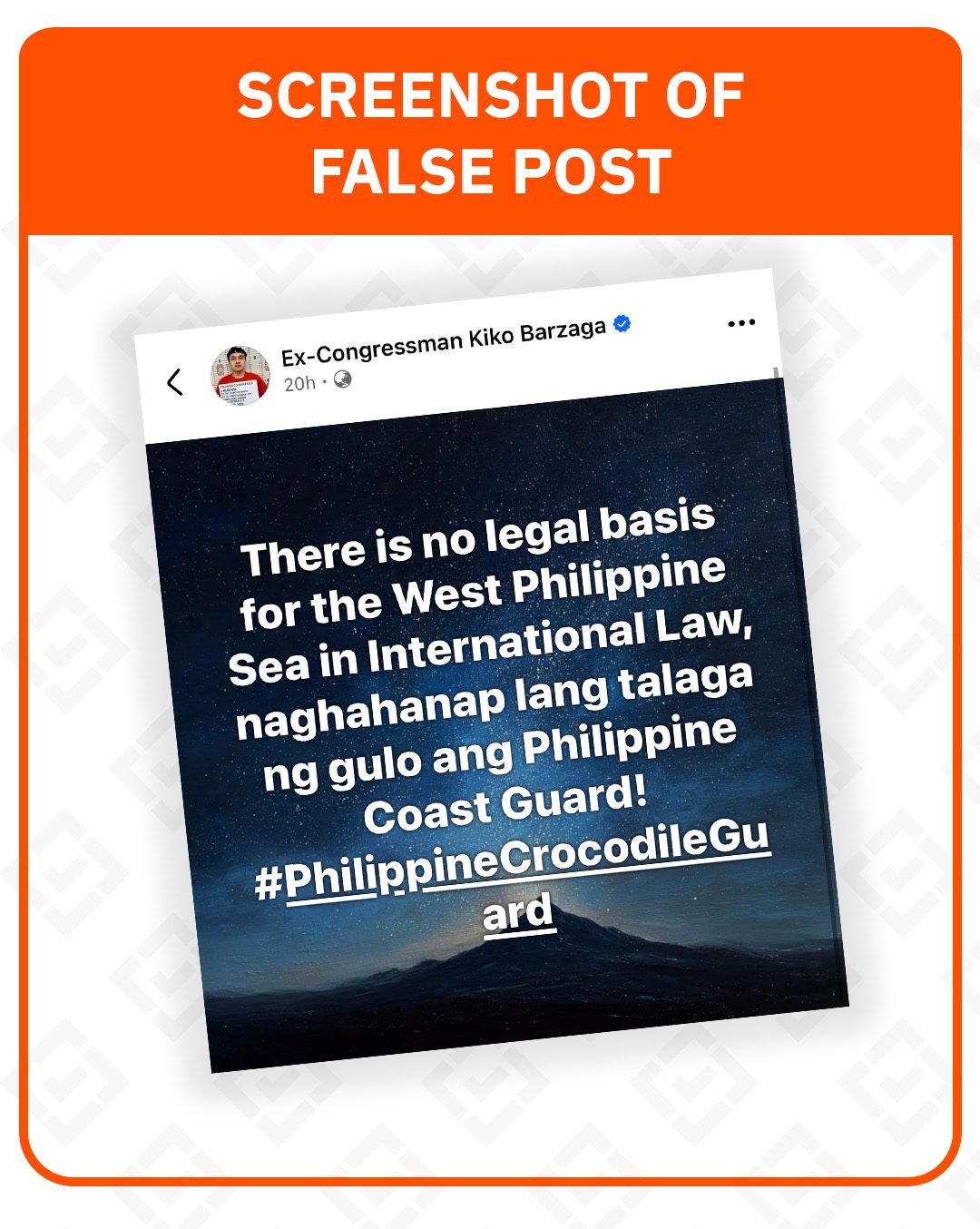
A former Philippine congressman's claim that the Philippines has no legal basis for its territorial claims in the West Philippine Sea (WPS) has been rated FALSE by Rappler. The assertion, made on social media, is contradicted by international law and a landmark arbitral ruling. Former Cavite 4th District Representative Kiko Barzaga posted on Facebook on June 22, stating: “There is no legal basis for the West Philippine Sea in International Law, naghahanap lang talaga ng gulo ang Philippine Coast Guard!” (The Philippine Coast Guard is really just looking for trouble!). Barzaga’s post has garnered over 3,200 reactions, 6 comments, and 69 shares. The former lawmaker’s Facebook page, which has over 1.9 million followers, consistently posts pro-Duterte and anti-Marcos content. However, Rappler's fact-check confirmed that the Philippines’ claim over the WPS is firmly anchored in the 1982 United Nations Convention on the Law of the Sea (UNCLOS). Under this international treaty, the Philippines, like other coastal states, is entitled to sovereign rights within its 200-nautical-mile exclusive economic zone (EEZ). The area was given the formal name West Philippine Sea in 2012 through Administrative Order 29. This legal framework also served as the foundation for the Permanent Court of Arbitration’s (PCA) July 2016 ruling in favor of the Philippines in its maritime dispute with China over the WPS. The ruling stated that China had “violated the Philippines’ sovereign rights in its exclusive economic zone, by interfering with Philippine fishing and petroleum exploration, constructing artificial islands and failing to prevent Chinese fishermen from fishing in the zone.” The landmark ruling also declared China’s sweeping “nine-dash line” claim over the South China Sea invalid. The United Nations-backed tribunal concluded that there was “no legal basis for China to claim historic rights to resources within the sea areas falling within the ‘nine-dash line.’”. Philippine Coast Guard spokesperson Rear Admiral Jay Tarriela reiterated this international law basis in a February 2026 interview with DYSS Super Radyo Cebu, stating, “We have been standing up for our rights in the WPS. We’re exposing the Chinese aggression, and the international community has been very supportive of our side.” The Department of Foreign Affairs (DFA) has also criticized Beijing’s posts rejecting the 2016 arbitral award, emphasizing that the award is “final and binding and has become an unassailable part of the corpus of international law, providing legal clarity regarding maritime rights and entitlements in the South China Sea.” Previous Rappler investigations have revealed how various pro-China communities on Facebook have been spreading propaganda and disinformation since the administration of former president Rodrigo Duterte to support China’s claims and narratives. These narratives are rooted in the arguments that downplayed the Philippines’ victory at The Hague, where the former Aquino administration brought the country’s case to the arbitral tribunal against China over the West Philippine Sea in 2016. Retired Supreme Court Senior Associate Justice Antonio Carpio has reminded Filipinos to vigorously fight China’s disinformation about the West Philippine Sea amid some content creators echoing China’s narratives. In a previous statement, Carpio said, “We are in a battle with China for the hearts and minds of the people of the world. Not only our people, but the people of the world. So we have to be on our toes. We have to do our own research and rebut them. That’s the only way. We have to present the facts and the law. That is where we are strong.” Some local content creators continue to echo claims from Media Unlocked, a program run by the Chinese government, which paints the Philippines as the aggressor in the West Philippine Sea. – Reinnard Balonzo/Rappler.com Keep us aware of suspicious Facebook pages, groups, accounts, websites, articles, or photos in your network by contacting us at [email protected]. Let us battle disinformation one Fact Check at a time.
多角的分析
南シナ海におけるフィリピンの主張の正当性は、同国の経済的利益、特に漁業および石油・ガス探査における権利を保護する上で極めて重要である。国際法に基づいた主張が揺るがされると、これらの資源へのアクセスが制限され、フィリピン経済、特に沿岸コミュニティに深刻な影響を与える可能性がある。中国の主張が国際法を無視して拡大すれば、フィリピンのEEZ内での経済活動は一層困難になる。
南シナ海情勢の不確実性は、フィリピンへの投資、特にエネルギー開発や漁業関連分野への投資リスクを高める。国際法に則ったフィリピンの権利が確立され、その遵守が保証されることは、海外からの直接投資(FDI)を誘致し、経済成長を促進する上で不可欠である。偽情報による主張の矮小化は、投資家のリスク評価を悪化させる要因となり得る。
西フィリピン海を巡る領有権問題は、フィリピン国民のナショナリズムと主権意識に深く関わる。元国会議員による国際法上の根拠否定は、国民の間に混乱と不信感を生じさせる可能性がある。特に、沿岸部の漁業コミュニティは、生活の糧を直接この海域に依存しており、主張の弱体化は彼らの生活基盤を脅かす。偽情報に対抗し、正確な情報を広めることは、社会的な結束と国家主権の維持に不可欠である。
元国会議員の発言は、南シナ海におけるフィリピンの権利について、一般市民の間に誤解や混乱を生じさせる可能性がある。特に、沿岸部に住む漁師たちは、その生活がこの海域の資源に依存しているため、主張の根拠が揺らぐことは直接的な生活への不安につながる。SNSで拡散される偽情報に対抗するため、正確な国際法上の根拠と、常設仲裁裁判所の判決の重要性を市民に周知することが求められる。
背景・歴史的文脈
フィリピンと中国の間で南シナ海(フィリピンでは西フィリピン海)の領有権を巡る対立は長年続いている。2012年、フィリピン政府は行政命令29号により、自国の排他的経済水域(EEZ)内の西側海域を「西フィリピン海」と正式に命名した。2013年、フィリピンは中国の広範な領有権主張に対し、常設仲裁裁判所(PCA)に提訴。2016年7月、PCAはフィリピンの主張を全面的に支持し、中国の「九段線」の法的根拠を否定する歴史的な判決を下した。この判決は国際法上の拘束力を持つが、中国はこれを認めず、現在も同海域での活動を続けている。近年のフィリピン国内では、SNSを中心に中国寄りの言説や偽情報が拡散される傾向があり、特に西フィリピン海におけるフィリピンの権利を否定する主張も見られる。
原文ソース
Rappler Philippines