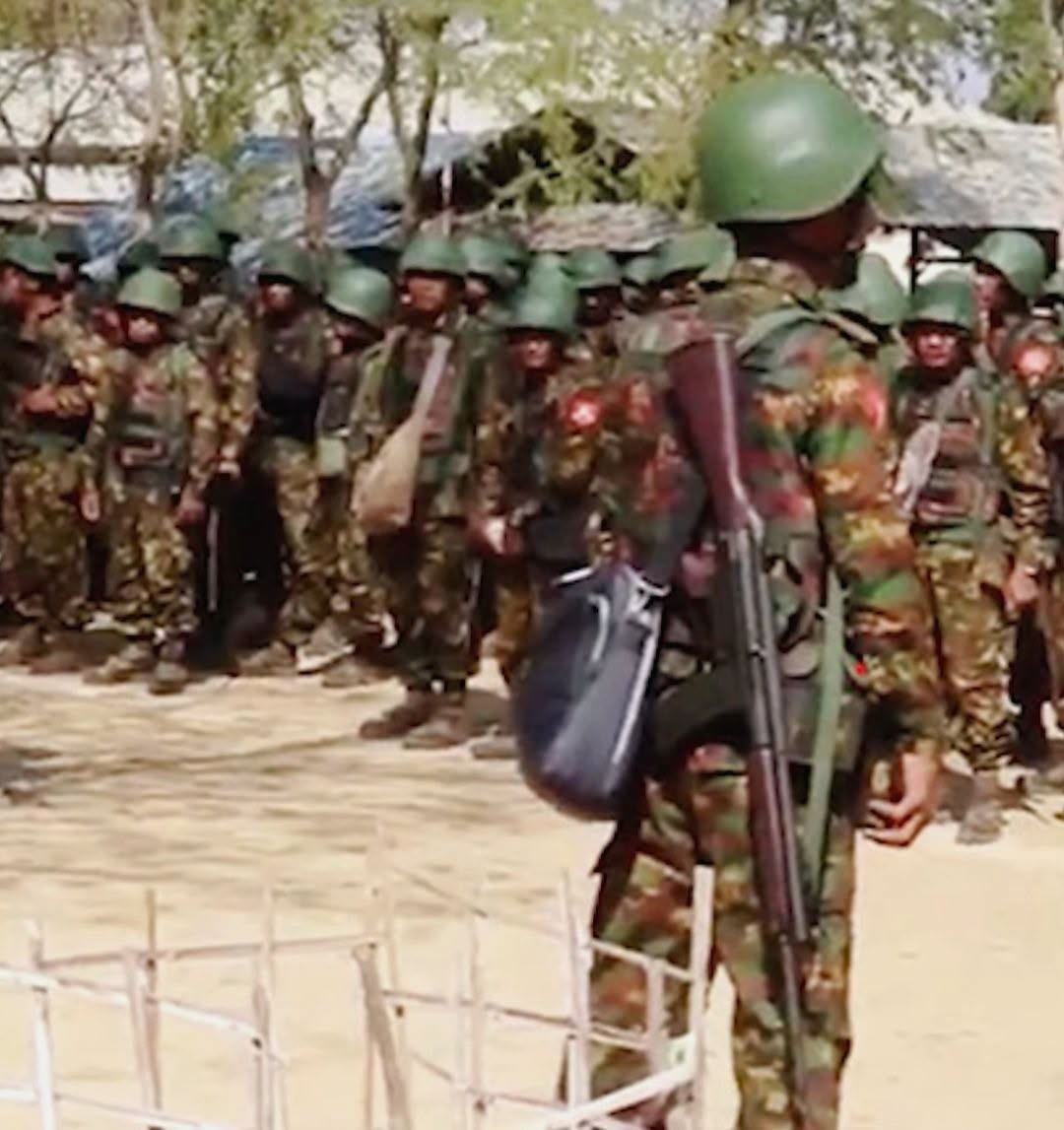
Revolutionary forces warn against using Katha-Tee Chaung road, urging caution
Ayeyarwaddy Times October 11 In Katha Township, Sagaing Region, revolutionary forces in the area have issued separate warnings on October 10 and 11 to ensure the safety of the public from the dangers of war. The Katha-Te
Read up to 3 eligible full articles per Japan day (JST) for free
Create a free account to open up to 3 eligible full articles per Japan calendar day (JST). Headlines and summaries remain available across ASEAN 7.
Related articles
- Counterfeit cosmetic products popular in Myanmar seized by Thai police in a warehouse in Thailand
Counterfeit cosmetic products, which are widely used in Myanmar, were seized by the Thai police in a warehouse in Thailand, according to reports from the Thai side. The counterfeit cosmetic products included Vaseline bra
- Illegal buildings used for online fraud and gambling activities in Phase II of Shwe Kokko area under systematic demolition
THE Government has prioritized efforts to combat online fraud and online gambling as a national duty, working not only with domestic forces but also with the governments of neighbouring countries to conduct effective ins
- How the military sold the world a democracy it never intended to build
Guest contributor Linn Thant In 2013, Myanmar was being presented to the world as one of Asia’s most promising political success stories. The generals were no longer speaking primarily the language of dictatorship. They were speaking the language of reform, democracy, economic liberalisation and peace. Political prisoners had been released. Aung San Suu Kyi and members of the National League for Democracy (NLD) had entered Parliament. Western governments were easing sanctions. Foreign investors were arriving. International leaders were visiting Naypyidaw. At the World Economic Forum on East Asia, the BBC hosted a debate entitled “Myanmar: What Future? ” More than thirteen years later, that debate is worth watching again. Not because anyone in 2013 could have predicted every tragedy that would follow, but because the language used by the military-backed government reveals something fundamental about Myanmar’s failed transition. The military did not deceive the world by pretending that Myanmar was already a perfect democracy. It did something more sophisticated. It made controlled political liberalisation look like an irreversible transition to democracy. And the international community wanted to believe it. The promise of an “irreversible” transition. One of the most striking ideas presented by the government in the 2013 debate was that Myanmar’s reform process was becoming irreversible. Today, that word is almost painfully ironic. The reforms were reversible. The political opening was reversible. The elected government was overthrown. Political leaders were imprisoned. Parliament was dismantled. The democratic process was suspended. And the military returned to the centre of political power through force. But the deeper problem is not simply that the military broke its promises. The deeper problem is that the international community misunderstood what the military’s “reform” actually represented. The transition was never designed to remove the military from political power. It was designed to repackage military power in a more acceptable political form. The military did not sell dictatorship. It sold transitions. This distinction matters. The generals did not tell the world: We intend to rule Myanmar forever. They said, in effect: We are changing. Give us time. That was a much more effective strategy. Myanmar’s military-backed political system permitted a degree of political opening while preserving the institutional foundations of military supremacy. The 2008 Constitution should have been the warning. Twenty-five per cent of seats in Parliament were constitutionally reserved for serving military personnel. The military retained control over key security ministries and extraordinary constitutional powers. The armed forces remained structurally protected from full civilian democratic control. The contradiction was therefore visible from the beginning. Myanmar could have elections without having civilian supremacy. It could have opposition politicians without having democratic control over the military. It could have a civilian government without having a civilian state. And it could have political reform without transferring ultimate political power. Yet the international community increasingly treated the visible symbols of change as evidence that the underlying system had fundamentally changed. That was the mistake. Looking democratic is not the same as transferring power Aung San Suu Kyi was in Parliament. Foreign journalists were entering the country. Western diplomats were visiting Naypyidaw. Sanctions were being lifted. International investment was returning. Myanmar looked different. But the essential questions remained unanswered: Who controls the armed forces?
- Military airstrikes on historic Mahasi monastery where Mahasi Sayadaw resided, 2 devotees and 2 displaced persons killed, more than 8 injured
Ayeyarwaddy Times October 11 On October 11, the interim government's military forces launched airstrikes on the historic Mahasi monastery in Shikkone village, Shwebo Township, Sagaing Region, resulting in the deaths of t